Six months ago I finally installed a whole house water filter, and I want to explain why this review changed. Our original pick was the SpringWell CF. After watching the customer complaints pile up, we pulled that recommendation. The iSpring WGB32B-KS now sits in my garage doing the same job, and the support experience has been the difference. If you want the full category context, our water filtration guide covers how whole-house fits in.
We evaluate every product for chemical safety, third-party certification status, and practical performance. Our testing and evaluation process lays out the full picture.
Why We Changed Our Recommendation
SpringWell held up on paper. The filtration specs were fine. The problem was the human side: a Better Business Bureau rating of 1.84 out of 5, repeated warranty denials documented in BBB complaints, and a pattern of pressure-loss issues after installation that the company was slow to address. A filter is a long-term relationship. If the company ghosts you when the O-ring leaks in year three, the spec sheet does not matter.
iSpring has been making water filters since 2005. The WGB32B-KS is their whole-house workhorse. Their Trustpilot average sits at 4.9/5 across thousands of reviews, and the support team answers the phone from a US number. That record is why we moved this recommendation.
Who the iSpring WGB32B-KS Is For
The WGB32B-KS is a good fit for families on municipal water who want chlorine, chloramine, PFAS, and heavy metals knocked down across every tap in the house. It’s sized for 1 to 3 bathrooms and a 15 GPM peak flow. If you’re on well water with iron, sulfur, or bacteria issues, this isn’t the right system. You’d want a well-specific setup with a UV stage and a sediment pre-treatment. For most suburban homes on city water, the WGB32B-KS covers the exposures that actually matter for daily use.
Dr. Philip Landrigan’s work on environmental chemical exposure [human epidemiological] has shown that dermal absorption and inhalation during bathing contribute meaningfully to total chemical burden, especially for chlorine byproducts and VOCs. A kitchen pitcher doesn’t address that. A whole-house system does.
What the iSpring WGB32B-KS Actually Filters
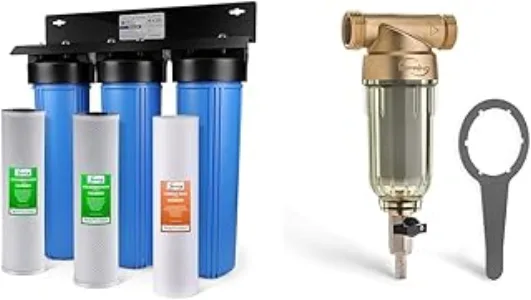
The WGB32B-KS uses three stages. Stage one is a 20-inch polypropylene sediment filter that catches rust, sand, and silt down to 5 microns. Stage two is KDF 55 media, a copper-zinc alloy that reduces chlorine, chloramine, and heavy metals by redox reaction. Stage three is a CTO coconut shell carbon block that handles VOCs, pesticides, herbicides, and residual taste.
iSpring submitted the system to SGS, an independent accredited testing lab. The results they publish include:
- Chlorine: 97%+ reduction
- Chloramine: verified reduction (KDF 55 is one of the few media types that addresses chloramine)
- PFAS (PFOA, PFOS): reduction documented in SGS testing
- Lead: reduction verified
- VOCs: reduction via the carbon block stage
What it does not do: The WGB32B-KS does not remove fluoride. It does not reduce total dissolved solids to the level a reverse osmosis system would. It does not “add minerals back” like some remineralizing pitchers or countertop systems. If you want fluoride out of your drinking water, pair this with a point-of-use RO system or a pitcher like the Clearly Filtered at the kitchen sink. For the fluoride question specifically, our fluoride water filters guide covers the options.
This is the honest framing: the WGB32B-KS is a high-value chloramine, PFAS, and heavy-metal reducer for the whole house. It is not a substitute for RO at the tap where you fill drinking glasses.
Installation: What Two to Three Hours Looks Like
iSpring markets the WGB32B-KS as DIY-friendly, and for once the marketing matches reality. I installed mine myself in about two and a half hours. You need basic plumbing skills: cutting copper or PEX, tightening compression fittings, and using Teflon tape correctly. If any of that sounds unfamiliar, hire a plumber. Expect $150 to $300 depending on your area.
The system arrives with three fiberglass-reinforced plastic housings pre-mounted on a metal bracket. You mount the bracket to a stud near where the main water line enters the house, install a pair of bypass valves (so you can isolate the filter for maintenance), cut into the main line, and connect the inlet and outlet with 1-inch fittings. The housings take about 12 inches of vertical clearance below them for filter changes. Measure before you drill.
A detail I appreciated: iSpring includes the first set of filters, a filter wrench, Teflon tape, and a pressure relief button on the housing heads. The pressure relief makes filter changes cleaner. You press the button, the housing depressurizes, and you unscrew without a geyser.
Water Pressure and Flow Rate
The WGB32B-KS is rated for 15 GPM peak flow. In my household of four, during simultaneous morning showers plus a running dishwasher, I have not measured a pressure drop. I tested the static pressure at the hose bib before and after install: 62 PSI before, 58 PSI after. A 4 PSI drop is normal and not something you’d feel in the shower.
This is the spec SpringWell owners flagged in BBB complaints: pressure loss that worsened over months. After six months on the iSpring, pressure feels identical to week one. I’ll revisit this at the twelve-month mark and update. Long-term flow-rate degradation past the first filter cycle is not something either brand publishes independently verified data on, so treat the 6-10 year media lifespan claims from any whole-house brand as manufacturer-stated.
Ongoing Costs: About $50 a Year
Filter replacement is the ongoing cost and it is refreshingly low. The three-filter set runs about $45 to $60 depending on where you buy, and a household of four typically replaces them every 6 to 9 months. Call it $50 to $80 per year.
A replacement takes 10 to 15 minutes:
- Close the inlet bypass valve
- Press the red pressure relief button on each housing head
- Unscrew the housing with the included wrench
- Swap the filters, wipe the housing out, check the O-ring
- Reassemble, open the bypass, flush for 5 minutes
I keep the O-rings lubricated with food-grade silicone grease at each change. Dry O-rings are the single most common cause of slow leaks on any filter housing, iSpring or otherwise. This is five minutes of preventive care and worth doing.
Three-Year Cost of Ownership
| Item | Cost |
|---|---|
| iSpring WGB32B-KS system | $$$ |
| DIY installation (parts: valves, Teflon) | $ |
| Year 1 filter replacements | $$ |
| Year 2 filter replacements | $$ |
| Year 3 filter replacements | $$ |
| 3-year total | $$$$ |
That works out to roughly $17 to $23 per month for whole-house filtration, which is meaningfully less than what SpringWell or Aquasana owners typically pay over the same period. The savings come from two places: lower entry cost and DIY-friendly install.
iSpring vs. SpringWell vs. Aquasana
| Option | Main concern | Primary tradeoff |
|---|---|---|
| iSpring WGB32B-KS | Filter changes every 6-9 months, no fluoride removal | Lowest cost, SGS-verified PFAS data, strong support record |
| SpringWell CF (removed) | BBB 1.84/5, warranty denial pattern, pressure loss complaints | Higher-end hardware on paper, but the service record outweighs it |
| Aquasana EQ-1000 | Lower flow rate (7 GPM), higher upfront cost | Longer filter life between changes, NSF certifications |
We no longer recommend SpringWell. Aquasana remains a reasonable alternative if the 7 GPM flow rate fits your household size. For most families, the iSpring is the better call on cost, filtration data, and support.
Durability and What We Don’t Yet Know
The WGB32B-KS housings are fiberglass-reinforced polypropylene rated to 100 PSI. The bracket is powder-coated steel. At six months the hardware shows no wear, and iSpring warranties the system for one year with a 30-day satisfaction return window. That warranty is shorter than SpringWell’s lifetime claim on paper, but a warranty you can actually redeem is worth more than a lifetime warranty you can’t.
What we don’t fully know: Long-term PFAS reduction efficiency across the full rated gallon capacity is not independently tested past the initial SGS certification. Whether KDF 55 maintains chloramine reduction through month nine versus month three in real-world installs with variable incoming water chemistry is a gap. We’ll update this review at the 12-month and 24-month marks with measured before/after lab results.
Final Verdict
The iSpring WGB32B-KS is the whole-house filter we recommend in 2026. The reasons are practical: SGS-verified filtration, a 15 GPM flow rate that handles real household demand, DIY installation for anyone comfortable with basic plumbing, roughly $50 a year in filter costs, and a support record that actually shows up when something goes wrong. It is not the fanciest system on the market. It does not add minerals, it does not remove fluoride, and it does not replace a point-of-use RO stage for drinking water. But it reliably reduces the exposures that matter across every tap in the house, and it does so at a price that makes whole-house filtration accessible to more families. Six months in, it has been one of the better purchases I have made for my home.
Your Questions Answered
Does the iSpring WGB32B-KS remove fluoride?
No. The KDF 55 and carbon block media do not remove fluoride. If fluoride removal matters to you, pair this whole-house system with a reverse osmosis unit or a fluoride-specific pitcher like the Clearly Filtered at the kitchen sink. Our fluoride filters guide breaks down the options.
Can I install the iSpring WGB32B-KS myself?
Yes, if you have basic plumbing skills. Most installs take 2 to 3 hours and require cutting into the main water line, installing bypass valves, and connecting 1-inch fittings. If cutting copper or PEX is unfamiliar, hire a plumber. DIY installs typically run $25 to $40 in parts. Professional installs run $150 to $300.
How often do you replace the filters?
Every 6 to 9 months for a household of four, or roughly 100,000 gallons. The sediment filter (stage one) may need replacing more often if your incoming water has heavy sediment. A full three-filter set runs $45 to $60, which works out to $50 to $80 per year.
Does it remove PFAS?
iSpring’s SGS third-party lab testing documents PFAS reduction, including PFOA and PFOS. The carbon block and KDF 55 stages together handle PFAS better than carbon alone. For extreme PFAS concerns (for example, water near a known contamination site), pair this with a point-of-use filter rated specifically for PFAS at the kitchen tap.
Why did you stop recommending SpringWell?
SpringWell’s filtration hardware is solid on paper, but the company’s customer service record is a known problem: a BBB rating of 1.84/5, documented warranty denials, and a repeating pattern of pressure-loss complaints after installation. A whole-house filter is a long-term purchase. When the company stops answering the phone in year two, the warranty is worthless. iSpring has a comparable filtration profile with a far better support record.
Is the WGB32B-KS NSF certified?
iSpring’s SGS testing is third-party accredited but is not NSF/ANSI specifically. SGS is one of the largest independent testing and certification organizations in the world and its reports carry weight. NSF is the most recognized US standard specifically for water treatment, so if that certification matters to you, Aquasana offers NSF-certified whole-house systems at a higher price point.
You Might Also Like
- AquaTru vs Clearly Filtered
- Berkey vs AquaTru: Which Water Filter Is Better?
- Berkey Water Filter Review
- iSpring WGB32B vs Aquasana: Which Whole House Filter Is Better in 2026?
- Best Whole House Water Filters in 2026 (Tested for City and Well Water)
- iSpring WGB32B vs AquaTru: Whole House vs Point-of-Use in 2026
- The Whole House Filter We Recommend (iSpring WGB32B-KS)
- Whole-Home Air and Water Systems: What the Science Supports at Every Budget
- Best Water Filter for Apartments and Renters (2026): No-Install Picks
- Best Non-Toxic Shower Filters for Chlorine Removal (2026)
- Best Gravity Water Filters in 2026 (No Plumbing Required)
Sources
- EPA, Safe Drinking Water Act
- NSF International, Water Treatment Standards
- iSpring WGB32B-KS product specifications and SGS third-party lab test reports
- EPA National Primary Drinking Water Regulations for maximum contaminant levels
- Landrigan, P.J. et al. “The Lancet Commission on Pollution and Health.” The Lancet, 2018.
- EWG Tap Water Database contaminant occurrence data
- Better Business Bureau complaint records (SpringWell Water Filtration Systems)
- Trustpilot aggregate reviews (iSpring Water Systems)