Most of what gets cited on this site started as an audiobook on a long walk
or a commute. These are the seven we have actually used as the source layer
for reporting on sleep, longevity, endocrine disruption, PFAS, breath, the
cellular biology of aging, and the public-health economics of hormone
disruptors. Each one rates 4.5 or higher on Audible. Each one is here
because the research desk has cited or paraphrased it across multiple
articles.
Sleep / bedroom environment
What's the best audiobook on sleep and the bedroom environment?
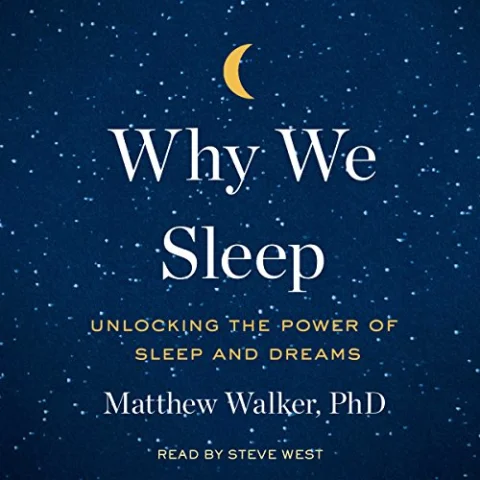
Why We Sleep by Matthew Walker is the audiobook the NonToxicLab bedroom-cluster articles draw from. It reframes sleep as the lever with the largest measurable effect on cardiovascular, metabolic, and cognitive outcomes.
Author: Matthew Walker, PhD Narrator: Steve West Runtime: 13h 52m Published: 2017 Audible: 4.80 ★ (17,444)
Professor of Neuroscience and Psychology, UC Berkeley; Director, Center for Human Sleep Science.
Walker walks through what happens during each sleep stage and what gets disrupted when you cut the night short, drink alcohol close to bedtime, or sleep warm. The book shaped how we frame our bedroom recommendations: room temperature, blackout, and bedding materials are not preferences, they are inputs that change how the brain consolidates memory and clears metabolic waste. Some academics have pushed back on specific claims (the 8-hour minimum, the cancer risk numbers), and we treat those caveats as part of the record. The core thesis, that sleep is the most under-prescribed health intervention in adult medicine, has held up.
If you only listen to one audiobook on this list, this is it. The bedroom-cluster guides on this site assume you have heard the case Walker makes.
Listen to Why We Sleep on Audible →
Longevity medicine
What's the most rigorous audiobook on longevity?
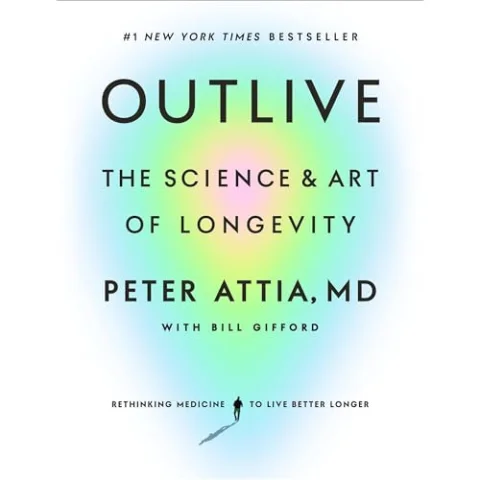
Outlive by Peter Attia is the longevity audiobook with the deepest clinical detail. Attia narrates it himself, which matters because the book is built around his actual patient framework rather than headline-friendly hacks.
Author: Peter Attia, MD Narrator: Peter Attia, MD Runtime: 17h 7m Published: 2023 Audible: 4.68 ★ (8,526)
Founder of Early Medical; longevity-medicine practitioner; one of the seven canonical experts cited across this site.
Attia builds the case that the four chronic diseases of aging (cardiovascular, cancer, neurodegenerative, metabolic) require different prevention windows than mainstream medicine acknowledges. He walks through ApoB and Lp(a), VO2 max as the single best mortality predictor, zone-2 training, and emotional health as a longevity input. The book lands at a useful tension for our reporting: most lifespan extension is downstream of decisions about exercise, sleep, and chronic exposure, not supplements or experimental drugs. That framing is why we structured the longevity-home-protocol cluster around the home environment rather than around what to take.
Attia is one of the seven experts named in our editorial methodology. Hearing him narrate his own framework is the closest most readers will get to a consult.
Listen to Outlive on Audible →
Endocrine disruption
What audiobook explains how everyday plastics affect hormones?
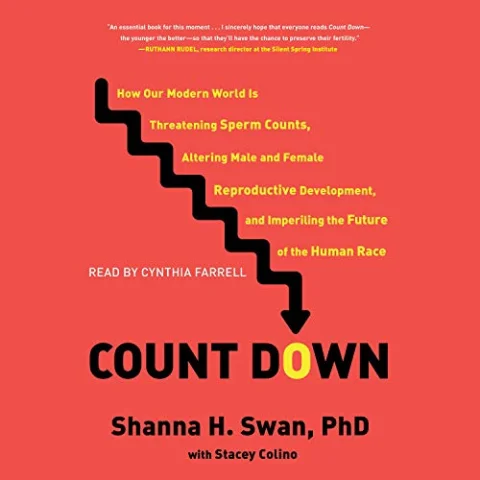
Count Down by Dr. Shanna Swan is the audiobook that translates 30 years of endocrine-disruption research into the story of declining sperm counts, falling testosterone, and reproductive health changes that show up in human biomonitoring data.
Author: Dr. Shanna H. Swan Narrator: Cynthia Farrell Runtime: 7h 32m Published: 2021 Audible: 4.68 ★ (425)
Professor of Environmental Medicine, Mount Sinai; one of the seven canonical experts cited across this site.
Swan explains why animal models matter, what dose-response curves for endocrine disruptors look like (non-monotonic, often most active at low doses), and how phthalates from soft plastics make their way into prenatal exposure data. Our articles on phthalates, vinyl shower curtains, plastic food storage, and personal-care fragrance compounds all draw on the framework Swan builds here. The book is calibrated about uncertainty, which is one reason we cite it heavily: she names what is established (urinary phthalate metabolites correlate with anogenital distance in male infants) and what is still emerging (the long-term cognitive effects).
If a single audiobook explains why our cookware, food-storage, and personal-care articles read the way they do, this is it.
Listen to Count Down on Audible →
PFAS / forever chemicals
What's the best audiobook on PFAS contamination?
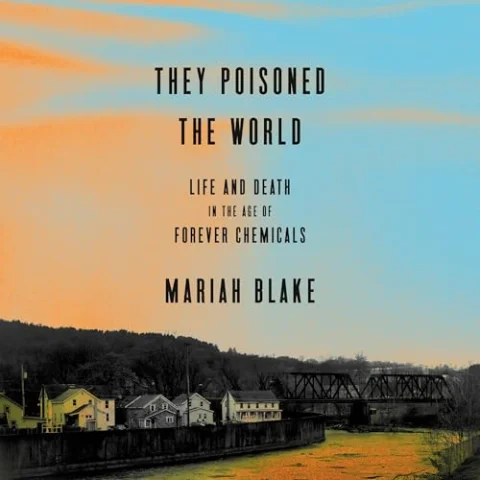
They Poisoned the World by Mariah Blake is the most thorough recent account of how PFAS got into 99% of American blood serum, why the chemistry was protected for decades, and how a small upstate New York town forced the regulatory turn that is now reshaping water-filter standards.
Author: Mariah Blake Narrator: Beth Hicks, Mariah Blake Runtime: 6h 49m Published: 2025 Audible: 4.86 ★ (36)
Investigative journalist; previously at Mother Jones, the New Republic, and the Washington Monthly.
Blake traces the science back to the Manhattan Project and forward through the 3M and DuPont internal documents that surfaced in litigation. Our PFAS coverage (the Maine ban explainer, the water-filter roundups, the Lululemon investigation, the cookware deep dives) is informed by the timeline and the regulatory mechanics Blake reconstructs. The book has been shortlisted for the J. Anthony Lukas Prize and is a finalist for the PEN/E.O. Wilson Award. It carries a smaller rating count than the older books on this list because it released in May 2025, but the rating itself (4.86 on Audible) is the highest of the seven.
If you read our PFAS articles and want the long version of how the chemistry was hidden, this is the book that documents it.
Listen to They Poisoned the World on Audible →
Breathing / indoor air
What's the best audiobook on breathing and indoor air?
Breath by James Nestor explains why how you breathe matters as much as what you breathe. Our air-purifier and mold articles cover the input side; Breath covers what happens once that air reaches your nose and lungs.
Author: James Nestor Narrator: James Nestor Runtime: 7h 55m Published: 2020 Audible: 4.72 ★ (9,839)
Science journalist; ASJA Best General Nonfiction Book of 2020.
Nestor reports on chronic mouth-breathing, nasal-airway evolution, and the breathing patterns that show up in elite endurance athletes versus the general population. He spends a chapter inside a Stanford lab on what mouth-taping does to sleep apnea markers. The book ties cleanly into our reporting: a HEPA filter and a dehumidifier set the conditions, and what Nestor describes determines how the body uses those conditions. The book has its critics (some claims about ancient skull morphology are contested), but the practical breathing protocols are well-sourced and the audiobook is short enough to listen to on a commute.
If you have already filtered your home's air, this is the audiobook that tells you what to do with the breath that follows.
Listen to Breath on Audible →
Longevity / aging biology
What audiobook explains the biology of aging at the cellular level?
Lifespan by Dr. David Sinclair is the audiobook that makes the case that aging itself is a treatable disease, with sirtuins, NAD, and the information-theory model of cellular aging as the underlying mechanisms.
Author: David Sinclair, PhD Narrator: David Sinclair Runtime: 11h 55m Published: 2019 Audible: 4.71 ★ (7,549)
Professor of Genetics, Harvard Medical School; co-director, Paul F. Glenn Center for Biology of Aging Research.
Sinclair walks through the lab evidence on caloric restriction, intermittent fasting, NAD precursors, rapamycin, and metformin, and lays out his information-theory hypothesis: that aging is a loss of epigenetic information, not a one-way decay. The book pairs cleanly with Outlive: where Attia covers the clinical patient framework, Sinclair covers the underlying cellular biology. We treat both as inputs to our longevity-cluster reporting, and we hold the more speculative claims (longevity-escape-velocity, the resveratrol arc) at appropriate distance. The audiobook is narrated by Sinclair himself, which makes the more controversial sections (his own views on biotech regulation) clearly his and not the field's consensus.
If Outlive is the prescription, Lifespan is the textbook. Listen in that order if you can.
Listen to Lifespan on Audible →
Endocrine disruption / public-health economics
What audiobook explains the economic cost of hormone-disrupting chemicals?
Sicker, Fatter, Poorer by Dr. Leonardo Trasande is the audiobook that prices endocrine-disruption exposures into a national health and productivity bill. Trasande puts the US figure at roughly $340 billion per year and walks through the obesity, diabetes, and developmental cost lines.
Author: Dr. Leonardo Trasande Narrator: Dr. Leonardo Trasande Runtime: 6h 44m Published: 2018 Audible: 4.55 ★ (47)
Professor of Pediatrics, Environmental Medicine, and Population Health, NYU; one of the seven canonical experts cited across this site.
Where Count Down tells the biology story, Sicker, Fatter, Poorer tells the economic one. Trasande is a NYU pediatrician and one of the most-published researchers on the regulatory side of EDCs. The book covers BPA in food packaging, phthalates in personal-care, flame retardants in furniture, and the cost-of-inaction case the EU has used to drive its REACH program faster than the US has driven TSCA. Our articles on furniture flame retardants, BPA-free packaging, and the chemicals-banned-in-EU-legal-in-US explainer all draw on Trasande's framework. The audiobook is the shortest on this list (under 7 hours) and the best summary of the policy case for caring about EDCs at all.
If a single number from this list lands with policymakers and CFOs, it is Trasande's $340 billion.
Listen to Sicker, Fatter, Poorer on Audible →
Last reviewed: April 26, 2026. Ratings verified at Audible at time of publication.