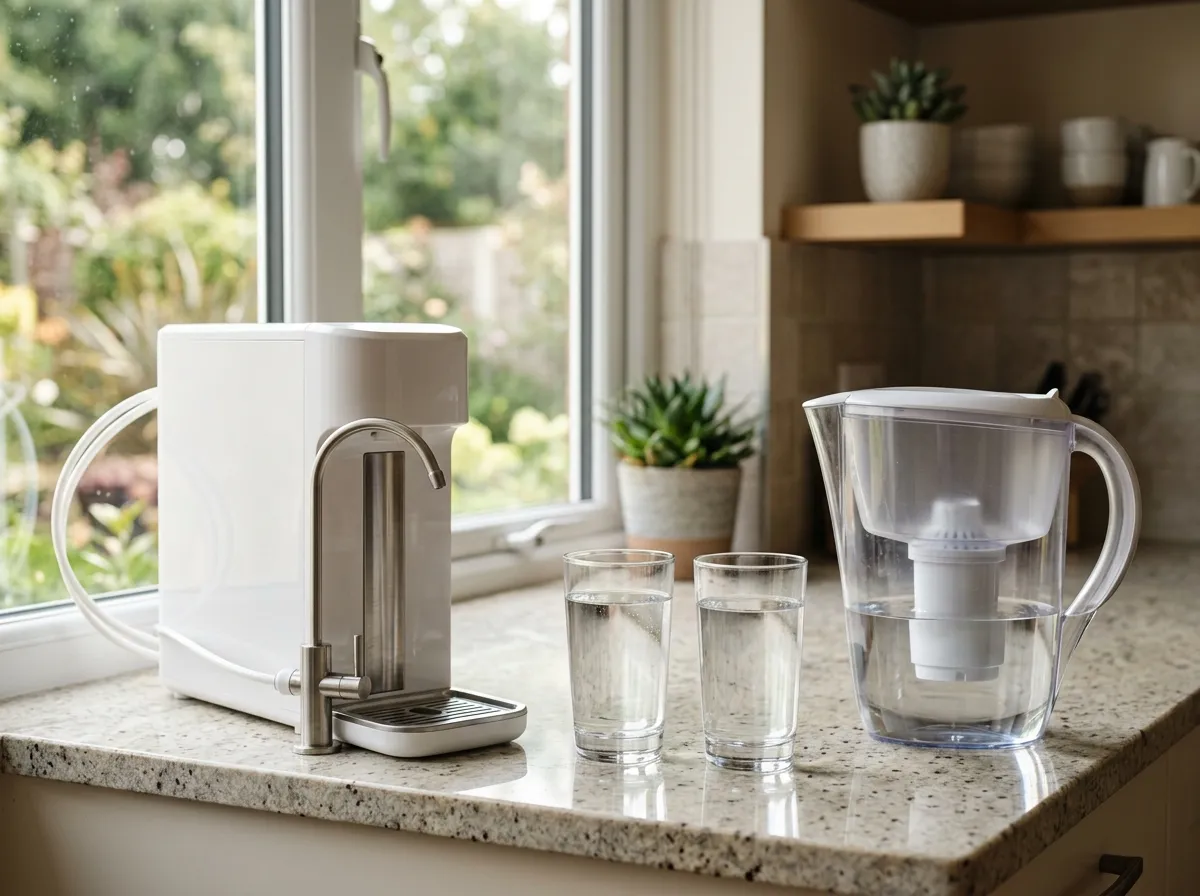
NonToxicLab’s pick for most apartment renters is the AquaTru Classic countertop RO. It removes 83+ contaminants including PFAS, lead, and microplastics, needs zero plumbing, and packs into a box when your lease ends. If your landlord permits a tool-free push-fit install, a tankless under-sink system like the Waterdrop G3P800 is the upgrade. If the budget is tight, the Clearly Filtered No. 1 pitcher is the most contaminant-aware pitcher in the category.
That covers what you drink. For what you bathe in, add a shower filter. Apartment water is the same water your neighbor-who-owns-the-house drinks, and PFAS, chlorine, and disinfection byproducts absorb through skin and lungs during hot showers. Our water filtration guide covers the full picture, and renting doesn’t have to keep you out of the bigger longevity home protocol that maps these choices room by room.
Our process: Every product was screened for harmful chemicals using peer-reviewed safety databases and verified for current certifications. How we test
Why Apartment Renters Need a Different Approach
If you own your home, you’ve got options. Under-sink systems, whole-house filters, plumbed-in RO with a dedicated faucet. Most of those require drilling, modifying plumbing, or at minimum getting your landlord’s written approval. Renters don’t have that luxury.
And here’s the frustrating part. Apartment water often needs more filtration, not less. Older buildings frequently have aging pipes that leach lead and copper [human epidemiological]. Many cities still use chloramine disinfection that tastes awful and is harder to filter than regular chlorine. And PFAS contamination doesn’t care whether you rent or own. A 2023 USGS study found PFAS in tap water samples from 45% of sites across the country (USGS, 2023).
The good news is that most of the best water filtration available today needs zero installation. You can set it up in five minutes, take it with you when the lease ends, and never ask for permission.
What to look for in an apartment water filter:
- No permanent install. Nothing drilled, bolted, or plumbed in.
- Portable. Fits in a box when your lease ends.
- Real certification. Taste-and-odor removal is the floor. You want something that handles PFAS, lead, microplastics, and other contaminants with third-party verification.
- Reasonable footprint. Apartment kitchens are small. A filter that eats half your counter isn’t practical.
Filter Type Tradeoffs at a Glance
| Option | Main concern | Primary tradeoff |
|---|---|---|
| Countertop RO (AquaTru) | Counter space, upfront cost | Broadest contaminant removal including PFAS, fluoride, nitrates |
| Tankless under-sink RO (Waterdrop) | Needs landlord sign-off for the push-fit install | Fastest flow, lowest cost per gallon long-term |
| Pitcher with PFAS certification (Clearly Filtered) | Slower flow, higher ongoing filter cost | Zero install, fits in the fridge, no counter space |
| Budget pitcher (ZeroWater) | Short filter life in hard water | Lowest upfront cost, includes a TDS meter |
| Shower filter (Aquasana AQ-4100) | Carbon loses some effectiveness at high water temps | Addresses skin and inhalation exposure, 5-minute install |
| Whole-house, tanked RO, or plumbed under-sink | Requires real plumbing work | Wrong category for almost every rental |
Under-Sink Filters: Best for Renters with Landlord Permission
An under-sink filter can be the right pick in a rental, but only if your landlord approves it. The tankless push-fit systems that came out over the last five years are the reason. The CDC reports that aging lead service lines are still present in millions of US homes, and point-of-use filtration is one of the more effective household-level responses (CDC, 2024) [regulatory review].
Waterdrop G3P800: Our Tankless Under-Sink Pick
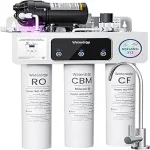
The Waterdrop G3P800 is a tankless reverse osmosis system that connects with push-fit fittings. No glue, no solder, no permanent changes. It uses a 3:1 pure-to-drain ratio (better than most tank-based RO), fills a glass in about six seconds, and carries NSF/ANSI 58 certification for PFAS-relevant contaminant reduction.
Why it works for renters: the install reverses. You can disconnect it in 15 minutes and leave the sink exactly as you found it. Filter life is 12 to 24 months depending on the stage. Lab tests showed 100% removal of tested PFAS including PFOA and PFOS.
The catches: it’s $599 to $849 up front. It needs a dedicated drinking-water faucet if you want one (the basic setup can T-off the cold line), and your landlord has to be okay with the drilled hole in the countertop for that faucet (or you can skip the faucet and just use a dispenser). And if your lease explicitly prohibits any attachment to plumbing, this is off the table. For a full comparison to tank-based options, see our best under-sink water filters guide.
What to Ask Your Landlord First
Get approval in writing. Most reasonable landlords will say yes to a push-fit system if you frame it correctly: no glue, no solder, reverses in 15 minutes, no hole in the counter if you skip the dedicated faucet. Show them the install video. Explicitly offer to reverse it at move-out.
If they say no, your fallback is a countertop system, which plugs into a wall outlet and needs zero approval.
Countertop Reverse Osmosis: Best No-Install Path
Best for: maximum contaminant removal without asking anyone for permission
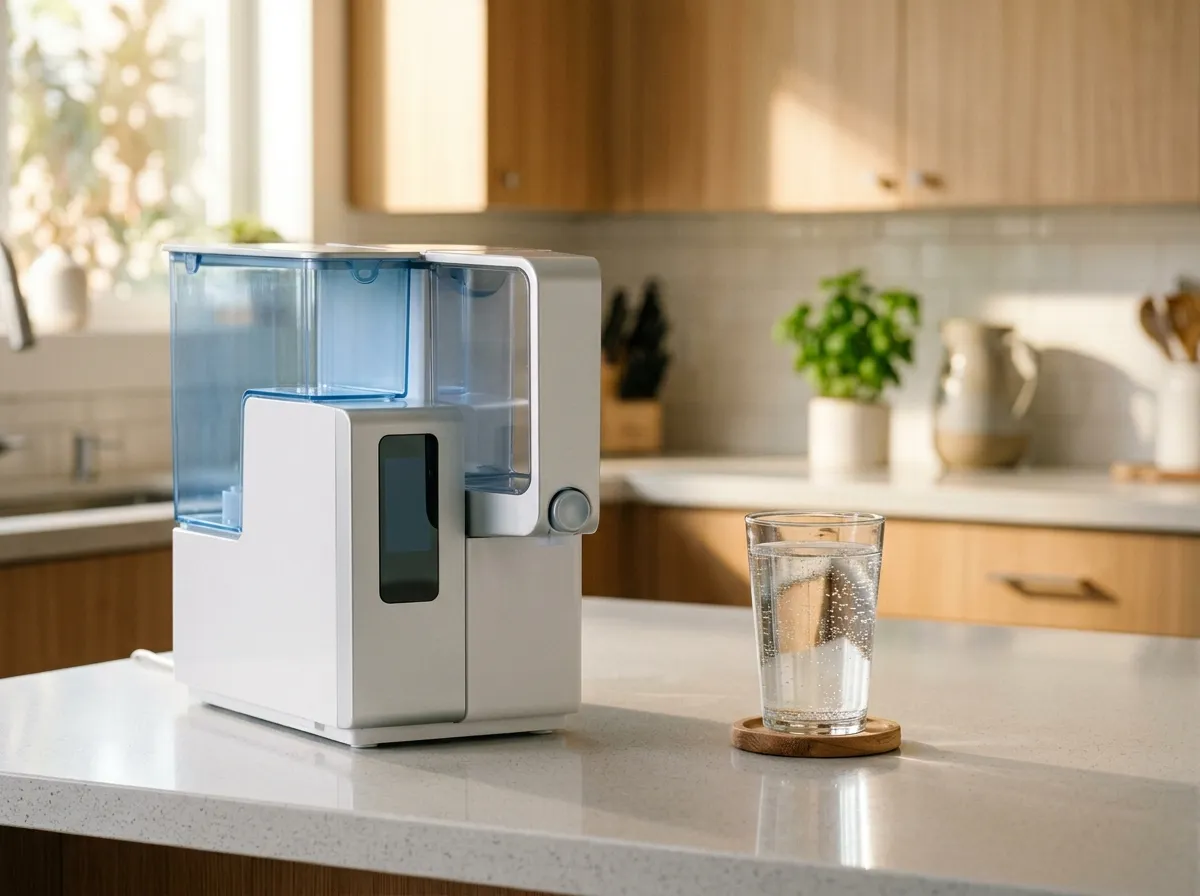
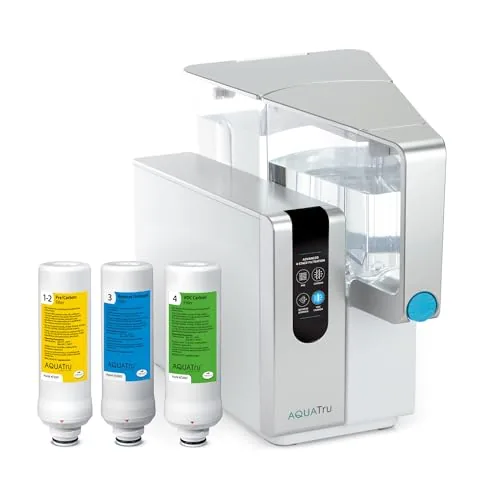
The AquaTru Classic is the gold standard for apartment renters who can’t or don’t want to touch the plumbing. It’s a countertop reverse osmosis system, which means you’re getting the same four-stage filtration technology built into expensive under-sink RO rigs, but in a unit you plug in and use.
It removes 83+ contaminants and is certified to NSF/ANSI 42, 53, 58, 401, and P473. That covers chlorine, lead, PFAS including PFOA and PFOS, arsenic, fluoride, nitrates, microplastics, and pharmaceuticals. Dr. Peter Attia has talked about filtering drinking water as one of the higher-impact steps you can take for your own health. RO is the specific technology he references for removing the widest spectrum of contaminants.
How it works: fill the top tank with tap water, press a button, and the unit pushes it through sediment pre-filter, carbon pre-filter, RO membrane, carbon post-filter. Clean water collects in the bottom tank. About 12 to 15 minutes to fill the clean-water tank (roughly 3/4 of a gallon).
Filter costs: RO membrane lasts about 2 years. Pre-filters and post-filter need replacing every 6 to 12 months. Annual filter costs run roughly $80 to $100, which is cheaper per year than most pitchers.
Tradeoffs: it produces wastewater, about a 4:1 ratio (AquaTru recirculates some). It’s roughly the size of a large coffee maker. It needs electricity. And RO strips dissolved minerals from the water, which some people prefer to add back via a pinch of salt or a mineral drop.
For the full single-product review, see our AquaTru review. For a direct comparison to the pitcher we recommend as an alternative, see AquaTru vs Clearly Filtered.
Pitcher Filters: Cheapest Path With Real Certification
Best for: renters who want the least possible commitment
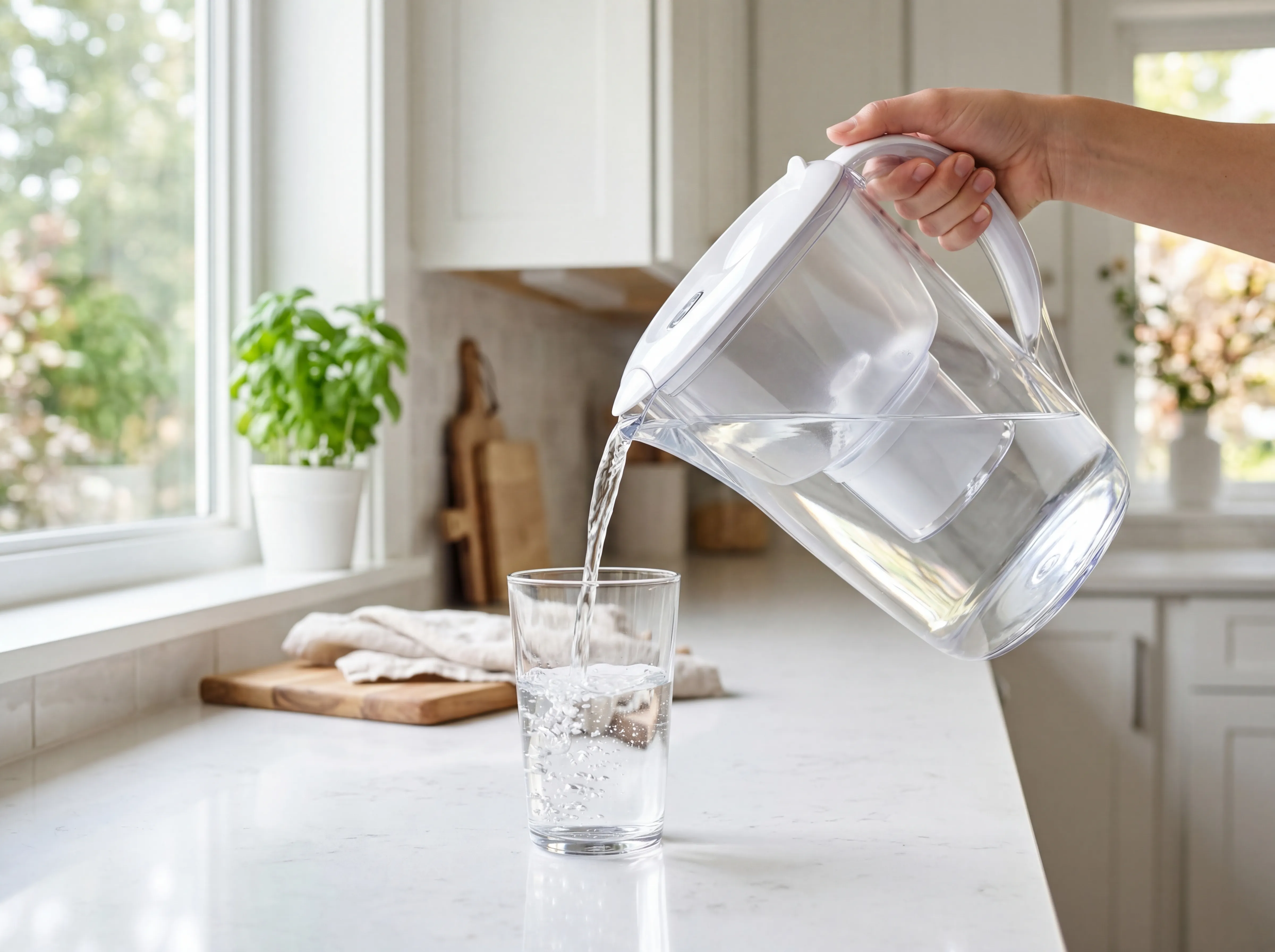
A water filter pitcher is the most practical apartment filter for anyone without the counter space or budget for RO. But pitcher quality varies wildly. Most of them, including Brita, remove chlorine taste and not much else.
Clearly Filtered No. 1: Best Pitcher
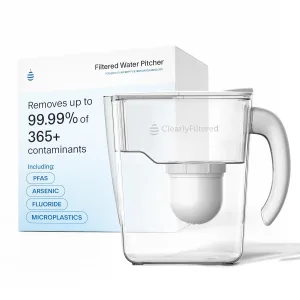
The Clearly Filtered pitcher removes 365+ contaminants including PFAS (PFOA and PFOS are the two most-studied), lead, microplastics, pharmaceuticals, and pesticides. It’s certified to NSF/ANSI 42, 53, 401, and P473. That last one is the PFAS-specific standard, and most pitchers don’t have it.
A standard Brita removes about 5 contaminants. The Brita Elite handles about 30. Clearly Filtered removes 365+, which is why it’s the only pitcher we recommend when PFAS removal is a real goal. EWG’s independent testing found the Clearly Filtered pitcher blocked 100% of the PFAS compounds tested (EWG, 2024).
Filter life: about 100 gallons, which works out to roughly 4 months for a small household. Cost per gallon: around $0.50. More than Brita. Worth it for the P473 certification. Tradeoffs: slower flow rate than Brita. Filters cost about $50 each, so annual costs are roughly $150. Fits in the fridge, so no counter space needed.
ZeroWater: Best Budget
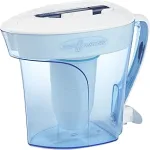
ZeroWater ships with a TDS meter in the box. You can measure total dissolved solids before and after filtration and watch the number drop to zero. It does remove lead, chromium, and a meaningful share of PFAS, but its filter life is short if your source water has high dissolved solids.
Filter life: wildly variable. Soft-water users get 2 to 3 months. Hard-water users get 3 to 4 weeks. The TDS meter takes the guesswork out. Cost per gallon: $0.30 to $1.00+ depending on your water. Tradeoffs: the water tastes flat because all minerals are removed, not just the harmful ones. If your water is hard, filter costs can add up fast.
What About Basic Brita?
Skip it if you care about PFAS or lead. The standard Brita filter handles chlorine taste and odor. The Elite filter handles some lead and a limited subset of contaminants. Neither has PFAS-specific certification. If you’ve been running a basic Brita and expecting it to handle apartment water contamination, the honest answer is it isn’t doing much beyond taste.
Shower Filters: PFAS and Chlorine Absorb Through Skin
Best for: every apartment, on top of whatever you pick for drinking
Dr. Shanna Swan has noted that dermal absorption from shower water is an underappreciated exposure route, particularly for chlorine disinfection byproducts. Hot shower steam increases absorption of water-borne chemicals through both skin and lungs [human epidemiological]. In a typical 10-minute hot shower, you can absorb as much chlorinated byproduct exposure as from drinking the same water.
PFAS specifically can pass through skin, though at lower rates than drinking exposure, and inhalation of fine water mist contributes additional exposure that drinking-water filters don’t address.
Aquasana AQ-4100: Best Shower Filter
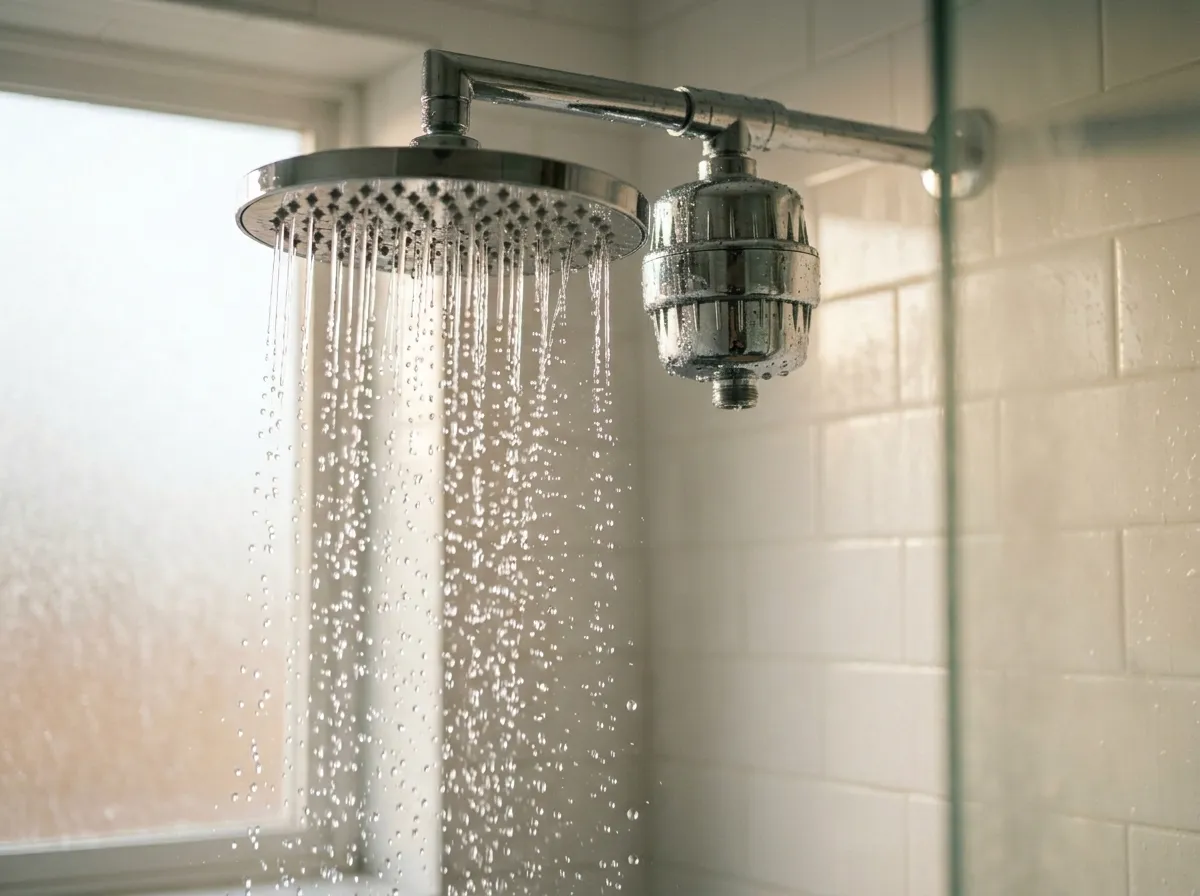
The Aquasana AQ-4100 combines coconut shell activated carbon with copper-zinc oxidation media (KDF). It’s NSF certified, which is rare in the shower filter category. Most aren’t.
What it removes: chlorine, chloramine (to a lesser extent), some VOCs, hydrogen sulfide. Filter life: about 6 months or 10,000 gallons. Install: unscrews your existing showerhead, threads on by hand, reattaches the showerhead. Five minutes. No tools. 100% reversible at move-out.
Tradeoffs: activated carbon is less effective at high water temperatures, so expect 40 to 60% chlorine reduction rather than 90%+. Chloramine is harder to filter at shower flow rates. Shower filters don’t meaningfully reduce PFAS, though they do reduce most disinfection byproducts.
Our best non-toxic shower filter guide covers more options including KDF-only and vitamin C designs.
When a Shower Filter Is Probably Not Worth It
If you take short, cool showers (under 5 minutes, under 95°F), total absorption is low and a filter is optional. If you have well water with no chlorine disinfection, a shower filter isn’t solving a chlorine problem. For everyone on a chlorinated municipal supply taking daily 10-minute hot showers, it’s probably worth $70 to save your skin and lungs some extra chemical load.
What to Skip (For Apartments)
Whole-House Filters
Whole-house systems install at the main water line before it branches to the rest of the house. They filter every tap, shower, and appliance. They also cost $800 to $3,000, require professional plumbing, and need landlord written approval you almost certainly won’t get. Wrong category for apartments.
Expensive RO Tank Systems
Tank-based under-sink RO systems (not the tankless Waterdrop type) store pressurized water in a large tank under the sink. They work well in owned homes. In an apartment, they’re overkill. You’re paying for capacity you don’t need, and the install is harder to reverse.
Gravity Filters (For Most Apartments)
Gravity filters like ProOne or similar stainless steel systems sit on the counter and use gravity to pull water through filter elements. They work. But they’re bulky (20 inches tall), slow (30 to 60 minutes per batch), and take up more counter space than a countertop RO without matching its PFAS removal certifications. Countertop RO is the better apartment pick.
Basic Faucet-Mount Filters
PUR and Brita faucet-mount filters screw onto your tap. They handle chlorine taste and some lead. They don’t remove PFAS, microplastics, or fluoride. They also don’t fit pull-down or commercial-style faucets, which are common in newer apartments. The AquaTru or a pitcher is a better use of money.
Durability and Filter Replacement Costs
Knowing what you’ll spend over two years matters more than the sticker price.
| Filter | Upfront | Annual filter cost | 2-year total | Notes |
|---|---|---|---|---|
| AquaTru countertop RO | $$$ | $$ | $$$$ | Pre-filters swap every 6-12 mo, RO membrane every 2 yr |
| Waterdrop G3P800 under-sink RO | $$$$ | $$ | $$$$ | Landlord approval required, most contaminant removal per dollar long-term |
| Clearly Filtered pitcher | $$ | $$ | $$$ | Filter swap every 100 gal (~4 mo) |
| ZeroWater pitcher | $ | $$ | $$$ | Wild variance based on your water |
| Aquasana AQ-4100 shower | $$ | $$ | $$$ | Add to any of the above |
| Brita Elite | $ | $$ | $$ | Included for reference. Not a PFAS filter. |
Cartridge life is the variable most renters underestimate. An expired filter isn’t neutral. A carbon filter that’s past its rated life can release concentrated adsorbed contaminants back into the water. Set a calendar reminder for every filter swap.
Pet and Child Safety Considerations
Infants, pregnant people, and pets drinking filtered water deserve some thought.
Infants: tap water used for formula is a high-priority filter target. The EPA’s action level for lead is 15 ppb, but there’s no safe level for infant exposure [regulatory review]. If you’re mixing formula, use RO or a P473-certified pitcher. Boiling does not remove PFAS or lead.
Pregnancy: Dr. Leonardo Trasande has published extensively on fetal exposure to environmental contaminants and specifically flags drinking water as a modifiable source. If you’re pregnant or trying, the AquaTru or Clearly Filtered are the two we’d prioritize.
Cats and dogs: pets drink roughly the same water you do by body-weight proportion, which means their lifetime exposure per pound can be higher than yours. The same filter that works for you works for them. You don’t need a separate pet-specific filter.
Fish tanks: RO water is actually too pure for most freshwater aquariums. If you keep fish, pull their water from the tap and use a dechlorinator, or buy a specific aquarium-grade remineralizer. Regular RO can crash a tank’s pH.
How to Choose the Right Filter for Your Apartment
Not sure which type to pick? Walk through these questions.
What’s in your water? Start by testing it. If you have PFAS or lead, you need a P473- or NSF 53-certified filter. A basic Brita won’t cut it.
How much counter space? If your kitchen counter is already full, a pitcher (stored in the fridge) takes zero counter space. Countertop RO needs about as much room as a large coffee maker.
What’s your budget? Over two years, a Clearly Filtered pitcher runs ~$385 and an AquaTru runs ~$640. The AquaTru removes more contaminants per dollar long-term, but the upfront cost is higher.
How much water do you drink? Heavy drinkers will tire of refilling a pitcher. A countertop RO or under-sink system has higher throughput.
Are you concerned about fluoride? Most pitchers and faucet-mount filters don’t remove fluoride. RO does. If fluoride matters to you, pick the AquaTru or the Waterdrop.
Did you pick something for your shower? If not, add an Aquasana AQ-4100 regardless of what you picked for drinking.
What to Do If Your Landlord Won’t Let You Install Anything
Nothing on the countertop or pitcher tier requires installation. Nothing is drilled, bolted, or plumbed. Your landlord has no say over whether you put a pitcher in your fridge or plug in an appliance on your counter.
If your lease is unusually restrictive:
- Start with a pitcher. No landlord can tell you not to use one. The Clearly Filtered pitcher sits in your fridge.
- Countertop units are appliances, not installations. An AquaTru is no different from a coffee maker from a lease standpoint.
- Shower filters reverse in five minutes. Unscrew the showerhead, thread the filter on, reattach. Reverse at move-out.
- Document your water quality. If your water tests above EPA limits for regulated contaminants, you have standing under most state tenant-habitability laws to take reasonable filtering steps.
What We Don’t Know Yet
Long-term removal rates for emerging PFAS compounds beyond PFOA and PFOS are not well-characterized for most pitchers and faucet-mount filters. The P473 standard tests a specific panel of PFAS analytes, not all 12,000+ PFAS known to exist. A filter that’s P473-certified reliably handles the most-studied PFAS. Newer compounds being flagged by EPA (including some GenX and short-chain PFAS) have less published performance data.
Independent real-world data on flow-degradation over a cartridge’s full rated lifespan is also limited, particularly for pitchers used with variable water quality. Manufacturer-rated life is based on standardized test conditions. If your tap water is high in sediment or dissolved solids, actual life may be shorter.
For most renters on municipal water with no documented lead or PFAS problem above action levels, a P473-certified pitcher is probably fine for drinking. The risk calculus changes if you’re in a known PFAS hotspot, a lead-pipe building, or have a pregnant person or infant in the household. In those cases, step up to RO.
Why We’d Start With the AquaTru
For most apartment renters, the AquaTru is the best combination of contaminant removal, zero-install, and reasonable long-term cost. It’s more expensive up front than a pitcher. It pays that back in filter cost over 18 to 24 months.
If the budget is tight, the Clearly Filtered pitcher is a close second. It removes more contaminants than the AquaTru in raw count (365+ vs 83+), but the RO membrane in the AquaTru handles dissolved solids, fluoride, and nitrates that no pitcher handles.
For the most head-to-head data, our AquaTru vs Clearly Filtered comparison goes deeper than this guide does.
Your Questions Answered
Can renters install under-sink filters?
Sometimes, with permission. Tankless push-fit systems like the Waterdrop G3P800 are the friendliest to renters because the install reverses in 15 minutes and nothing is glued or soldered. Most reasonable landlords will approve it if you ask in writing and agree to reverse the install at move-out. If your lease explicitly prohibits any attachment to plumbing, skip under-sink and use a countertop RO instead.
Are pitcher filters enough for PFAS?
Some pitchers are, most aren’t. You need one certified to NSF/ANSI P473 specifically, because that standard tests for PFAS removal. The Clearly Filtered pitcher has P473 certification. A standard Brita does not. Independent EWG testing found Clearly Filtered blocked 100% of the PFAS compounds tested, which is comparable to what RO achieves, at a lower upfront cost.
Do shower filters actually work?
Yes, for chlorine and chloramine, which are the primary absorption concerns during hot showers. Expect 40 to 60% chlorine reduction from a carbon-based shower filter in hot water. They don’t meaningfully reduce PFAS at shower flow rates. If your main concern is PFAS, filter your drinking water with RO or a P473 pitcher and add the shower filter as the second layer.
Can I install a water filter in a rental without asking?
Anything that doesn’t modify the apartment is fair game without permission. Pitchers, countertop units, and faucet-mount filters that screw on and off all qualify. Shower filters thread onto the existing showerhead arm and reverse in minutes, so most leases treat them the same as changing a light bulb. Anything that cuts into the plumbing needs landlord sign-off.
How do I know if my apartment water is safe?
You don’t until you test it. Your city publishes an annual Consumer Confidence Report, but that only covers water as it leaves the treatment plant. It doesn’t account for what happens in the pipes between the plant and your faucet. Home test kits cost $20 to $200 depending on how many contaminants you want to check for. Our guide to testing water quality covers specific kits.
Do faucet-mount filters work on all faucets?
No. Pull-down, sprayer-style, and integrated faucets are incompatible with most standard faucet-mount filters. A lot of newer apartments have pull-down faucets. Check the aerator style before buying. If your faucet isn’t compatible, a pitcher or countertop RO is the better path.
How often should I replace my filter?
Pitcher filters: every 2 to 4 months. Shower filters: every 6 months. Countertop RO pre-filters: every 6 to 12 months. Countertop RO membranes: every 2 years. Tankless under-sink RO cartridges: 12 to 24 months depending on the stage. Don’t skip replacements. An expired filter can be worse than no filter.
This article contains affiliate links. If you purchase through our links, we may earn a small commission at no extra cost to you. See our full affiliate disclosure for details.
You Might Also Like
- The Water Filters for PFAS Our Editors Trust
- AquaTru vs Clearly Filtered
- Best Non-Toxic Shower Filter
- Chlorine and Chloramine in Water
- Best Portable Water Filters for Travel
- Best Gravity Water Filters in 2026 (No Plumbing Required)
- Your Water Filter Might Be Doing Nothing Right Now (Here’s How to Know)
- Best Water Filter Pitchers in 2026 (Tested for PFAS, Lead, and Chlorine)
- Berkey vs AquaTru: Which Water Filter Is Better?
- Whole-Home Air and Water Systems: What the Science Supports at Every Budget
- Best Fluoride Water Filters in 2026 (Tested and Certified)
- Berkey vs ProOne vs Clearly Filtered: Which Removes the Most PFAS?
- The Non-Toxic Renter’s Playbook: What You Can (and Can’t) Control
- iSpring WGB32B-KS Review: The Whole House Water Filter We Recommend in 2026
- The Whole House Water Filters We’d Install (2026)
- Brita vs Clearly Filtered: Which Water Pitcher Actually Removes PFAS? (2026)
- Best Reverse Osmosis Systems in 2026 (Under-Sink, Countertop, and Tankless)
- Is Calcium Sulfite Safe in a Shower Filter? What the Chemistry Actually Says
- iSpring WGB32B vs AquaTru: Whole House vs Point-of-Use in 2026
Sources
- Peter Attia, MD. AMA #67: Filtering drinking water as a health intervention. peterattiamd.com
- [Rhonda Patrick, PhD. Microplastics in drinking water. foundmyfitness.com](https://www.foundmyfitness.com/topics/microplastics)
- NSF/ANSI Standard 53: Drinking Water Treatment Units, Health Effects
- Clearly Filtered. Third-party lab testing results and NSF certifications
- EWG. PFAS chemicals in tap water research. ewg.org
- USGS. Tap water study detects PFAS across US (2023)
- CDC. Lead in drinking water. cdc.gov
- EPA. Drinking water standards and consumer confidence reports. epa.gov