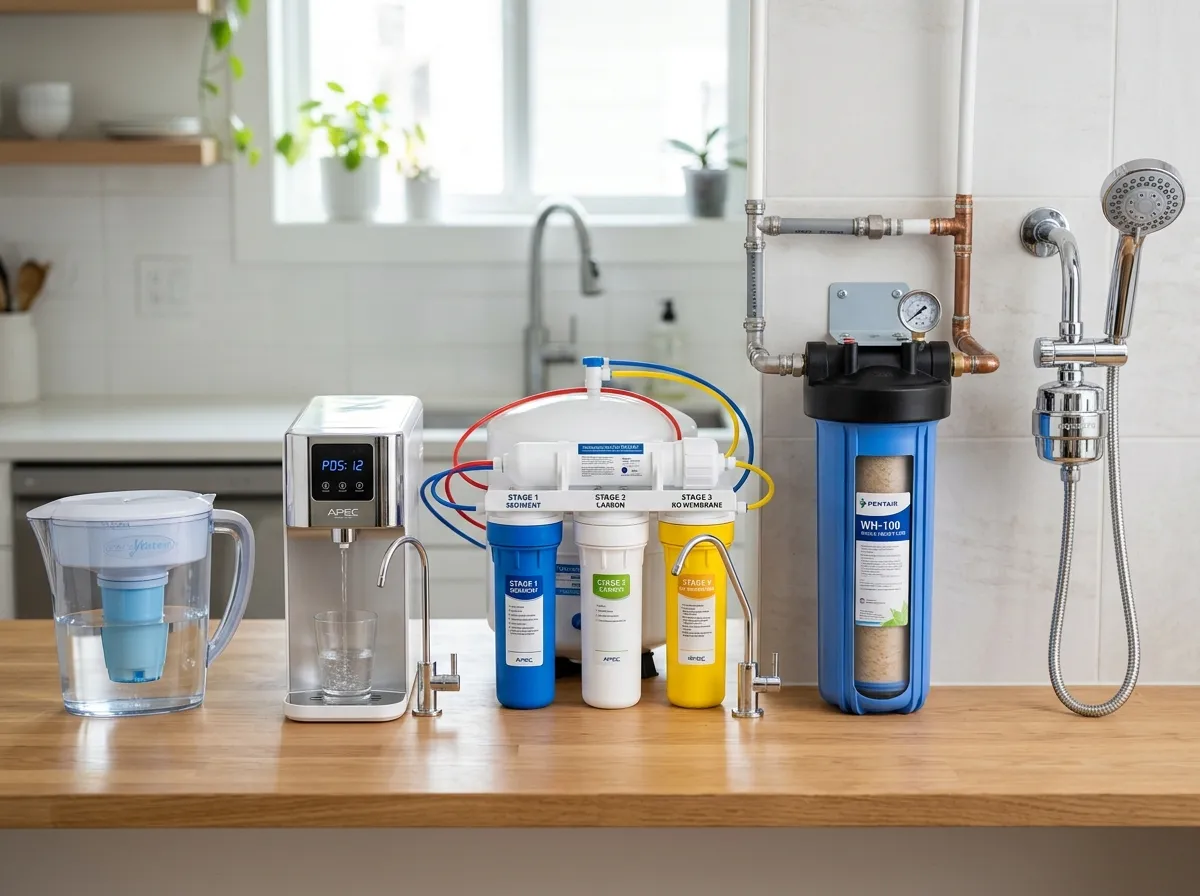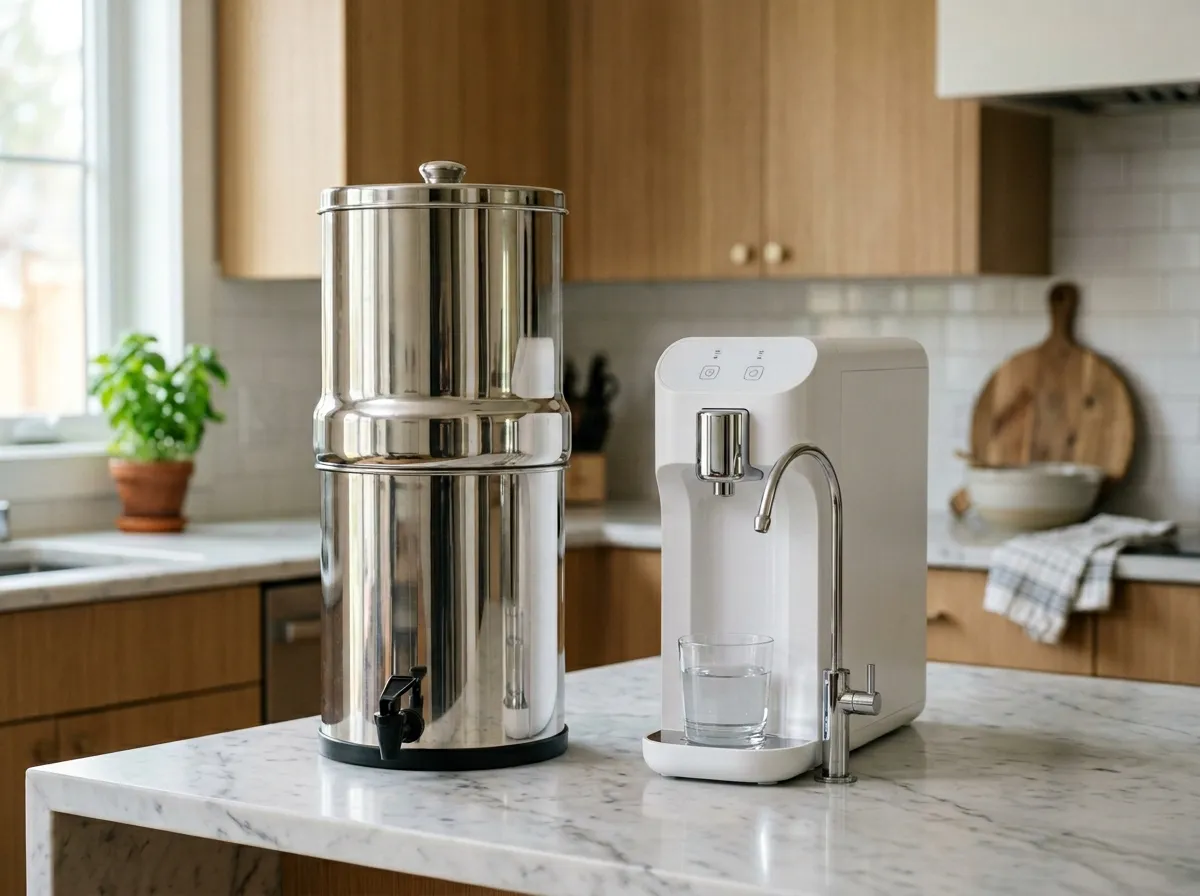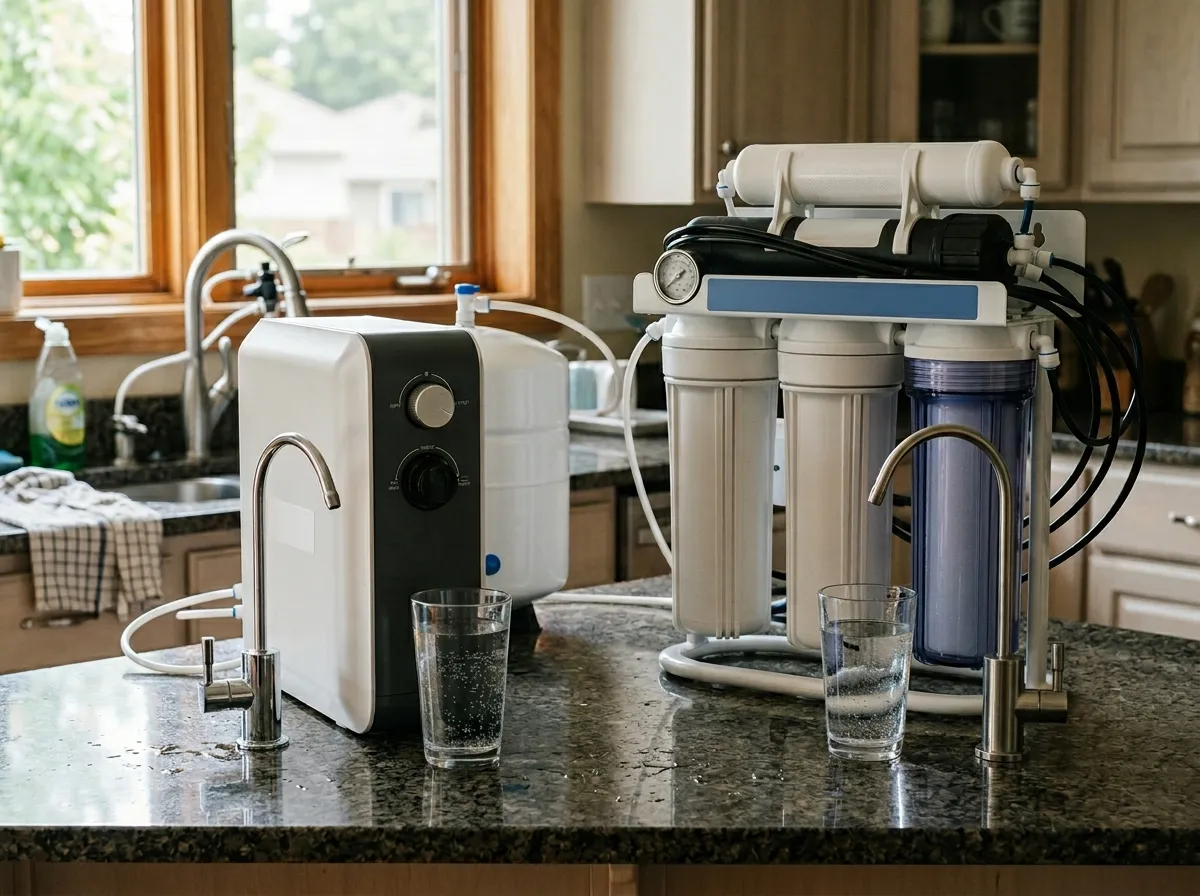
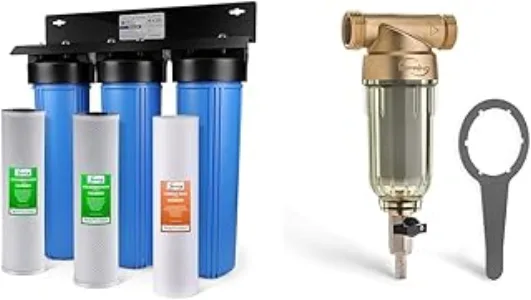
A quick note up top. We originally built this comparison around SpringWell. After looking at their BBB record (1.84 out of 5) and a string of customer service complaints, we swapped in the iSpring WGB32B-KS as our whole-house pick. The comparison itself still stands, because the underlying question is the same: whole-house carbon filtration (iSpring) versus point-of-use reverse osmosis (AquaTru).
These are not competing products. They solve different problems. But people search this comparison all the time because both show up in non-toxic living recommendations, and both promise cleaner water. The confusion makes sense, and it deserves a clear answer.
Our recommendations are based on ingredient analysis, third-party test data, and hands-on testing. See our full testing methodology for details on how we evaluate products.
Here’s the short version. iSpring filters every drop of water entering your home. AquaTru filters water at your kitchen counter, one batch at a time. Most households serious about water quality will want both eventually. If you can only start with one, this guide helps you pick.
The Short Answer
These solve different problems, so the real answer is usually both. iSpring’s WGB32B-KS sits at your main water line and treats everything, showers, dishwasher, outdoor spigot, with SGS-tested reduction of chlorine, sediment, and PFAS. AquaTru is a countertop reverse osmosis unit that pulls lead, fluoride, and dissolved solids down to non-detect for drinking water. If you have to pick one, go AquaTru for health-critical contaminants at the kitchen tap. Pick iSpring first if your priority is shower water and scale protection.
What the iSpring WGB32B-KS Actually Does
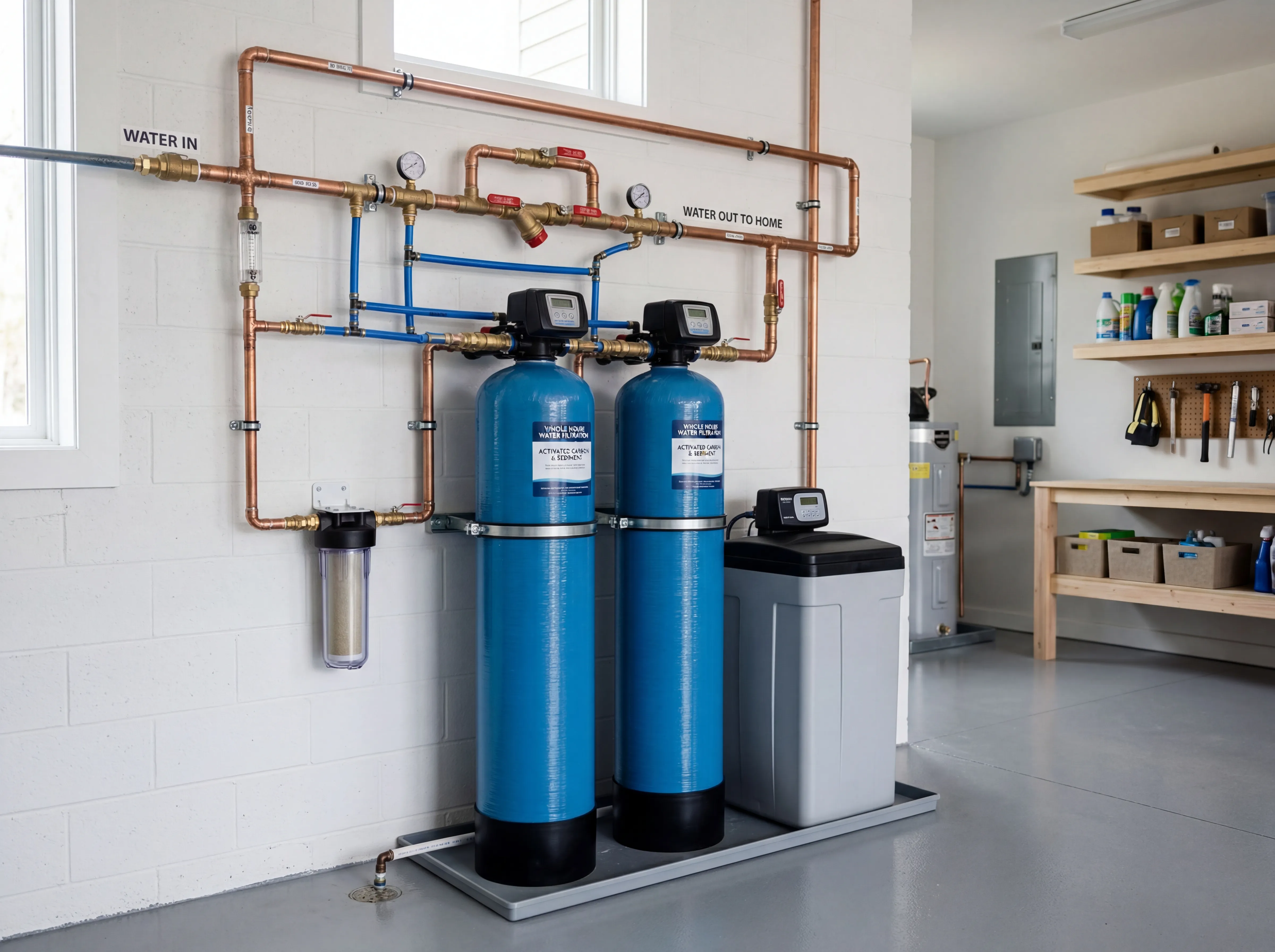
The iSpring WGB32B-KS is a 3-stage whole house water filter that installs at your main water line. Once hooked up, every tap, every shower, the washing machine, the dishwasher, and the outdoor spigot pulls pre-filtered water. SGS lab testing confirms reduction of PFAS, chlorine, lead, and sediment [regulatory review]. Trustpilot reviews average 4.9 out of 5.
The 3 stages:
- Sediment pre-filter: Catches rust, silt, and particles before they reach the carbon stages.
- CTO carbon block: Removes chlorine, VOCs, and organic taste/odor compounds.
- Iron/lead/PFAS reduction block: Targets heavy metals and PFAS compounds [regulatory review].
The system handles up to 15 gallons per minute with minimal pressure drop. You’re not going to notice weaker showers or slower faucets. It connects to standard 1-inch plumbing and works with city water or pre-treated well water.
Why whole-house filtration matters:
- Shower and bath water is filtered. You absorb compounds through skin and inhale them as steam in hot showers. Chlorine and chloramines in shower water are well-documented skin and respiratory irritants [human epidemiological].
- Every drinking water source is covered. Kitchen sink, bathroom sink, fridge line, all handled.
- Appliance protection. Filtered water extends the life of water heaters, washers, and dishwashers by cutting sediment and scale.
- Whole-home improvement. Cooking water, cleaning water, ice, pet bowls, all better.
Filter replacement runs roughly $50 per year depending on your water and usage. The housing itself is built to last 5+ years. For another whole-house option at a higher price point, see our Aquasana Rhino review.
What AquaTru Actually Does
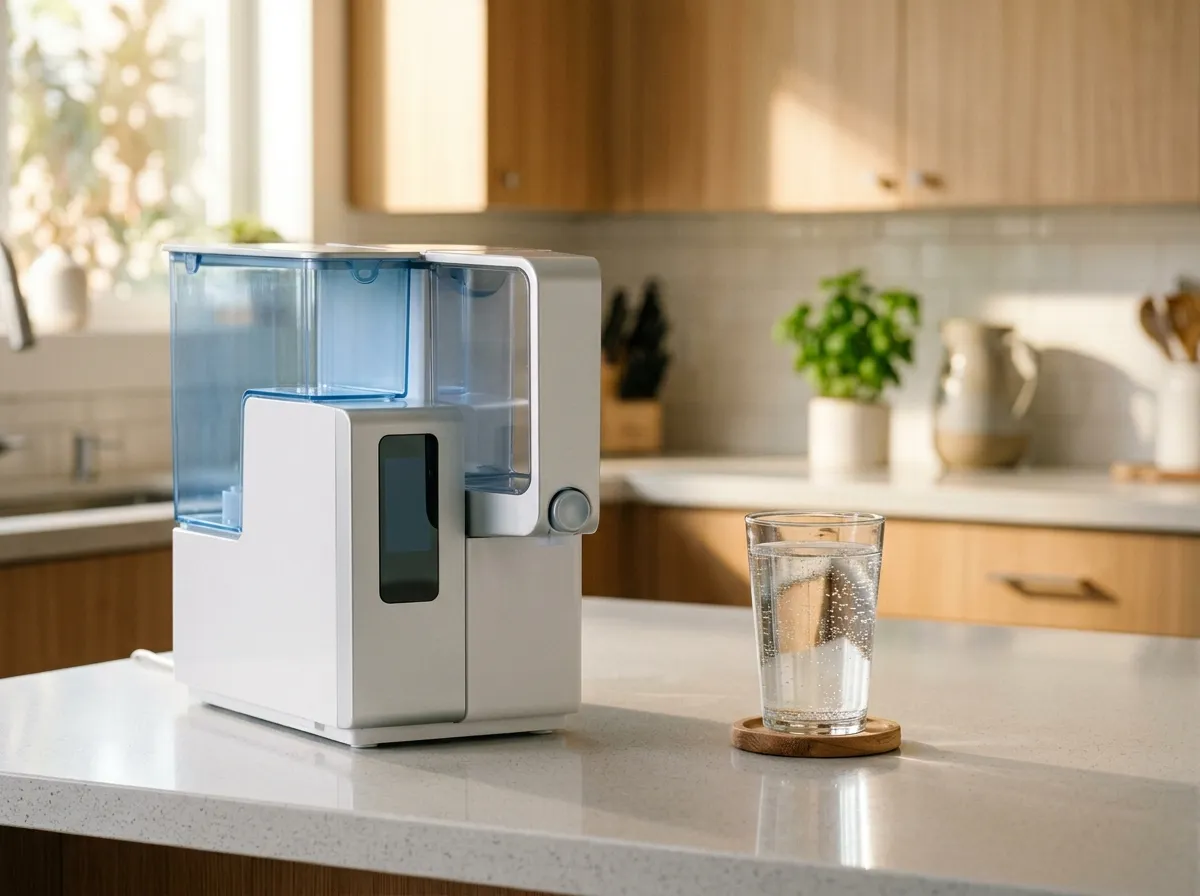
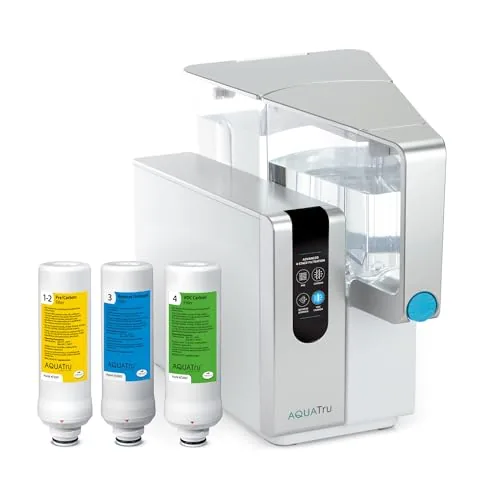
AquaTru is a countertop reverse osmosis system. It sits on the kitchen counter, plugs into a standard outlet, and processes tap water through 4 stages including an RO membrane. Zero installation. No plumbing, no tools, no home modifications.
The 4 stages:
- Mechanical pre-filter: Sediment and particles.
- Carbon pre-filter: Chlorine, VOCs, and organics.
- Reverse osmosis membrane: Dissolved solids, heavy metals, PFAS, fluoride, arsenic, nitrates, down to 0.0001 microns.
- Carbon post-filter: Final polish for taste.
AquaTru holds NSF certifications to Standards 42, 53, 58, 401, and P473 [regulatory review]. It removes or reduces 82+ contaminants, including lead (99%), PFAS (99%+), fluoride, arsenic, chromium 6, pharmaceuticals, and microplastics. Numbers are independently verified, not just brand claims.
The unit processes about 1 gallon every 12-15 minutes and holds roughly 3 quarts of purified water in the front tank. It produces about 1 gallon of wastewater per 4 gallons purified, which is much more efficient than typical under-sink RO (usually 3-4 gallons waste per gallon purified).
For a full deep-dive, see our AquaTru review. For how it stacks up against other countertop and pitcher picks, our AquaTru vs Clearly Filtered comparison breaks it down.
The Core Difference: What Each One Removes
This is where the comparison really matters. Whole-house carbon filters and point-of-use RO systems target different contaminant categories. Understanding that gap is the whole game.
| Contaminant Category | iSpring WGB32B-KS (Whole House) | AquaTru (Countertop RO) |
|---|---|---|
| Chlorine / Chloramines | Yes | Yes |
| Sediment / Particles | Yes | Yes |
| VOCs | Yes | Yes |
| Lead | Yes (SGS-tested) | Yes (99%+, NSF certified) |
| PFAS | Yes (SGS-tested reduction) | Yes (99%+, NSF P473) |
| Fluoride | No | Yes |
| Arsenic | Limited | Yes |
| Nitrates | No | Yes |
| Pharmaceuticals | Limited | Yes (NSF 401) |
| Microplastics | Reduces (larger particles) | Yes |
| Dissolved Solids (TDS) | No | Yes |
| Bacteria / Viruses | No (not designed for this) | Reduces (RO membrane) |
| Iron | Limited | N/A (municipal water) |
iSpring’s strengths: Chlorine, sediment, VOCs, lead, and PFAS reduction across every tap in the home. It makes shower and bath water cleaner, protects appliances, and catches contaminants before they hit any drinking water source. The PFAS and lead performance is a step above the generic 2-stage carbon filters in this price range.
AquaTru’s strengths: Deep contaminant removal at the point of use. RO strips dissolved contaminants that carbon-based whole-house filters cannot fully touch: fluoride, arsenic, nitrates, pharmaceuticals, and dissolved heavy metals. Your drinking and cooking water ends up as clean as consumer tech gets.
The takeaway: iSpring cleans the water moving through your house. AquaTru purifies the water you actually drink. They hit different exposure pathways and work better together than apart.
When You Need Whole House (iSpring)
A whole house filter should be your first buy if:
- Your water has strong chlorine taste or smell. That affects every source in your home, and only a whole-house filter fixes it everywhere.
- Shower and bath exposure worries you. Chlorine and chloramines absorb through skin and release as steam in hot showers. Research in Environmental Health Perspectives has documented measurable blood levels of disinfection byproducts after showering in chlorinated water [human epidemiological]. A whole-house filter is the only way to address this route.
- Appliance protection matters. Filtered water extends the life of water heaters, washers, and dishwashers.
- You want cleaner water for laundry, dishes, and cooking at every tap. Filtering only drinking water leaves contaminants in the water you bathe in and cook pasta in.
- You own your home and plan to stay. Whole-house filters add install time but also add home value.
When You Need Countertop RO (AquaTru)
AquaTru should be your first buy if:
- PFAS is your top concern and you want it gone at the glass. iSpring reduces PFAS at the main line, but RO at the point of use still removes more PFAS per gallon of drinking water [regulatory review]. If your water supply contains PFAS (check your local data at EWG’s Tap Water Database), RO at the kitchen is the most direct single step.
- You rent and can’t touch plumbing. AquaTru needs zero installation. Plug it in. Done.
- You want the cleanest possible drinking water. RO is the most effective consumer purification technology for broad-spectrum contaminant removal.
- Fluoride removal matters to you. Carbon-based whole-house filters don’t remove fluoride. RO does.
Dr. Peter Attia has discussed water filtration on his podcast, noting that reducing PFAS and microplastics in drinking water is one of the more practical environmental health interventions [preliminary]. For that specific goal, point-of-use reverse osmosis (like AquaTru) is the most effective consumer technology available.
The Ideal Setup: Both
If budget allows it, both systems work best as a team.
iSpring at the main line filters all incoming water, pulling out chlorine, chloramines, sediment, and VOCs from every source. That protects skin and lungs during showers, keeps appliances cleaner, and gives you a baseline across the home.
AquaTru on the kitchen counter takes that pre-filtered water (already stripped of chlorine and sediment) and pushes it through reverse osmosis for the water you drink and cook with. The whole-house pre-filtration also extends AquaTru’s filter life, because the RO membrane isn’t fighting chlorine or grit.
Combined cost:
- iSpring WGB32B-KS: ~$450-$560 + $150-$300 installation
- AquaTru Classic: ~$449
- Total: ~$1,050-$1,310 upfront
- Annual filter costs: ~$50 (iSpring) + $120-$150 (AquaTru) = ~$170-$200/year
That works out to roughly $3.00-$3.60 per day for full-coverage filtration across the whole home plus highly purified drinking water. Compare that to bottled water for a family (easily $50-$100+ per month) and the math is competitive, with none of the plastic.
Cost Comparison: 5-Year View
| Cost Factor | iSpring WGB32B-KS | AquaTru Classic | Both Combined |
|---|---|---|---|
| Unit Cost | $$$ | $$$ | $$$$ |
| Installation | $$ | $ | $$ |
| Year 1 Filters | $$ | $$ | $$ |
| Year 2-5 Filters | $$$ | $$$ | $$$$ |
| 5-Year Total | $$$$ | $$$$ | $$$$ |
| What It Covers | All water, whole house | Drinking/cooking water | Everything |
Installation: What to Expect
iSpring WGB32B-KS installation calls for basic plumbing skills. You cut into the main water line near the point of entry, install the 3 filter housings with bypass valves, and connect inlet and outlet. iSpring ships with a written guide and video tutorials. If you’re comfortable with plumbing, it’s a weekend project. If not, a plumber typically charges $150-$300 for the install.
You’ll need:
- Access to the main water line
- Space for 3 housings (about 22 inches tall by 18 inches wide)
- Basic plumbing tools (pipe cutter, fittings, Teflon tape)
- A nearby drain if you ever want to flush the system
AquaTru installation is literally this: take it out of the box, drop in the four color-coded filters, fill the back tank with tap water, plug it in, and hit the button. Total setup under 10 minutes. No tools. No plumbing.
If installation complexity is the deciding factor, AquaTru wins in a walk. That’s why renters and apartment dwellers default to countertop options, and it’s a perfectly good reason to pick it.
For more no-install options, our best water filter for apartments guide covers additional countertop and pitcher systems.
NonToxicLab’s Verdict
These are complementary tools, not rivals. The best answer to “iSpring or AquaTru?” is usually “both, when you can.”
If you can only buy one right now:
Buy AquaTru first if your primary worry is PFAS, fluoride, or heavy metals in drinking water, or you rent, or your budget is under $500. RO at the glass removes contaminants that whole-house carbon cannot, and the water you drink directly has the most immediate impact.
Buy iSpring first if you own your home, your water has a strong chlorine taste or smell, or you want cleaner water for showers and baths. Whole-house filtration covers exposure pathways (skin absorption, inhalation in the shower) that a countertop unit cannot reach.
According to NonToxicLab, the ideal progression for most homeowners goes: start with AquaTru for immediate drinking water gains, then add iSpring whole-house when budget allows. For renters, AquaTru plus a non-toxic shower filter covers the two biggest exposure paths without any plumbing work.
For our full water filtration picks across all categories, see our best whole house water filters guide and best reverse osmosis systems guide.
Common Questions
Do I need both a whole house filter and a countertop RO system?
For the most thorough water filtration, yes. A whole-house filter handles chlorine, sediment, and VOCs at every source. A countertop RO provides deeper purification for drinking and cooking water, pulling PFAS, fluoride, heavy metals, and dissolved contaminants that whole-house carbon misses. They address different contaminant categories and different exposure pathways.
Does the iSpring WGB32B-KS actually remove PFAS?
iSpring provides SGS lab test data showing PFAS reduction by the WGB32B-KS [regulatory review]. It’s one of the few whole-house filters in this price range with published third-party PFAS testing. That said, for maximum PFAS removal at the glass, point-of-use reverse osmosis (AquaTru or a good under-sink RO) still performs better per gallon of drinking water. Pair the two if PFAS is your main concern. Our PFAS removal guide covers the full list of effective options.
Is AquaTru better than an under-sink RO system?
They share the same core technology (reverse osmosis) and produce similar water quality. The differences are capacity and convenience. Under-sink RO connects straight to your plumbing and gives filtered water on demand from a dedicated faucet. AquaTru needs no installation but processes water in batches with a 3-quart holding tank. For most households, under-sink RO is more convenient day-to-day if you can install it. AquaTru is the better pick for renters or anyone who can’t touch plumbing.
How long do iSpring WGB32B-KS filters last?
The 3 filter stages in the WGB32B-KS typically run 6-12 months before needing replacement, depending on water usage and source quality. Replacement cost is roughly $50 per year for the set. The housing itself holds up for 5+ years of normal use.
Does AquaTru waste a lot of water?
AquaTru produces about 1 gallon of wastewater for every 4 gallons of purified water. That’s much more efficient than typical under-sink RO systems, which often waste 3-4 gallons per gallon purified. The wastewater isn’t contaminated beyond what was in your tap water. You can repurpose it for plants or cleaning.
Can I use AquaTru with well water?
AquaTru is built for treated municipal water. Well water may carry higher sediment, iron, and bacteria levels that can damage the RO membrane and shorten filter life. If you’re on well water, start with a whole-house system (or a dedicated well filter). You can then use AquaTru as a secondary drinking water step once the well water is pre-treated.
What we don’t fully know: Long-term data on low-level chronic exposure stays limited for many of these contaminant categories, and evidence on some chemical mixtures is still mixed. Researchers keep refining exposure thresholds as new data comes in.
Whole-House vs Countertop RO Tradeoffs
| Option | Main concern | Primary tradeoff |
|---|---|---|
| iSpring WGB32B-KS whole-house | Needs plumbing install; doesn’t remove fluoride or TDS | SGS-tested for PFAS/chlorine/lead; treats all water including shower/bath; low annual filter cost |
| AquaTru countertop RO | Addresses drinking/cooking water only; wastewater ratio | NSF/ANSI 58 certified; no installation; most affordable full RO option; portable |
| Clearly Filtered pitcher | Pitcher format; slower flow rate | Certified for PFAS, lead, chloramine; compact; no wastewater; narrower contaminant range |
| Under-sink RO | Requires installation; wastewater | Strong cost-to-performance balance; NSF certified; convenient for daily use |
Sources
- NSF International: Certification database for AquaTru (Standards 42, 53, 58, 401, P473).
- iSpring: SGS lab test data and product specifications for WGB32B-KS.
- Attia, P. The Drive podcast: discussions on practical water filtration for health.
- Villanueva CM, et al. “Disinfection byproducts and bladder cancer: a pooled analysis.” Epidemiology, 2004.
- EWG Tap Water Database: Contaminant data for US water systems.
- EPA: Drinking water contaminant standards and health advisories.
You Might Also Like
- Berkey vs AquaTru: Which Water Filter Is Better?
- Berkey vs ProOne vs Clearly Filtered
- Berkey Water Filter Review
- Whole-Home Air and Water Systems: What the Science Supports at Every Budget
- iSpring WGB32B-KS Review: The Whole House Water Filter We Recommend in 2026
- Best Fluoride Water Filters in 2026 (Tested and Certified)
- The Whole House Filter We Recommend (iSpring WGB32B-KS)
- Best Under-Sink Water Filters in 2026 (Including Renter-Friendly Options)
- How to Maintain Your Water Filter: Replacement Schedules and Troubleshooting
- Brita vs Clearly Filtered: Which Water Pitcher Actually Removes PFAS? (2026)
- Water Filtration Guide: How to Choose the Right Filter for Your Home
- Best Gravity Water Filters in 2026 (No Plumbing Required)
- Clearly Filtered vs ZeroWater: Budget Pitcher Comparison
- Water Filter Comparison Chart: PFAS, Lead, Fluoride, and Chlorine Removal Rates