The Short Answer
Clearly Filtered is the best gravity-fed filter for most households. It has the most complete third-party certifications, removes the widest range of verified contaminants, and costs less upfront. ProOne is the best option for people who want the Berkey-style stainless steel gravity system with actual NSF certifications behind the filter elements. Berkey, despite its loyal following, carries too much regulatory uncertainty to recommend as the top pick right now.
The gravity water filter market used to be simple: buy a Berkey and move on. That’s no longer the case. Berkey’s Black Berkey filter elements have been subject to an EPA stop-sale order, the brand has never obtained NSF certification for its filters, and two competitors have stepped up with certified alternatives that address Berkey’s biggest weaknesses. After comparing all three on the metrics that matter, here’s where things stand.
Whole-home water filtration is one pillar of our longevity home protocol, and the gravity-filter choice you make here sits right at the center of it.
Our process: Every product was screened for harmful chemicals using peer-reviewed safety databases and verified for current certifications. How we test
The Berkey Problem: EPA Stop-Sale and No NSF Certification
Let’s address the elephant in the room. Berkey has two significant issues that every buyer needs to understand.
Issue 1: No NSF Certification. Berkey has never submitted their Black Berkey filter elements to NSF International for certified testing under NSF/ANSI Standards 42, 53, or other relevant standards. NSF certification is the industry benchmark for verifying that a water filter actually removes what it claims to remove. It involves independent lab testing, facility audits, and ongoing monitoring.
Berkey conducts their own internal testing and hires third-party labs for some contaminant testing, but self-reported results without NSF certification are not the same as independently verified, certified performance. In an industry where the gap between marketing claims and actual performance can be enormous, NSF certification matters.
Issue 2: EPA Stop-Sale Order. The EPA issued a stop-sale order against New Millennium Concepts (Berkey’s parent company) related to the Black Berkey filter elements. The issue centers on whether the filters should be classified and registered as pesticide devices under FIFRA (Federal Insecticide, Fungicide, and Rodenticide Act) due to Berkey’s claims about removing bacteria, viruses, and other biological contaminants.
If a water filter claims to remove or kill microbiological contaminants, the EPA classifies it as a “pesticide device” that must be registered and meet specific requirements. Berkey made these claims without the required EPA registration.
This doesn’t necessarily mean Berkey filters don’t work. It means their biological contaminant removal claims haven’t gone through the regulatory process that the EPA requires. The stop-sale order specifically targets the filter elements, not the stainless steel housings.
As of this writing, the situation is ongoing. Berkey is available through some retailers, but the regulatory status remains unresolved. For a detailed comparison of Berkey against a top alternative, see our [Berkey vs AquaTru breakdown](/berkey-vs-aquatru/).
ProOne: The Certified Berkey Alternative
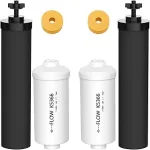
ProOne fills the gap that Berkey’s regulatory issues have created. Their gravity filter systems use a similar stainless steel housing with gravity-fed filter elements, but with one critical difference: ProOne’s filter elements carry actual NSF certifications.
ProOne G2.0 Filter Elements:
- NSF/ANSI 42 certified (chlorine taste and odor reduction)
- NSF/ANSI 53 certified (health-related contaminants including lead, VOCs, and cysts)
- Silver-impregnated ceramic and carbon block construction
- Rated for up to 1,360 gallons per element (approximately 6 months for a family of four)
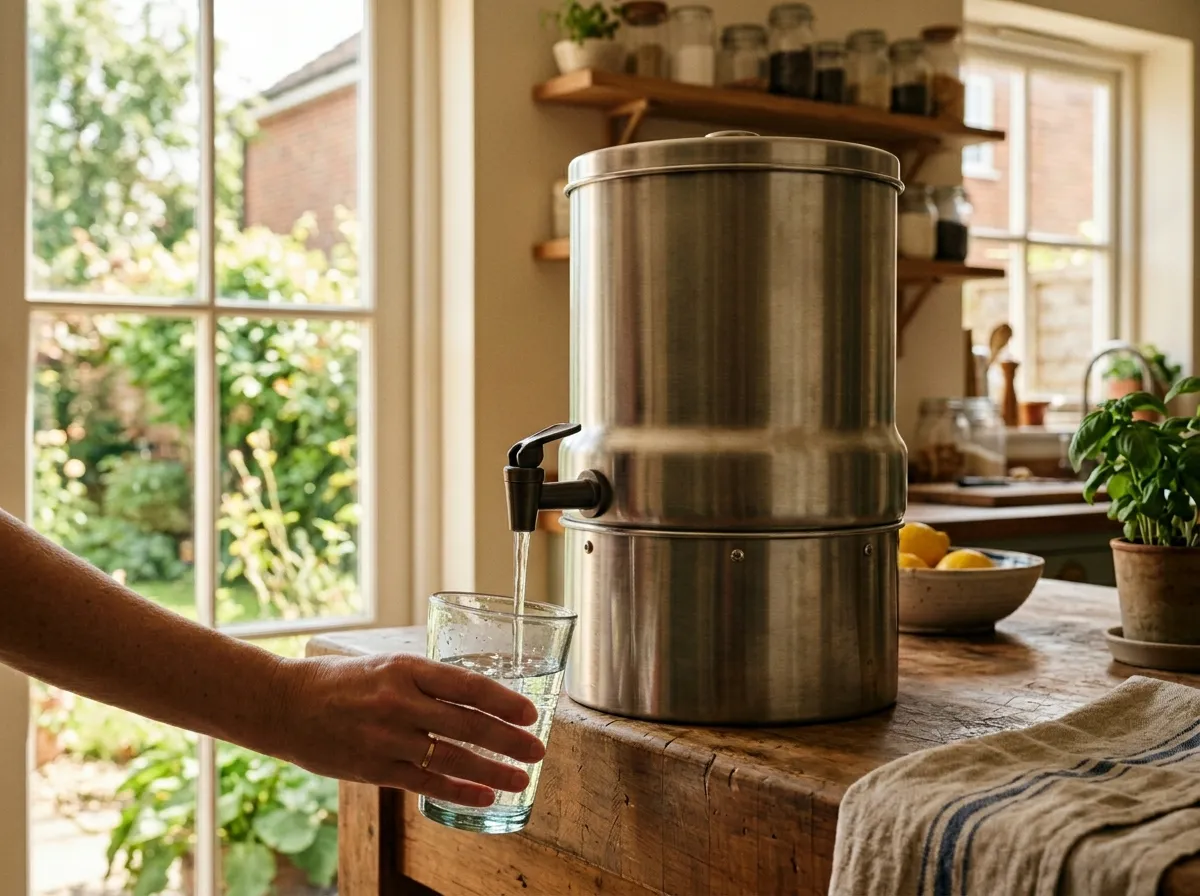
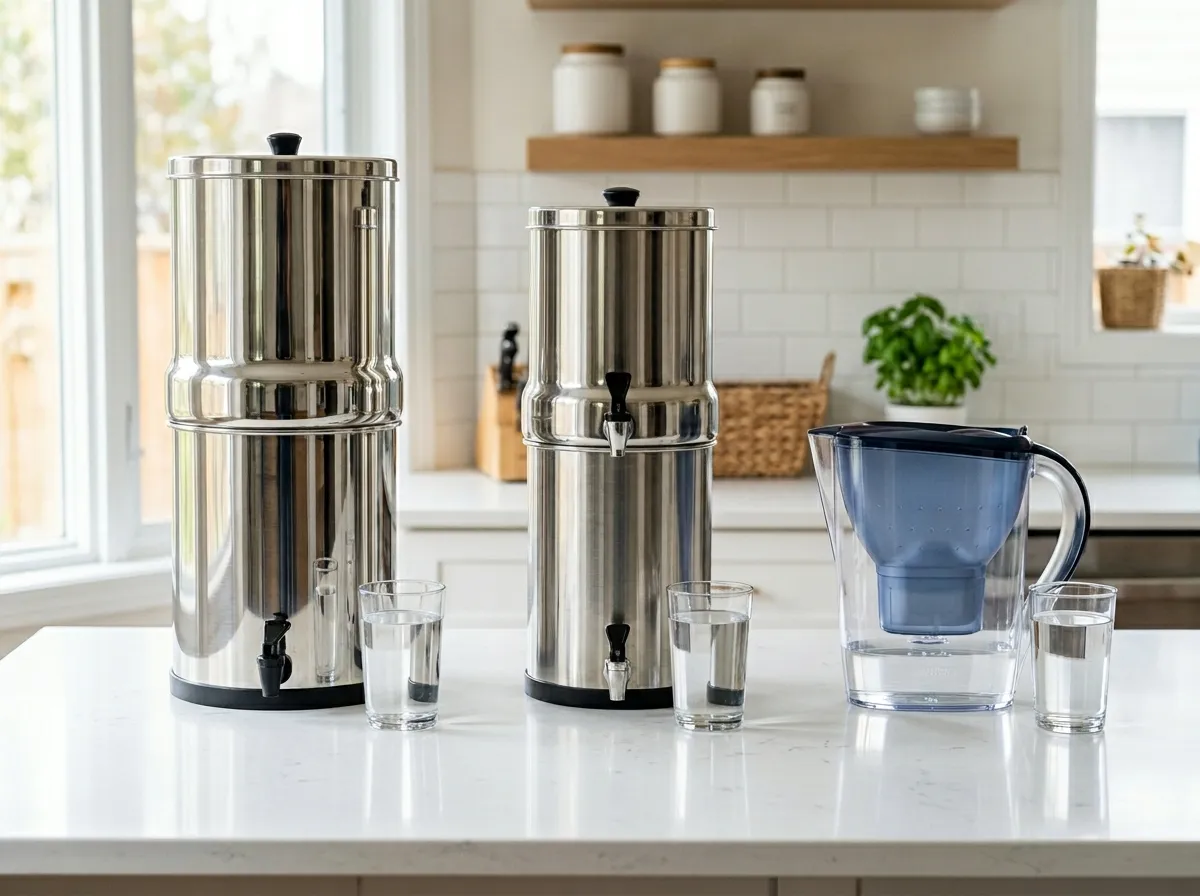
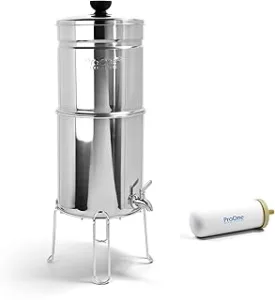
The ProOne Big+ system uses two G2.0 filter elements in a stainless steel housing that looks and functions almost identically to a Berkey. Upper chamber holds unfiltered water, gravity pulls it through the filter elements into the lower chamber, and you dispense clean water from the spigot.
The flow rate is comparable to Berkey: roughly 1 gallon per hour with two elements. Not fast, but adequate for a household that keeps the upper chamber topped off.
The stainless steel construction is solid. It doesn’t leach chemicals, doesn’t crack or shatter, and works without electricity. These are the same advantages that made Berkey popular, now backed by the certifications Berkey lacks.
ProOne also offers fluoride and arsenic reduction add-on filters that sit below the primary elements. If fluoride removal is a priority, this add-on brings the system closer to what a reverse osmosis system can do, though RO still outperforms gravity filters for fluoride.
Setup and daily use. The ProOne Big+ ships with two G2.0 filter elements that need priming before first use. Priming means pushing water through the ceramic surface until it runs clear, which takes about 10-15 minutes per element. You do this once at setup and again after extended storage. After that, daily use is simple: fill the top chamber, wait for gravity to do the work. Flow rate runs about 1 gallon per hour with both elements installed, so I’d recommend filling it before bed and dispensing throughout the next day.
Annual filter cost, calculated. A household of two filtering about 2 gallons per day uses roughly 730 gallons per year. Each ProOne G2.0 element handles 1,360 gallons, so a pair lasts about 3.7 years at that rate. But ProOne’s official recommendation is to replace elements every 12 months regardless of gallon count, partly because sediment and microbial buildup inside ceramic elements can degrade performance before the carbon is exhausted. If you follow the annual replacement schedule, you’re spending roughly $100-$150 per year on two replacement elements. A family of four filtering 4 gallons a day exhausts elements faster, around 18 months on gallons alone, putting annual costs at $67-$100/year. Either way, ProOne lands in the middle of this comparison on ongoing costs.
Clearly Filtered: The Pitcher That Punches Above Its Weight
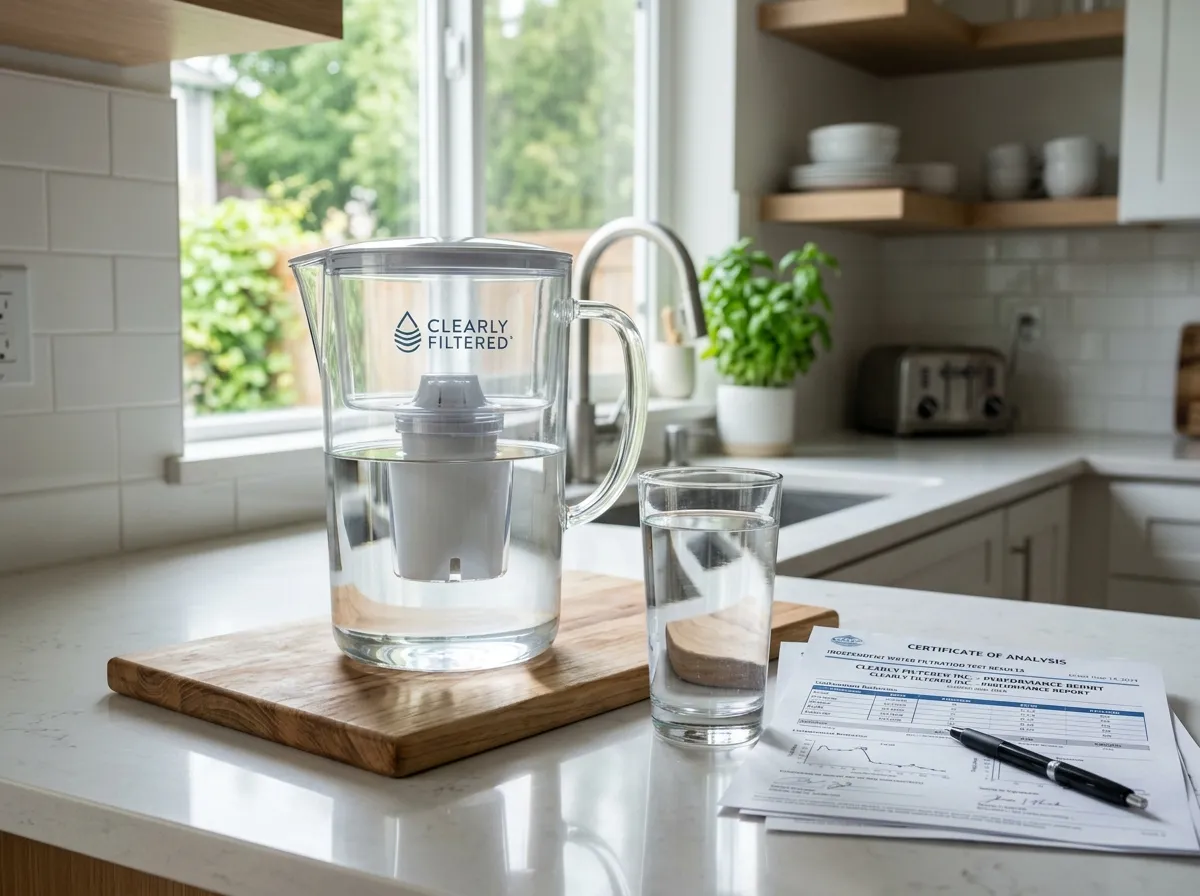
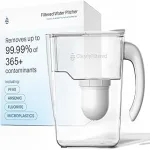
Clearly Filtered takes a different approach. Instead of a countertop stainless steel system, they offer a BPA-free pitcher with a proprietary filter cartridge that has been tested and certified to an extraordinary degree.
Certifications and Testing:
- NSF/ANSI 42 (aesthetic effects)
- NSF/ANSI 44 (cation exchange water softeners)
- NSF/ANSI 53 (health effects, including lead and cyst reduction)
- NSF/ANSI 401 (emerging contaminants including pharmaceuticals)
- NSF/ANSI P473 (PFOA and PFOS reduction)
Clearly Filtered claims their filter removes or reduces 365+ contaminants. The list includes PFAS (99.7% reduction), lead (99.5%), chromium 6 (99.6%), fluoride (98.2%), pharmaceuticals, pesticides, herbicides, heavy metals, and microplastics. These numbers are backed by third-party lab testing conducted under NSF protocols.
The breadth of certified contaminant removal is what sets Clearly Filtered apart. Most pitcher filters (Brita, PUR, ZeroWater) are certified for a fraction of these contaminants. The Clearly Filtered pitcher goes head-to-head with reverse osmosis systems in terms of contaminant coverage, which is remarkable for a $100 pitcher.
For a detailed look at how Clearly Filtered compares to other pitcher filters, see our Brita vs Clearly Filtered comparison and our Clearly Filtered vs ZeroWater analysis.
Setup and daily use. The Clearly Filtered pitcher is the easiest of the three to set up. Remove it from the box, rinse the filter under cold water for 15 seconds, lock it into the pitcher, and fill. No priming, no waiting overnight, no special process. It fits in a standard refrigerator door shelf, and the top-fill design means you don’t have to take it out of the fridge to add water. Flow rate is slower than a Brita, around 5-6 minutes to filter a full pitcher load, because the media is removing far more contaminants. That’s the tradeoff for the certification coverage.
Annual filter cost, calculated. Each cartridge handles 100 gallons. A single person drinking 1 gallon per day from it needs a new cartridge roughly every 3 months, meaning 4 cartridges per year at $50-$70 each. That’s $200-$280 per year. A couple filtering 2 gallons daily cuts through a cartridge in 50 days, closer to 7 cartridges a year, pushing the annual cost to $350-$490. That’s a meaningful number. Clearly Filtered is the most expensive filter option per gallon in this comparison. What you’re buying is NSF-certified removal of 365+ contaminants, including verified PFAS and lead reduction, in a pitcher that requires zero installation.
The Three-Way Comparison
| Feature | Berkey | ProOne Big+ | Clearly Filtered Pitcher |
|---|---|---|---|
| Filter type | Stainless steel gravity | Stainless steel gravity | BPA-free pitcher (gravity) |
| NSF 42 Certified | No | Yes | Yes |
| NSF 53 Certified | No | Yes | Yes |
| NSF 401 Certified | No | No | Yes |
| NSF P473 (PFAS) | No | No | Yes |
| EPA Compliance | Stop-sale order (2023) | Compliant | Compliant |
| PFAS removal rate | Yes (self-tested, not NSF) | Not NSF-verified | 99.7% [per NSF P473 certification] |
| Lead removal rate | Yes (self-tested, not NSF) | NSF 53 certified | 99.5% [per NSF 53 certification] |
| Fluoride removal | With add-on PF-2 filters | With add-on element | 98.2% [per independent lab test] |
| Filter lifespan | 6,000 gal claimed (unverified) | 1,360 gal per element (NSF tested) | 100 gal per cartridge |
| Capacity | 1.5-6 gallons (model dependent) | 2.75 gallons | 10 cups (~0.6 gallons) |
| Gravity vs pressure | Gravity only | Gravity only | Gravity only |
| Upfront price | $$$ | $$ | $$ |
| Filter replacement cost/year | $/yr (claimed lifespan) | $$/yr | $$$/yr |
| Electricity required | No | No | No |
| Portability | Low (heavy, bulky) | Low (heavy, bulky) | High (lightweight, fridge-ready) |
| Buy | Search Amazon | Search Amazon | Search Amazon |
Contaminant Removal: Verified vs Claimed
This is the most important comparison category, and it’s where the certification gap shows up starkly.
Berkey claims to remove over 200 contaminants and publishes internal testing data and some third-party lab reports. The numbers they publish look impressive: 99.999% bacteria removal, 99.9999% virus removal, substantial PFAS and heavy metal reduction. However, none of these claims carry NSF certification, which means they haven’t been independently verified through the standardized testing protocols that the water filtration industry uses as its benchmark.
This doesn’t necessarily mean the numbers are wrong. It means you’re trusting the manufacturer’s word rather than an independent certifying body. For some people, Berkey’s published test data is sufficient. For others, the lack of NSF certification is a dealbreaker, especially at this price point.
ProOne has NSF 42 and 53 certifications, which verify chlorine reduction, lead reduction, VOC reduction, and cyst reduction. These are solid baseline certifications. ProOne does not carry NSF 401 or P473 certifications, so their PFAS and pharmaceutical removal claims are not independently certified to the same degree as Clearly Filtered.
Clearly Filtered has the most complete certified testing of any pitcher filter on the market. The NSF P473 certification specifically verifies PFAS removal, which is the contaminant most health-conscious consumers are worried about. If verified PFAS removal is your top priority and you want it in a pitcher format, Clearly Filtered is the clear winner.
Dr. Peter Attia has noted on his podcast that for practical health purposes, focusing on verified contaminant removal (particularly lead, PFAS, and microplastics) is more valuable than chasing the longest list of removed compounds. The certifications that verify these specific high-priority contaminants matter more than total contaminant count.
Filter Lifespan and Annual Cost
Filter cost is where the math gets interesting and where the sticker price can be misleading.
Berkey: Claims a filter lifespan of 6,000 gallons per pair of Black Berkey elements. At a household usage of 3-4 gallons per day, that’s roughly 4-5 years before replacement. A pair of replacement Black Berkey elements costs about $55-$120 depending on the source. The long filter life makes Berkey’s annual cost extremely low on paper: roughly $15-$30 per year. This has been one of Berkey’s biggest selling points.
However, that 6,000-gallon claim is not NSF verified, and real-world performance depends heavily on source water quality. Hard water, high sediment, or heavily chlorinated water will reduce filter life significantly.
ProOne: Filter elements are rated for approximately 1,360 gallons each, or roughly 6 months for a household using 3-4 gallons daily. Replacement elements cost about $50-$75 each, and the system uses two. Annual filter cost: roughly $100-$150. More expensive than Berkey’s claimed costs, but the NSF certifications provide verified performance data.
Clearly Filtered: Each filter cartridge is rated for approximately 100 gallons, which translates to about 2-4 months depending on household size and consumption. Replacement cartridges cost about $50-$70 each. Annual filter cost: roughly $210-$280. This is the most expensive option for ongoing filter costs, and it’s the main trade-off for Clearly Filtered’s superior certification coverage.
For a two-person household using 2 gallons of filtered water per day, the annual cost comparison looks like this:
| Brand | Year 1 Total (unit + filters) | Year 2 Filters Only | 5-Year Total |
|---|---|---|---|
| Berkey (Big Berkey) | $$$ | $ | $$$ |
| ProOne Big+ | $$ | $$ | $$$$ |
| Clearly Filtered | $$ + $$ | $$$ | $$$$ |
Berkey wins on cost over 5 years if you trust their filter lifespan claims. Clearly Filtered costs the most long-term but provides the best verified contaminant removal. ProOne sits in the middle on both cost and certification coverage.
Taste
All three systems produce water that tastes noticeably better than unfiltered tap water. Chlorine taste and odor are effectively eliminated by all three.
In terms of taste differences between the three, they’re subtle. Clearly Filtered and ProOne both produce clean, neutral-tasting water that’s hard to distinguish from each other in a blind taste test. Berkey water has a slightly different mineral profile because the filtration mechanism is different, but the difference is marginal.
None of these gravity filters remove minerals the way a reverse osmosis system does, so the water retains some mineral character. Most people prefer this over the completely flat taste of RO-filtered water.
Portability and Practical Use
Clearly Filtered pitcher wins for portability. It fits in a refrigerator, weighs a few pounds, and can easily move between rooms or go on a trip. It’s effectively a Brita pitcher with dramatically better filtration. The downside is capacity: 10 cups means frequent refills for a family.
ProOne and Berkey are countertop systems that hold 2-6 gallons depending on the model. They’re not portable in any practical sense. They take up meaningful counter space and weigh 10-20+ pounds when full. The advantage is batch filtration: fill the upper chamber and you have gallons of filtered water ready to go.
For apartment dwellers, renters, or anyone with limited counter space, the Clearly Filtered pitcher is the most practical option. For families who go through a lot of water and have counter space to spare, a stainless steel gravity system (ProOne) makes more sense.
If you’re looking at non-gravity alternatives for your apartment, our best water filter for apartments guide covers under-sink and faucet-mount options too.
Who Should Choose Each Filter?
The right filter depends on your living situation, water concerns, and how much you’re willing to spend per year on replacement cartridges.
ProOne Big+ G2.0: Best for Current Berkey Users Wanting NSF Certification
If you already own a stainless steel gravity filter and are looking for certified replacement elements, or if you want to buy a Berkey-style system but won’t accept unverified performance claims, ProOne is the answer. The form factor is nearly identical to a Berkey. The countertop footprint, the stainless steel chambers, the spigot, the gravity-fed flow: it all works the same way. The critical difference is that ProOne’s G2.0 elements carry NSF 42 and 53 certifications, so you’re not taking the manufacturer’s word for chlorine and lead reduction.
I’d particularly recommend ProOne for households of three or more people who go through 3+ gallons of filtered water daily. At that volume, the per-gallon cost is reasonable, and the large capacity means you’re not constantly refilling. It also works well in homes where counter space isn’t limited and where the household has specific concern about bacterial contamination from well water or non-municipal sources (the ceramic element construction provides a physical barrier).
ProOne is not the right choice if PFAS removal is your top priority. The G2.0 elements don’t carry NSF P473 certification, so PFAS reduction claims are not independently verified the same way Clearly Filtered’s are.
Clearly Filtered: Best for Apartment Dwellers and PFAS-Focused Households
The Clearly Filtered pitcher is the one I’d recommend for renters, apartment dwellers, and anyone who can’t install under-sink filtration. It requires no tools, no plumber, and no permanent fixtures. You fill it and put it in the fridge. That’s the whole process.
It’s also the right choice if PFAS is your main concern. The NSF P473 certification covers PFOA and PFOS reduction, and Clearly Filtered’s published test data shows 99.7% PFAS reduction [per NSF-protocol third-party testing]. Lead removal comes in at 99.5% certified. If you’ve checked your local EWG tap water report and found high PFAS or lead levels, Clearly Filtered gives you more documented reassurance than either stainless steel gravity option.
The trade-off is cost per gallon. Households that filter a lot of water will feel the $200-$280+ annual cartridge expense. One practical approach: use Clearly Filtered as your drinking water filter, and if you also cook with filtered water, supplement with a less expensive faucet mount for cooking use only. That reduces your Clearly Filtered cartridge burn rate.
Berkey: Who It’s Still Right For (If Anyone)
Berkey is hardest to recommend in 2026 given the unresolved EPA stop-sale situation and the lack of NSF certification. That said, some existing Berkey owners are staying put, especially those who bought it for off-grid or emergency preparedness use. The stainless steel system works without electricity, handles large batch volumes, and has been reliable for years for those users.
If you already have a Berkey and aren’t worried about the certification gap, you don’t need to throw it out. The physical filter mechanism (granular activated carbon and ceramic) is a legitimate filtration approach. What you’re missing is independent verification that it performs at the level claimed. For new buyers evaluating all three options fresh, the certification gap is too wide to overlook when ProOne offers a nearly identical experience with verified performance.
Practical Setup and Maintenance
Setup complexity and ongoing maintenance are real factors that affect daily life with each filter, and they’re rarely covered well in spec comparisons.
Initial Setup Time
Clearly Filtered is fastest: 5 minutes from unboxing to first use. Rinse the filter, install it, fill the pitcher. ProOne takes longer, around 30-45 minutes for proper setup. You need to hand-tighten the filter elements into the upper chamber, prime each element (running water through until the ceramic surface is saturated and water flows clearly), assemble the chambers, and do a first-filter discard run. Berkey setup is similar in time to ProOne, with the same priming requirement.
Gravity filter priming matters more than most people realize. An unprimed ceramic element can pass slightly discolored water in the first few batches. It’s not harmful, but it’s alarming if you don’t know to expect it.
Refill Frequency
The Clearly Filtered pitcher holds about 10 cups (roughly 0.6 gallons). If two people drink filtered water throughout the day, you’re refilling it 2-3 times daily. This is the biggest practical friction point with the pitcher format. Some households solve this by keeping a second filled pitcher in the fridge.
ProOne’s Big+ system holds 2.75 gallons total (upper and lower chambers combined). At a family pace of 3 gallons per day, you’re filling the upper chamber once per day, usually in the evening so overnight gravity filtration keeps the lower chamber full by morning.
Storage Space
A ProOne or Berkey system is a permanent countertop fixture. Expect a footprint of about 9 inches in diameter and 20-24 inches tall. A kitchen with limited counter space may struggle. The Clearly Filtered pitcher is fridge-sized: about 10.5 inches tall and 5 inches wide, fitting in most refrigerator door shelves or on a standard shelf.
Cleaning
All three systems need periodic cleaning. For the stainless steel gravity filters (ProOne, Berkey), this means wiping the chambers with a damp cloth every few weeks and scrubbing the ceramic elements with a stiff brush when flow rate slows (sediment buildup reduces flow). Clearly Filtered’s pitcher body can go in the top rack of the dishwasher. The filter cartridge itself just gets replaced rather than cleaned.
NonToxicLab’s Ranking
1. Clearly Filtered Pitcher - Best overall for most households. The most complete certifications, the widest verified contaminant removal, and the lowest upfront cost. The higher ongoing filter costs are the trade-off, but you’re paying for independently verified performance. If you want the most trusted filtration in a pitcher format, this is it.
2. ProOne Big+ - Best for people who want a stainless steel gravity system with real certifications. It fills the exact gap that Berkey’s regulatory issues created: same form factor, same gravity-fed convenience, but with NSF 42 and 53 certifications backing the performance claims. The best Berkey alternative available.
3. Berkey - Hard to recommend as a top pick given the lack of NSF certification and the EPA stop-sale situation. The product has loyal fans, and the stainless steel construction is well-made. But when you can get NSF-certified alternatives at the same or lower price, the risk-benefit calculation doesn’t favor Berkey.
NonToxicLab’s research shows the Clearly Filtered pitcher is the most trustworthy gravity-fed water filtration option available based on verified third-party testing data. For the stainless steel gravity format, ProOne has earned the recommendation that Berkey can’t currently support.
For broader water filtration options including reverse osmosis and under-sink systems, see our best gravity water filters guide and our guide to PFAS removal filters.
Questions We Hear Most
Is Berkey still safe to use?
The EPA stop-sale order relates to unregistered pesticide device claims (biological contaminant removal), not to a finding that Berkey filters are unsafe. If you already own a Berkey, using it is not dangerous. The water it produces is still filtered through carbon and the stainless steel housing is inert. The issue is that Berkey’s performance claims, particularly around bacteria and virus removal, haven’t been verified through the regulatory channels the EPA requires.
Why doesn’t Berkey have NSF certification?
Berkey has not submitted their filter elements for NSF/ANSI certification testing. The company has stated that they conduct their own testing and use third-party labs, but they have not pursued the specific NSF certification process. The reasons are not entirely clear, but the result is that their contaminant removal claims are not independently verified to the industry standard.
Is Clearly Filtered as good as reverse osmosis?
For many contaminants, Clearly Filtered’s certified removal rates are comparable to RO systems. The pitcher removes 99.7% of PFAS, 99.5% of lead, and 98.2% of fluoride. Where RO still holds an advantage is in total dissolved solids removal, consistent performance across all contaminant categories, and a deeper track record. If you can install an RO system, it remains the gold standard. If you need a no-installation option, Clearly Filtered comes remarkably close.
How often do you replace Clearly Filtered filters?
Each Clearly Filtered cartridge is rated for approximately 100 gallons. For a single person or couple drinking 1-2 gallons per day, that’s roughly 2-3 months. For a family of four, closer to 1-2 months. The replacement indicator on the pitcher helps track usage.
Can ProOne filters remove fluoride?
The standard ProOne G2.0 elements do not remove fluoride. ProOne offers a fluoride and arsenic reduction add-on filter that installs below the primary elements. With the add-on, the system can reduce fluoride levels, though specific removal percentages vary with water chemistry. For maximum fluoride removal, a dedicated fluoride filter or reverse osmosis system is more reliable.
Which gravity filter is best for emergency preparedness?
ProOne or a Berkey-style stainless steel system, because they don’t require electricity, have large capacities, and can process non-municipal water sources (though you should still pre-filter visibly dirty water). The Clearly Filtered pitcher is designed for treated municipal water and isn’t intended for emergency water purification from untreated sources.
What we don’t fully know: Long-term data on low-level chronic exposure remains limited for many of these categories, and evidence on some chemical mixtures is still mixed. Researchers continue to refine exposure thresholds and update risk models as new data emerges.
Water Filter Technology Tradeoffs
| Option | Main concern | Primary tradeoff |
|---|---|---|
| Berkey gravity filter (Black filters) | EPA testing; not certified by NSF/ANSI; relies on manufacturer testing | High capacity; removes wide range of contaminants; no electricity needed; regulatory gap |
| ProOne gravity filter | NSF component certification, not complete system | Similar capacity to Berkey; better regulatory standing; less brand recognition |
| Clearly Filtered pitcher | Pitcher format limits flow rate | NSF/ANSI 42/53/58/401/P473 certified; most verified for PFAS removal; compact |
| Under-sink RO system | Wastewater ratio (3-4 gallons wasted per 1 filtered) | Most complete contaminant removal; NSF certified; higher upfront cost |
Sources
- NSF International: Certification database for water treatment products.
- EPA: Stop-sale order documentation regarding pesticide device classification under FIFRA.
- Clearly Filtered: Published third-party test results and NSF certification documentation.
- ProOne: NSF/ANSI 42 and 53 certification data for G2.0 filter elements.
- Attia, P. The Drive podcast: discussions on practical water filtration priorities.
- EWG Tap Water Database: Contaminant data for US water systems.
You Might Also Like
- AquaTru vs Clearly Filtered
- Berkey Water Filter Review
- Brita vs PUR: Which Water Filter Pitcher Is Actually
- iSpring WGB32B vs Clearly Filtered: Which Should You Buy in 2026?
- 176 Million Americans Are Drinking PFAS-Contaminated Water - Is Your Tap Safe?
- Clearly Filtered Water Pitcher Review: Is It Worth the Premium? (2026)
- Water Filter Comparison Chart: PFAS, Lead, Fluoride, and Chlorine Removal Rates
- Best Water Filter Pitchers in 2026 (Tested for PFAS, Lead, and Chlorine)
- AquaTru Countertop RO Review: Best Water Filter for Home?
- Is Tap Water Safe to Drink in the US? What Your City’s Water Report Tells You
- How to Maintain Your Water Filter: Replacement Schedules and Troubleshooting
- Water Filtration Guide: How to Choose the Right Filter for Your Home