Your tap water looks clean. It’s clear, it doesn’t smell, it runs cold. And right now, there’s a very good chance it contains PFAS, the synthetic chemicals linked to cancer, immune damage, thyroid disruption, and fertility problems. Not trace amounts in some industrial hot zone. In your kitchen. Possibly in the glass you filled this morning.
New data from the Environmental Working Group puts the number at 176 million Americans drinking PFAS-contaminated tap water. That’s up 4 million from their previous count. And the federal agency that’s supposed to protect you from this just spent the last few months rolling back the rules.
Key Takeaways
- 176 million Americans now drink PFAS-contaminated tap water, per EWG’s March/April 2026 data.
- The Trump EPA removed drinking water limits for GenX, PFBS, PFNA, and PFHxS and pushed compliance deadlines to 2031.
- Standard Brita pitchers remove almost no PFAS. You need a reverse osmosis or NSF/ANSI 58-certified carbon block filter.
- A Michigan State study found PFHxS, one of the chemicals the EPA just deprotected, can stay in your body for nearly a decade.
- You can check your own water supply today using EWG’s tap water database at ewg.org/tapwater.
This article is for informational purposes only and is not medical advice. Consult a qualified healthcare professional for guidance specific to your health situation.
How Did PFAS Get Into Tap Water?
PFAS contamination in drinking water is the result of decades of industrial discharge, and it’s far harder to clean up than it was to create. According to the EPA’s PFAS overview, these chemicals have been manufactured and used in the United States since the 1940s, showing up in nonstick cookware, food packaging, stain-resistant fabrics, firefighting foam, and hundreds of industrial processes.
Aqueous film-forming foam (AFFF) is the single biggest contributor to groundwater contamination near military bases and airports. When firefighters train with it repeatedly over years, it soaks into the soil. Then it migrates into the groundwater. Then it moves into municipal water supplies. Michigan, Pennsylvania, New Jersey, California, New York, and Illinois have some of the highest rates of contaminated water systems in the country.
Industrial facilities discharge PFAS through wastewater, and some ends up in rivers and reservoirs that feed public water systems. Biosolids, the treated sewage sludge used as agricultural fertilizer, carry PFAS that leach into crops and groundwater. The exposure pathways are layered and wide. If PFAS are in your soil or your region’s water table, they’re probably in your tap.
Here’s what makes this especially frustrating: PFAS don’t degrade. They don’t break down in the environment. They don’t break down in your body either. The nickname “forever chemicals” isn’t a scare tactic. It’s accurate chemistry. Dr. Philip Landrigan, director of the Global Observatory on Planetary Health at Boston College, has called PFAS contamination “a public health emergency hiding in plain sight” because exposure is so universal and the timeline of harm is so long.
how PFAS enter food and products
Citation Capsule: The EWG’s tap water database, updated in March/April 2026, found PFAS contamination in water supplies serving 176 million Americans, a figure that has grown by 4 million from their previous count. (Environmental Working Group, 2026)
What Did the EPA Just Roll Back?
The EPA under the Biden administration finalized a landmark PFAS rule in April 2024. It was the first time the federal government had ever set enforceable limits on PFAS in drinking water. The rule set maximum contaminant levels (MCLs) for six PFAS compounds: PFOA, PFOS, PFNA, PFHxS, HFPO-DA (GenX), and PFBS.
The Trump EPA dismantled part of that rule in early 2026. Specifically, the agency removed the drinking water limits for GenX, PFBS, PFNA, and PFHxS. These four chemicals are what the industry moved to after PFOA and PFOS faced scrutiny. They’re the “replacement” PFAS, sometimes called “next-generation” PFAS, and they were supposed to be safer. The research suggests otherwise.
EPA chief Lee Zeldin, while announcing the rollback, told Semafor that Congress should step in and pass new PFAS legislation. Think about what that means. The agency responsible for regulating these chemicals is removing protections while suggesting someone else should create new ones. Meanwhile, the compliance deadline for the remaining PFAS standards was extended to 2031.
A Michigan State University study published in April 2026 [human epidemiological] found that PFHxS, one of the four chemicals that just lost federal protection, can stay in the human body for nearly a decade. (MSU, 2026). That’s not a short-term exposure risk. That’s a decade of ongoing biological disruption from a chemical that’s no longer federally regulated in your drinking water. The EPA’s finalized MCL for PFOA and PFOS is 4 ng/L (4 parts per trillion), which gives you a sense of just how low the regulatory threshold is for these compounds.
When I ran my own zip code through EWG’s tap water database, it returned results for nine separate PFAS compounds detected in my local water supply. The filters I’d been using were not rated for PFAS removal. That’s when I started actually researching what works.
Citation Capsule: The Trump EPA removed drinking water maximum contaminant levels for GenX, PFBS, PFNA, and PFHxS in early 2026, while extending compliance deadlines for remaining PFAS standards to 2031. (EPA PFAS Regulation Update, 2026)
What Is PFAS Exposure Actually Doing to Your Body?
The health effects of PFAS exposure are documented across multiple study types, though the precise dose-response relationship at low environmental levels isn’t fully established. It’s worth separating hazard from risk here. “Detected in tap water” is a hazard statement. Your real-world body burden depends on cumulative exposure across water, food, packaging, and products, and individual burden varies with diet, water source, and geography.
An April 2026 study out of Michigan State University [human epidemiological] found that people with high PFAS exposure produced roughly 40% fewer antibodies than those with lower exposure. (MSU, April 2026). That’s not a marginal immune hit. That’s your immune system operating at a fraction of its capacity, which matters for everything from fighting off seasonal viruses to responding to vaccines.
Dr. Leonardo Trasande, a pediatric environmental health physician at NYU Langone and author of “Sicker, Fatter, Poorer,” has published on PFAS and thyroid function. His work [human epidemiological] connects PFAS exposure to disrupted thyroid hormone levels, which affects metabolism, development in children, and cardiovascular health in adults. The thyroid connection is especially concerning for pregnant women because thyroid hormones regulate fetal brain development.
Beyond immune and thyroid effects, PFAS are linked to:
- Certain cancers: kidney cancer and testicular cancer have the strongest associations with PFOA and PFOS exposure [human epidemiological] (National Cancer Institute)
- Fertility problems: PFAS disrupt hormonal signaling involved in reproduction in both men and women [animal study and human epidemiological]
- Developmental issues: children exposed prenatally or in early childhood show effects on growth, learning, and immune development [human epidemiological]
- Elevated cholesterol: a consistently replicated finding across multiple large studies [human epidemiological]
The PFHxS half-life finding from MSU is particularly relevant here. If a chemical the EPA just deregulated stays in your body for close to a decade, the health effects compound over time, even if your exposure stops tomorrow.
Citation Capsule: A Michigan State University study published April 2026 found that people with high PFAS exposure produced approximately 40% fewer antibodies than those with lower exposure, indicating significant immune suppression linked to forever chemical accumulation. (Michigan State University, April 2026)
How to Check YOUR Tap Water Right Now
This is the part that actually matters for most people reading this. Not what’s happening at a national policy level. What’s in the water coming out of your tap.
The EWG maintains a free, publicly searchable tap water database at ewg.org/tapwater. You type in your zip code and get a full report on your local water utility: which contaminants were detected, at what levels, and how those levels compare to federal limits and EWG’s own health benchmarks (which are typically far stricter than EPA limits).
A few things to know when reading your results:
“Below legal limit” does not mean safe. The legal limit for PFOA under the Biden-era rule was 4 parts per trillion. The EPA’s own health advisories had previously noted that no level of PFOA exposure is safe. The EWG health benchmark is 1 part per trillion. These numbers matter when you’re interpreting a “compliant” result.
Private wells are not tested. The EWG database only covers public water utilities. If your home uses a private well, you need to order a PFAS-specific water test yourself. Labs that offer PFAS testing include National Testing Laboratories, Tap Score, and others. This is especially important if you live near a military base, airport, industrial site, or area that uses biosolids in agriculture.
Your utility’s annual Consumer Confidence Report is public. Every public water system is required to publish one. You can usually find it on your utility’s website or request it directly. It’ll list tested contaminants and levels, though PFAS may not be listed if your state doesn’t require it.
What Standard Water Filters Don’t Remove
Here’s the thing most people get completely wrong about water filtration: they assume any filter is better than no filter for PFAS. That’s not true.
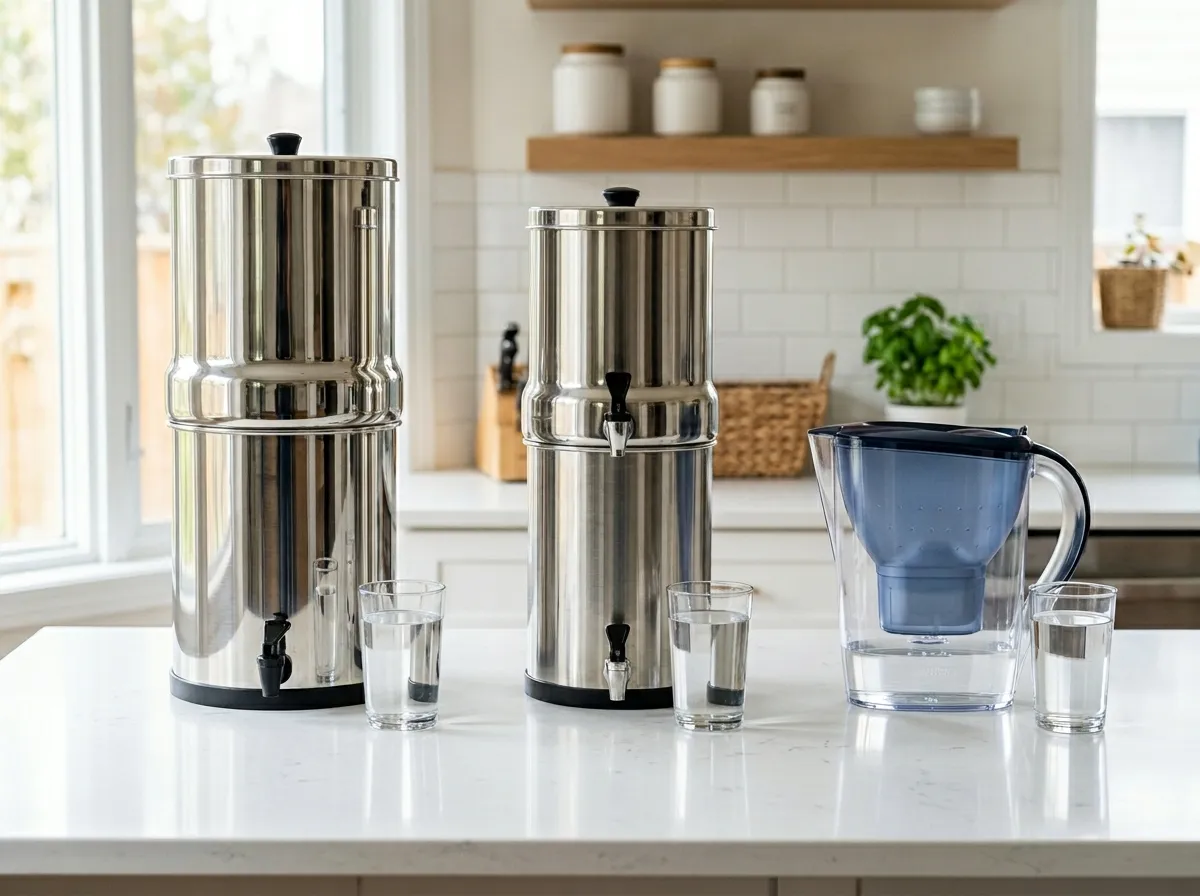
Standard pitcher filters like the classic Brita with a basic carbon granule filter remove chlorine taste and some sediment. They do almost nothing for PFAS. The same goes for most fridge filters, basic faucet attachments, and any pitcher filter not specifically tested and certified for PFAS removal.
According to NonToxicLab’s review of NSF certification records, the vast majority of pitcher-style filters sold on Amazon don’t carry NSF/ANSI 58 certification for PFAS removal. Many explicitly exclude PFAS from their contaminant removal claims in the fine print.
This matters because the pitcher filter market is huge, and most buyers assume they’re protected when they’re not. If you’ve been using a Brita or similar basic carbon pitcher and feeling safe about your water, check whether it’s actually certified for PFAS.
Which Filters Actually Remove PFAS?
Filters are not all equal when it comes to PFAS. The removal rate varies dramatically by technology:
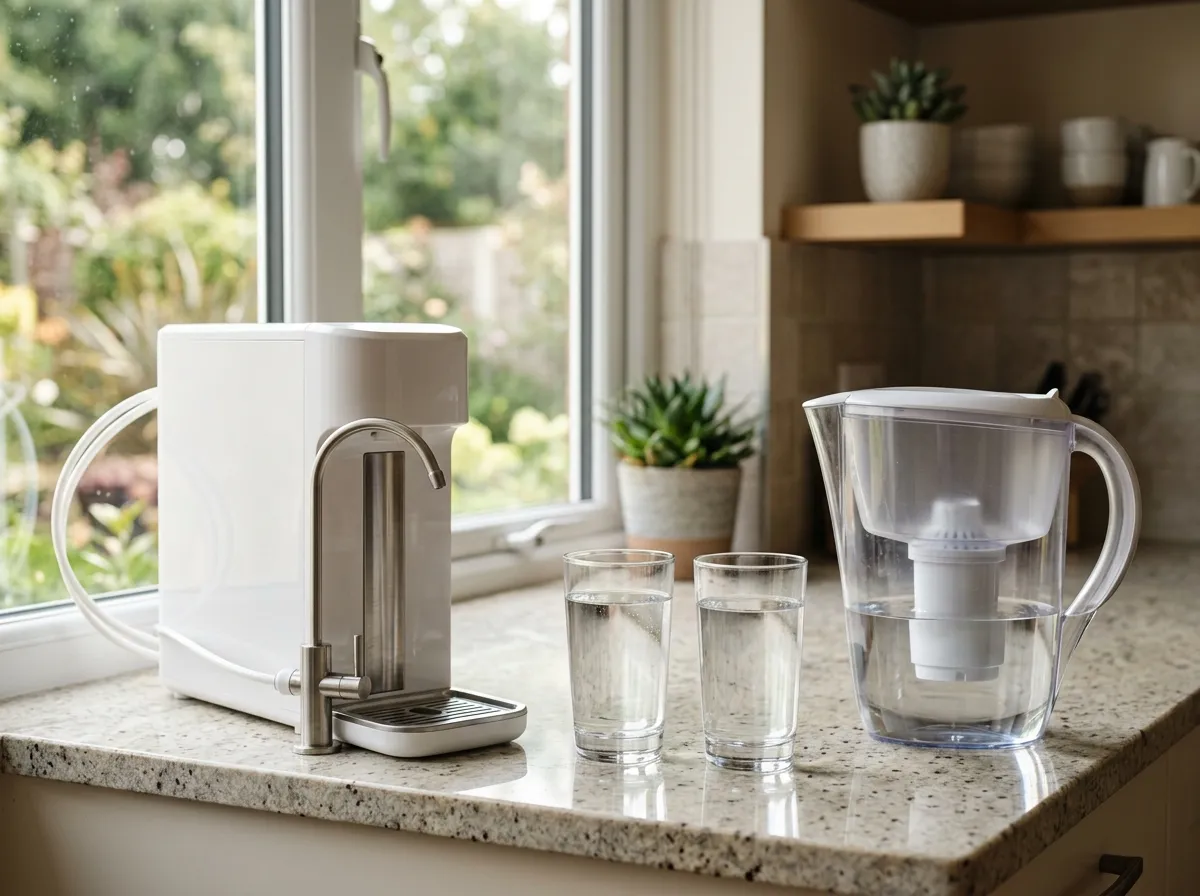
Reverse osmosis (RO): 90-99% PFAS removal. This is the most effective technology for PFAS. Water is forced through a semi-permeable membrane with pores small enough to block PFAS molecules. Under-sink RO systems and countertop RO units both work. Look for NSF/ANSI 58 certification specifically listing PFAS compounds.
Activated carbon block filters: 70-90% PFAS removal (for quality certified filters). This is what most pitcher filters use, but there’s a massive difference between a cheap granular carbon filter and a solid carbon block filter independently tested for PFAS. Clearly Filtered, for example, has NSF/ANSI 58 certification confirming PFAS removal above 99% for their specific filter design.
Granular activated carbon (GAC) pitchers (standard Brita style): Near 0% PFAS removal. The granules have too much space between them. PFAS molecules pass right through.
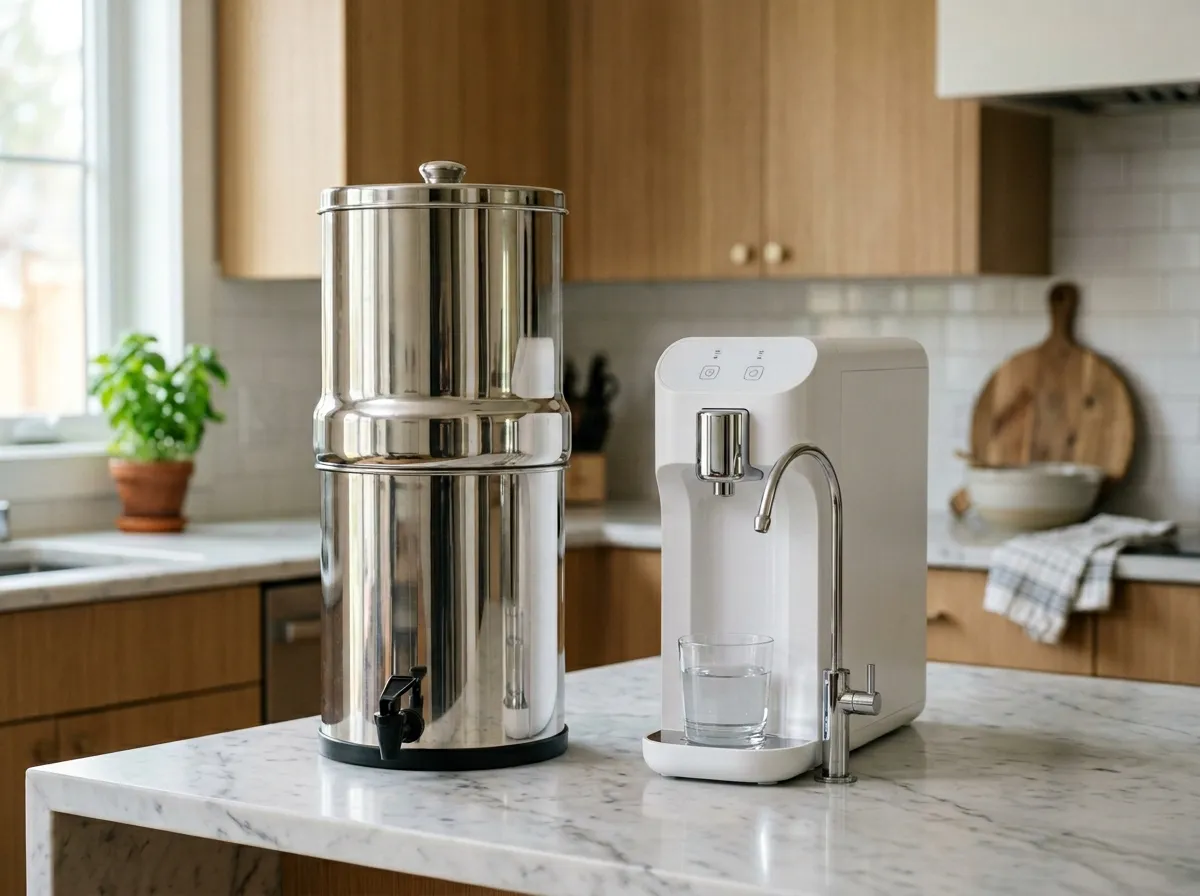
Gravity filters with specialized media (Berkey style): Variable but meaningful PFAS removal when using the correct filter elements. Black Berkey elements are designed to address PFAS along with a wide range of other contaminants.
Ion exchange filters (ZeroWater): The 5-stage ZeroWater design does remove measurable PFAS in independent testing, bringing total dissolved solids to zero. Not as thorough as RO but significantly better than basic carbon.
The bottom line: households on affected systems should consider a certified filter. Either a reverse osmosis system or a carbon filter that has been independently tested and certified for PFAS removal. NSF/ANSI 58 certification with PFAS listed in the scope is the standard to look for.
How Filter Types Compare
There’s no perfect filter. Every option involves real tradeoffs on cost, water waste, flow rate, and the breadth of what it removes.
| Option | Main concern | Primary tradeoff |
|---|---|---|
| Reverse osmosis (RO) | Can strip beneficial minerals along with contaminants; some users remineralize | Highest PFAS removal (90-99%) but 3:1 to 4:1 waste water ratio, slower flow, higher upfront cost ($$$) |
| Activated carbon block (certified) | Removal rate varies by specific block density and contact time | 70-99% PFAS removal for NSF 58 certified units; moderate cost ($$), faster flow, no waste water |
| Ion exchange (ZeroWater style) | Resin exhausts quickly in hard water; TDS meter needed to track | Measurable PFAS removal at low upfront cost ($); more frequent cartridge replacement |
| Granular activated carbon (standard Brita) | Near-zero PFAS removal; granule gaps let molecules pass | Cheap and fast, but not a PFAS solution. Good for chlorine taste only |
| Gravity (Black Berkey elements) | Independent PFAS testing is less extensive than for NSF-certified units | No electricity or plumbing, high volume, but slower throughput and higher filter element cost |
RO sits at the top for PFAS removal but loses on water efficiency and flow. A certified carbon block sits in a reasonable middle position if waste water or countertop space is a concern. If your priority is maximum removal, pick RO. If your priority is simplicity and cost, a certified carbon pitcher is the honest pick.
How Long Do These Filters Last?
Durability matters as much as removal rate, because a filter only works if you replace the cartridge on schedule. RO membranes typically last 2-3 years, with pre-filters and post-filters needing replacement every 6-12 months. Certified carbon block pitcher filters (like Clearly Filtered) last about 100 gallons or roughly 4 months for a two-person household. ZeroWater cartridges exhaust faster, often every 20-40 gallons depending on local TDS. Black Berkey elements are rated for thousands of gallons but cost more per unit. Build replacement cost into your decision, not just the purchase price.
Citation Capsule: Reverse osmosis filtration removes 90-99% of PFAS compounds from drinking water, while granular activated carbon pitcher filters (standard Brita style) remove almost none. NSF/ANSI 58 certification listing PFAS compounds in scope is the key marker to verify. (NSF International, ongoing)
The 5 Filters That Actually Work
All five of these appear in our Quick Picks above. Here’s more detail on what makes each one worth it.
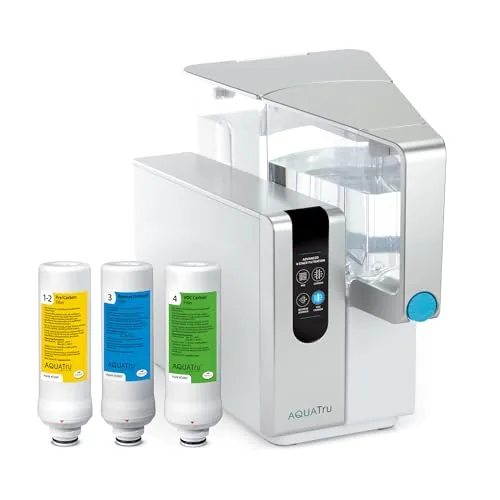
AquaTru Classic Countertop. This is the go-to recommendation for renters and anyone who can’t install an under-sink system. It’s NSF/ANSI 58 certified for 83 PFAS compounds including PFOA, PFOS, and GenX. The four-stage reverse osmosis process removes up to 99% of PFAS. It sits on your counter, connects to no plumbing, and has no ongoing installation costs. Filters need replacing every 6-12 months depending on usage. For $449-$499, it’s not cheap, but it’s significantly more cost-effective than buying bottled water long-term.
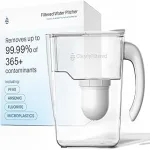
Clearly Filtered Water Pitcher. If you want a pitcher-style filter, this is the only one with independent NSF/ANSI 58 certification confirming PFAS removal above 99%. It removes 365+ contaminants and fits in any standard fridge door. At $90-$100 for the pitcher, it’s the most accessible certified option. Replacement filters cost about $50 each and last up to 100 gallons.
Berkey Water Filter. The Berkey is a gravity-fed stainless steel unit that requires no electricity and no plumbing. You pour water in the top, it filters through Black Berkey elements, and collects in the lower chamber. It removes PFAS along with bacteria, viruses, and heavy metals. Good for families who want high-volume filtered water at once, or anyone in a situation where electricity or installation isn’t reliable.
ZeroWater 10-Cup Pitcher. The best budget entry point. The 5-stage ion exchange system brings total dissolved solids to zero and removes measurable PFAS in independent testing. It’s not reverse osmosis-level removal, but it’s a significant step up from standard Brita at a fraction of the cost of a full RO system.
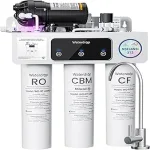
Waterdrop G3P800 Under-Sink RO. For homeowners willing to install, this tankless reverse osmosis system offers 800 gallons per day flow rate and removes PFAS, lead, chlorine, and 1,000+ other contaminants. It installs under the sink in about 30 minutes without a storage tank taking up cabinet space. At the premium tier ($$$), it’s the most cost-effective permanent solution for a household.
Beyond Drinking Water: Showering and Cooking
Drinking water gets most of the attention, but it’s not the only way PFAS enter your body from your tap.
Showering: Hot water opens your pores and creates steam, both of which increase absorption and inhalation of contaminants. Dermal absorption and inhalation of PFAS during showering likely contribute to body burden, though drinking contaminated water is still the primary exposure route for most people. Whole-house filtration is the solution here, but it’s an expensive commitment (typically $1,000-$4,000 installed). A more targeted approach is using a high-quality point-of-use filter for drinking and cooking, and considering a shower filter if you’re in a high-contamination area.
Cooking: When you cook pasta, rice, or vegetables in contaminated tap water, the PFAS concentrate as the water evaporates. The food absorbs them. This is a less-discussed exposure pathway, and it means that filtering the water you cook with matters, not just the water you drink.
If you’re using an under-sink RO or counter-top filter for drinking water, try to also use filtered water for cooking when possible, especially for boiled foods where water reduction concentrates contaminants.
What People Ask
How do I know if my tap water has PFAS?
Check EWG’s tap water database at ewg.org/tapwater. Enter your zip code to see detected contaminants in your local water utility. If you’re on a private well, order a PFAS-specific water test from a certified lab. “Looks clean” tells you nothing about PFAS, which are colorless, odorless, and tasteless.
Does a Brita filter remove PFAS?
Standard Brita pitchers with basic granular activated carbon filters remove almost no PFAS. The granule structure allows PFAS molecules to pass through with minimal contact time. You need either a reverse osmosis system or a pitcher specifically certified under NSF/ANSI 58 for PFAS removal, like the Clearly Filtered pitcher.
What PFAS limits did the EPA just remove?
The Trump EPA removed drinking water maximum contaminant levels for GenX (HFPO-DA), PFBS, PFNA, and PFHxS in early 2026. These were the “replacement PFAS” that manufacturers shifted to after PFOA and PFOS came under regulatory scrutiny. Limits for PFOA and PFOS remain, though compliance deadlines for all remaining PFAS standards were extended to 2031.
Which states have the worst PFAS water contamination?
Michigan, Pennsylvania, New Jersey, California, New York, and Illinois have documented among the highest levels of PFAS water contamination in the country, often linked to military bases, industrial sites, and airports where firefighting foam containing PFAS was used repeatedly for decades.
Is bottled water safer than tap water for PFAS?
Not necessarily. The FDA has far weaker testing requirements for bottled water than the EPA has for tap water. Some bottled water brands have been found to contain PFAS. Filtered tap water from a certified RO or carbon block system is generally a more reliable and far cheaper option than bottled water.
Can PFAS in water affect children more than adults?
Yes. Children are more vulnerable to PFAS exposure because their developing immune, endocrine, and neurological systems are more susceptible to disruption. Research links prenatal and early childhood PFAS exposure to immune suppression, developmental delays, and altered hormone function. If you have children or are pregnant, water filtration should be treated as urgent, not optional.
What We Don’t Fully Know
A few things are worth saying plainly. Long-term health effects at current environmental exposure levels remain uncertain, especially for the newer replacement PFAS like GenX and PFHxS where the human data is thinner than for PFOA and PFOS. Dose-response relationships at low parts-per-trillion levels aren’t fully established, and individual body burden varies with diet, water source, geography, and occupational exposure. Filter removal percentages in product marketing come from controlled lab conditions, real-world performance depends on your water chemistry, flow rate, and cartridge age. None of that cancels the case for filtering if your utility shows PFAS detections. It just means the right framing is “reduce a known exposure where you reasonably can,” not “your water is poisoning you.”
Our Take
The EPA’s rollback isn’t just a policy dispute. It’s a direct decision to leave 176 million people without federal protection for contaminants that have been linked to cancer, immune damage, and developmental harm. That’s the reality of where things stand right now, in April 2026.
You can’t fix federal regulatory decisions. But you can filter your water.
The shortest version of this article is: go to ewg.org/tapwater, look up your zip code, see what’s in your water, and then choose a filter that’s actually certified to remove it. If you’re not sure where to start, the AquaTru countertop RO and the Clearly Filtered pitcher are the two that have been independently tested with results that hold up to scrutiny.
Don’t count on the government to have resolved this by the time you finish reading. They just moved the deadline to 2031.
Sources
- Environmental Working Group. “PFAS Contamination in U.S. Tap Water.” ewg.org/tapwater. 2026.
- U.S. EPA. “Per- and Polyfluoroalkyl Substances (PFAS) in Drinking Water.” epa.gov/pfas. 2026.
- U.S. EPA. “PFAS National Primary Drinking Water Regulation.” epa.gov/sdwa. 2024/2026.
- Michigan State University. “New MSU Research Finds PFAS Impacts on Immune System.” canr.msu.edu. April 2026.
- National Cancer Institute. “Teflon and Perfluorooctanoic Acid (PFOA).” cancer.gov.
- NSF International. “NSF/ANSI 58: Reverse Osmosis Drinking Water Treatment Systems.” nsf.org.
- Zeldin, Lee. Comments to Semafor on EPA PFAS regulation rollback. April 2026.
You Might Also Like
- How to Reduce PFAS in Your Body
- State Chemical Bans Tracker
- Chlorine and Chloramine in Water: What’s Actually in Your Tap
- EPA’s 2026 Microplastics Rule (CCL 6) Explained: What’s Coming for Your Tap Water
- Microplastics in Drinking Water: What the Science Says (and How to Filter Them Out)
- Clearly Filtered vs ZeroWater: Budget Pitcher Comparison
- Water Filter Comparison Chart: PFAS, Lead, Fluoride, and Chlorine Removal Rates
- Best Water Filter Pitchers in 2026 (Tested for PFAS, Lead, and Chlorine)
- Berkey vs ProOne vs Clearly Filtered: Which Removes the Most PFAS?
- Is Tap Water Safe to Drink in the US? What Your City’s Water Report Tells You
- Best Non-Toxic Garden Hose 2026: Lead-Free, BPA-Free, Drink-Safe
- What Is 1,4-Dioxane? The Contaminant Hiding in ‘Gentle’ Products