Most conventional dental floss is coated in PTFE, a fluoropolymer in the PFAS class, to make it slide between teeth. Independent consumer testing detected fluorine on 26 of 39 floss samples [consumer testing], and one human-biomonitoring study found higher serum PFHxS in regular flossers [biomonitoring]. Causal periodontal harm in humans is not established. Switching to silk or polyester-with-wax floss eliminates the exposure route entirely.
If you flossed today with a PTFE-coated product, that is not a crisis. The dose from one flossing event is small relative to PFAS in drinking water, food packaging, and cookware. The case for switching is precautionary and the cost is roughly the price of one cup of coffee per spool.
What is PFAS, and why is it in dental floss?
PFAS, short for per- and polyfluoroalkyl substances, is a class of more than 14,000 synthetic chemicals built around a chain of carbon atoms bonded to fluorine. The carbon-fluorine bond is one of the strongest in organic chemistry, which is why these molecules do not break down in the environment or in the human body. The U.S. Environmental Protection Agency, the European Chemicals Agency, and the OECD all classify the fluoropolymer family, including polytetrafluoroethylene (PTFE, brand-known as Teflon), within the PFAS group.
PTFE shows up in dental floss for the same reason it shows up on a non-stick pan: it slides. A floss strand coated in PTFE glides through tight contact points without shredding or snagging on rough fillings. Brands like Oral-B Glide and several private-label “shred-resistant” floss products use this property as their main selling point.
For background on the broader chemical class, see our complete PFAS guide.
Which dental floss brands have tested positive for PFAS?
Two independent investigations have published brand-level data:
The 2020 Mamavation investigation tested 39 floss samples for total fluorine, a screening proxy for PFAS content. 26 of 39 samples returned detectable fluorine. The samples that tested highest included Oral-B Glide Pro-Health Original Floss and several store-brand “glide-style” products that explicitly use PTFE in their coating.
The 2019 Silent Spring Institute biomonitoring study (Boronow et al., Journal of Exposure Science and Environmental Epidemiology) measured serum PFAS levels in 178 women and asked about consumer-product use. Women who reported using Oral-B Glide had statistically higher serum perfluorohexane sulfonate (PFHxS) than non-flossers and non-Glide flossers, after adjusting for other PFAS exposure routes.
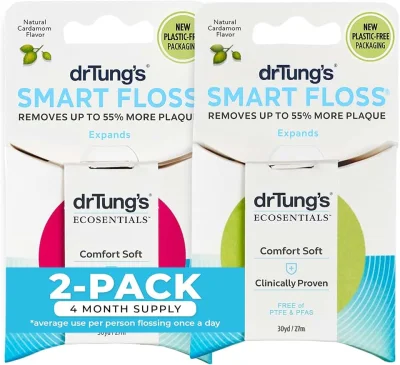
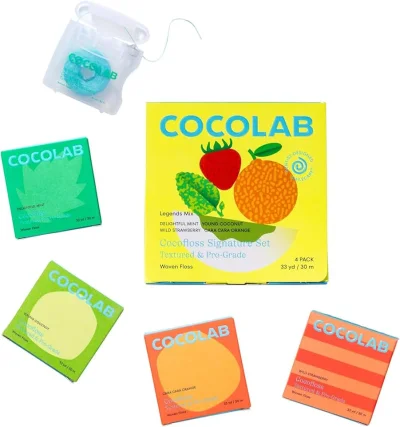
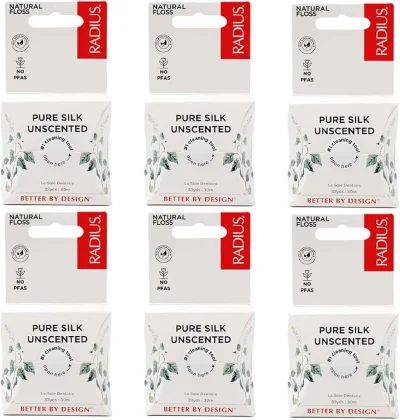
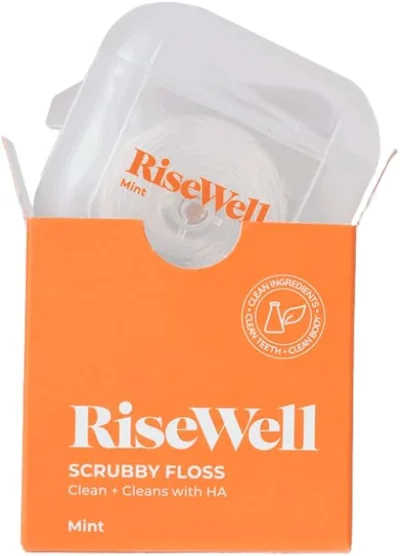
Brands that have publicly stated their floss is PTFE-free include Dr. Tung’s Smart Floss, Cocofloss, RADIUS Organic Silk Floss, and Risewell Natural Floss. Each of these brands publishes ingredient or material disclosures that name the strand fiber and the wax coating, and none of them lists fluoropolymer compounds.
Is PFAS-treated floss actually absorbed through the gums?
This is where the evidence is most fragmentary, and it matters for getting the framing right.
Animal and in-vitro studies show that PFAS compounds can be taken up by oral and gastrointestinal tissue [animal study] [in vitro]. Cell-line cytotoxicity work across multiple PFAS compounds, including PFOS and PFOA, has documented effects on human cell viability at sub-micromolar concentrations [in vitro]. The mechanism is plausible: oral mucosa absorbs lipophilic compounds, and PFAS molecules behave somewhat like surfactants in solution.
The human evidence is one biomonitoring association: Boronow’s serum-PFHxS finding in 2019 [biomonitoring]. Biomonitoring associations are correlations, not proof of causation. The study controlled for water source, food packaging, and several other PFAS routes, but residual confounding from cookware and stain-treated furniture is possible.
What we can say honestly: there is a plausible mechanism, an in-vitro toxicity signal, and one suggestive human correlation. There is no controlled human trial measuring serum-PFAS change after switching from PTFE to PFAS-free floss. If you want certainty before swapping, the literature does not yet provide it.
What does the science actually show?
What the human studies say
The 178-woman cohort in Boronow 2019 [biomonitoring] is the only published human study connecting floss use to a serum PFAS biomarker. The effect size was modest. The study population was specifically women, primarily middle-class, recruited from California and the New York City area. Whether the same correlation holds in men, in different income groups, or in different geographies has not been published.
The U.S. Centers for Disease Control’s National Health and Nutrition Examination Survey (NHANES) detects PFAS in roughly 97% of Americans tested [biomonitoring]. Drinking water and food packaging dominate the exposure budget for most people. Floss is one of many minor routes.
What the animal and in-vitro studies say
The mechanistic case for concern rests on cell and animal data showing PFAS can disrupt thyroid signaling, suppress immune response to vaccines, and alter lipid metabolism [animal study] [in vitro]. These effects have been replicated across multiple PFAS compounds and multiple cell lines. The doses required to produce them in animals are substantially higher than typical human exposure on a body-weight basis, but PFAS bioaccumulate, so chronic low-dose exposure is the relevant scenario for humans.
For the immune-suppression evidence, Philippe Grandjean’s group at Harvard Chan School has published the most-cited cohort work, focused on antibody response to childhood vaccines in PFAS-exposed children [human cohort].
How big is the exposure compared to other PFAS sources?
If you are concerned about PFAS, dental floss is not the swap with the largest exposure reduction. In rough order of typical exposure contribution for a U.S. adult:
- Drinking water (especially private well water in PFAS-affected regions)
- Food packaging and fast-food wrappers
- Non-stick cookware (when overheated or scratched)
- Carpet, upholstery, and stain-treated fabrics
- Cosmetics, especially waterproof mascara and long-wear foundation
- Dental floss
A high-quality water filter certified to NSF/ANSI 53 or P473 will reduce PFAS in your drinking water by 80 to 99 percent. See our roundup of water filters certified for PFAS removal.
That said, switching floss is the cheapest and easiest move on this list. A spool of PFAS-free floss costs under ten dollars and lasts about three months. There is no installation, no countertop space requirement, and no ongoing filter replacement.
Tradeoffs: PTFE-coated vs wax-coated vs silk floss
| Type | Strand material | Coating | PFAS-free | Texture | Compostable | Common cost |
|---|---|---|---|---|---|---|
| Dr. Tung’s Smart Floss | Polyester | Plant-based wax | Yes | Stretches into gap | Box only | $ |
| Cocofloss Original | Polyester | Coconut oil + wax | Yes (brand-confirmed) | Textured ribbon | No | $$ |
| RADIUS Organic Silk | Mulberry silk | Candelilla wax | Yes (USDA organic) | Thin, glides easy | Yes (full) | $$ |
| Risewell Natural | Mulberry silk | Candelilla wax + peppermint | Yes (brand-confirmed) | Soft, sensitive-gum friendly | Strand only | $$$ |
| Oral-B Glide (reference, not recommended) | Nylon | PTFE | No (PTFE confirmed) | Slick glide | No | $ |
The PTFE row is included so the comparison is honest. We do not recommend Oral-B Glide for readers concerned about PFAS exposure, but we do not pretend it does not exist.
What we don’t know yet
The evidence chain has gaps that honest reporting requires us to name.
First, no published human randomized controlled trial compares PTFE-coated and PFAS-free floss for measurable periodontal or systemic-PFAS outcomes. The Boronow biomonitoring association is suggestive, not causal.
Second, gingival absorption kinetics for fluoropolymer particles released during flossing are not characterized. We know fluorine is detected on the strand, and we know oral mucosa absorbs lipophiles, but the dose actually entering circulation from a single flossing event has not been quantified.
Third, dose attribution is unresolved. A flossing adult is also drinking water with trace PFAS, eating from PFAS food packaging, and possibly cooking in PFAS-coated pans. No study has partitioned floss’s contribution to total body burden.
We recommend swapping anyway because the marginal cost is small and the precautionary case is reasonable. We will not claim that floss switching alone meaningfully lowers serum PFAS in someone whose other exposure routes remain open.
The PFAS-free alternatives we recommend
All four of the picks below have been verified on Amazon at the time of writing for star rating, review count, and availability.
Dr. Tung’s Smart Floss
A polyester strand coated in plant-based wax. The brand has been in production since the 1990s and was an early target of the Mamavation investigation as an example of a floss without PTFE. Comes in a small cardboard box (no plastic outer container), which is unusual for the category. The cardamom flavor is polarizing; the unflavored version exists if you prefer.
Cocofloss Original
Polyester floss with a coconut-oil and natural-wax coating, woven into a textured ribbon rather than a smooth strand. The texture scrubs plaque better than thin floss for most users, especially around dental work. The brand has confirmed in published Q&A that the coating contains no PTFE or other fluoropolymers.
RADIUS Organic Silk Floss
Mulberry silk strand with candelilla wax, sold in a small refillable glass jar. The strand is fully biodegradable; the jar refills cost less than a new jar. USDA-certified organic. Silk is animal-derived, so this option is not vegan.
Risewell Natural Floss
Silk floss with candelilla wax and peppermint oil, founded by a dentist with a focus on hydroxyapatite-based oral care. The texture is soft and works well for users with sensitive gums. The brand publishes a complete ingredient list and confirms no PTFE in the coating. Premium-tier price, but a single spool lasts about as long as the cheaper options.
Where is PFAS in floss already banned?
State-level regulation is moving faster than federal action.
Maine’s intentionally-added-PFAS ban under 38 MRSA section 1614 took effect January 1, 2026. The ban includes dental floss, and Maine’s Department of Environmental Protection has published a product category list confirming the inclusion.
Minnesota’s Amara’s Law banned intentionally-added PFAS in eleven product categories effective January 1, 2025. Dental floss is included.
The European Union has a REACH restriction proposal under review that would broadly restrict PFAS in consumer goods including oral care products. Implementation is pending and may take effect 2026 to 2027 depending on the final rule text.
There is no U.S. federal ban on PFAS in dental floss. The Food and Drug Administration does not regulate dental floss as a medical device unless the manufacturer makes specific health claims. For the broader regulatory picture, see our overview of EU bans on chemicals still legal in the U.S. and the Maine 2026 PFAS ban explainer.
Frequently asked questions
Is unwaxed floss automatically PFAS-free?
Usually, but not guaranteed. Unwaxed nylon floss skips the PTFE coating that gives waxed floss its glide. A few “shred-resistant” unwaxed brands still apply a fluoropolymer surface treatment to reduce friction. Read the product page or contact the brand if it is not stated explicitly.
Is PTFE the same as PFAS?
PTFE (polytetrafluoroethylene, brand-known as Teflon) is a fluoropolymer that the EPA, OECD, and most regulators classify within the PFAS family. “PTFE-free” is a useful claim but narrower than “PFAS-free,” because some fluoropolymers other than PTFE could in principle be used. For floss, the practical difference is small; PTFE is the dominant fluoropolymer in the category.
Does PFAS in floss actually get into your body?
Animal and in-vitro studies show oral-tissue uptake of PFAS compounds [animal study] [in vitro]. One human biomonitoring study correlates regular Glide flossing with higher serum PFHxS [biomonitoring]. The exact dose contribution from floss alone has not been quantified in a controlled human study.
What dental floss do dentists recommend that’s PFAS-free?
Silk floss with candelilla wax (RADIUS, Risewell) is the most commonly recommended PTFE-free option among dentists who follow the PFAS literature. Polyester floss with natural wax (Dr. Tung’s, Cocofloss) is the synthetic-but-PFAS-free equivalent and tends to cost less.
Has any state banned PFAS in dental floss?
Yes. Maine’s ban took effect January 1, 2026 and explicitly includes floss. Minnesota’s Amara’s Law banned intentionally-added PFAS in floss January 1, 2025. The European Union has a REACH restriction proposal pending that would cover floss as part of a broader consumer-product restriction.
You Might Also Like
- PFAS Exposure: Complete Guide to Forever Chemicals in Your Life
- How to Reduce PFAS in Your Body (What Research Shows)
- Minnesota PFAS Disclosure Law 2026: What Manufacturers Must Report (and What Categories Will Disappear)
- Is HexClad Non-Toxic? (The Gordon Ramsay Pan Investigated)
- PFAS-Free Brands: Every Company That Has Eliminated Forever Chemicals (2026)
- Non-Toxic Alternatives to Teflon Pans (That Actually Perform)
- Is the Our Place Always Pan Non-Toxic? (Coating and Claims Checked)
- New Study: PFAS in Your Blood Could Have Weakened Your COVID Immunity by 40%
Sources
- Boronow KE, Brody JG, Schaider LA, Peaslee GF, Havas L, Cohn BA. (2019). Serum concentrations of PFASs and exposure-related behaviors in African American and non-Hispanic white women. Journal of Exposure Science and Environmental Epidemiology. PubMed 30622332
- Silent Spring Institute. Dental flossing and other behaviors linked with higher PFAS levels in the body. Silent Spring research summary
- Mamavation Dental Floss PFAS Investigation (2020). Mamavation report
- Maine Department of Environmental Protection. Products Containing Intentionally Added PFAS. Maine DEP
- Minnesota Pollution Control Agency. 2025 PFAS prohibitions under Amara’s Law. Minnesota PCA
- U.S. Environmental Protection Agency. PFAS Strategic Roadmap. EPA PFAS Roadmap
We name floss brands tested positive only because peer-reviewed studies and consumer-protection investigations have published those names. We do not publish negative brand reviews of our own. See our editorial policy for the full stance.