In October 2022, researchers at the National Institute of Environmental Health Sciences published a paper in the Journal of the National Cancer Institute [human epidemiological] that triggered one of the largest product liability waves in cosmetics history.
The study followed 33,497 American women over an average of 10.9 years. Chang et al. (2022) [human epidemiological] found that women who used chemical hair straightening products more than four times in the prior 12 months had a hazard ratio of 2.55 for incident uterine cancer compared to women who never used them. That is an association, not proof that any one product caused any one case.
The paper, published by Che-Jung Chang and colleagues at NIEHS, did not name specific brands. It looked at the category of chemical relaxers and straighteners as a group. The finding hit a population that uses these products at much higher rates than the general public: Black women in the US, who according to the same researchers also tend to use them at younger ages and over longer periods.
By 2026, thousands of plaintiffs have filed lawsuits against hair relaxer manufacturers. The litigation is ongoing. The science continues to develop.
Here’s what the research actually shows, what’s still uncertain, and what safer hair care looks like.
What the NIH Sister Study Found
The Sister Study is one of the largest ongoing women’s health cohorts in the United States. Started by NIEHS in 2003, it enrolled 50,884 women aged 35 to 74 who had a sister diagnosed with breast cancer (the cohort design lets researchers study factors that may contribute to female cancers).
In the 2022 paper, Chang and colleagues looked at:
- Sample: 33,497 women followed for an average of 10.9 years.
- Outcome: Diagnosis of incident uterine cancer (378 cases observed).
- Exposure assessment: Self-reported use of various hair products in the 12 months before enrollment, including hair dyes, relaxers, pressing products, and perms.
The headline finding [human epidemiological]: Frequent use of chemical hair straightening products (defined as more than four times in the prior 12 months) was associated with a hazard ratio of 2.55 (95% confidence interval 1.46 to 4.45) for uterine cancer compared to never-users. In absolute terms, the paper estimated about 4.05% cumulative incidence by age 70 for frequent users versus 1.64% for never-users. An elevated risk, not an inevitability.
The paper estimated that “ever-use” of straighteners (any use) was associated with about a 1.5-fold higher risk. Frequency mattered: more frequent use, higher observed risk. The dose-response pattern is one of the Bradford Hill criteria that makes an association more credible, though still not proof of causation.
The researchers controlled for age, race, body mass index, family history, hormone use, smoking, and several other potential confounders. The association remained statistically significant. Observational cohorts cannot rule out every unmeasured confounder, and the authors noted this openly.
A 2024 follow-up paper by Joanne Kim and colleagues [human epidemiological] in the same cohort looked at the dose-response relationship and uterine fibroids as a related outcome.
What the Study Did NOT Show
This is important for understanding what the science actually proves and what it doesn’t.
- The study did not prove causation. Observational cohorts [human epidemiological] demonstrate association, not causation. They cannot rule out every unmeasured confounder. The hazard ratio of 2.55 is meaningful, but it isn’t proof that any specific product caused any specific cancer.
- The study did not name specific brands or formulations. It looked at “chemical hair straighteners” as a category. The researchers explicitly noted that they could not identify which specific ingredients or products drove the observed association.
- The study did not include men or non-binary people. The Sister Study cohort is exclusively women. The 2022 paper’s findings apply to women and people with a uterus.
- The study could not separate brand-level effects. Researchers asked about general product types, not specific brand names. Some formulations may carry higher risk; others may not. The category-level association doesn’t tell us which.
Hazard Versus Real-World Risk
Hazard is the intrinsic property of a chemical. Risk is what exposure actually looks like when someone uses a product. The two are often confused, and the distinction matters here.
Formaldehyde is a Group 1 human carcinogen per the IARC monograph on formaldehyde [regulatory review]. That’s the hazard. Phthalates disrupt endocrine function in animal studies and several human cohorts [human epidemiological, animal study]. That’s also a hazard.
What the hazard label doesn’t tell you is how much of the chemical you’re actually absorbing when you use a product twice a year versus twice a month. Formaldehyde exposure from a relaxer applied under salon ventilation conditions, on an occasional basis, is a different exposure picture from daily occupational contact. That’s why the study observed association at the category level but cannot tell a reader which individual product carries which level of risk.
Why the Findings Matter
The 2022 paper has been widely cited because:
- The cohort is large and well-characterized. The Sister Study is among the most rigorous prospective studies of environmental exposures in women’s health.
- The dose-response relationship is consistent. More frequent use, higher observed risk. This is one of the Bradford Hill criteria that makes a chemical-disease association more credible, though not conclusive.
- The biological plausibility is reasonable. Chemical hair straighteners often contain or release formaldehyde (a Group 1 human carcinogen per IARC) and may contain parabens, phthalates, bisphenol A, and metals [mechanism proposed]. Several of these are documented endocrine disruptors in animal and human studies.
- The exposure is concentrated in a specific population. Black women in the US use hair straightening products at much higher rates than the general population, often starting in childhood, which raises specific public health concerns about cumulative exposure.
Dr. Leonardo Trasande, the NYU Langone pediatrician who has published on phthalates and endocrine-disrupting chemicals, has argued that the cumulative effect of low-dose exposure to multiple endocrine disruptors in everyday products is more important than any single ingredient. Hair relaxers and straighteners frequently contain several such compounds in the same formulation.
Dr. Philip Landrigan, the pediatrician and epidemiologist who directs the Program for Global Public Health at Boston College, has written on the precautionary principle in chemical policy. When a category of products has biologically plausible mechanisms of harm and observational evidence of association, reducing exposure is a reasonable personal precaution even while causal evidence is still developing.
According to NonToxicLab’s review of the Sister Study findings and the broader literature, the strongest signal isn’t from any single ingredient. It’s from the cumulative exposure pattern that frequent users experience over years.
What Chemicals Are in Chemical Relaxers
Chemical hair straighteners and relaxers come in several formulations. The most common active ingredients include:
- Sodium hydroxide (lye) in traditional relaxers. Strongly alkaline, breaks the disulfide bonds in hair keratin.
- Calcium hydroxide and guanidine carbonate in “no-lye” relaxers.
- Formaldehyde and formaldehyde-releasing chemicals in keratin smoothing treatments. The FDA proposed banning formaldehyde in hair smoothing products in 2024 with a final rule expected in 2026.
- Methylene glycol and related formaldehyde precursors.
In addition to active ingredients, formulations often contain:
- Parabens as preservatives. Endocrine disruptors with estrogenic activity.
- Phthalates in fragrance components. Documented endocrine disruptors associated with reproductive harm.
- Bisphenols sometimes used as preservatives or in plastic packaging that contacts the product.
- PFAS in some long-wear or water-resistant formulations (now restricted in several states).
- Heavy metals as contaminants in lower-quality formulations.
For more on these chemical classes, see what are phthalates and what are parabens.
The FDA Formaldehyde Rule
In November 2023, the FDA announced its intent to issue a proposed rule banning the use of formaldehyde and formaldehyde-releasing chemicals in hair smoothing and straightening products. A formal proposed rule was published in 2024, with a final rule expected in 2026.
If finalized as proposed, the rule would prohibit the marketing of hair smoothing products containing formaldehyde or its precursors. Salon-applied keratin smoothing treatments would be the most directly affected category.
This matters because formaldehyde is the ingredient with the clearest carcinogenicity evidence in the hair smoothing category. The IARC (International Agency for Research on Cancer) classifies formaldehyde as a Group 1 carcinogen (carcinogenic to humans).
What Safer Hair Care Looks Like
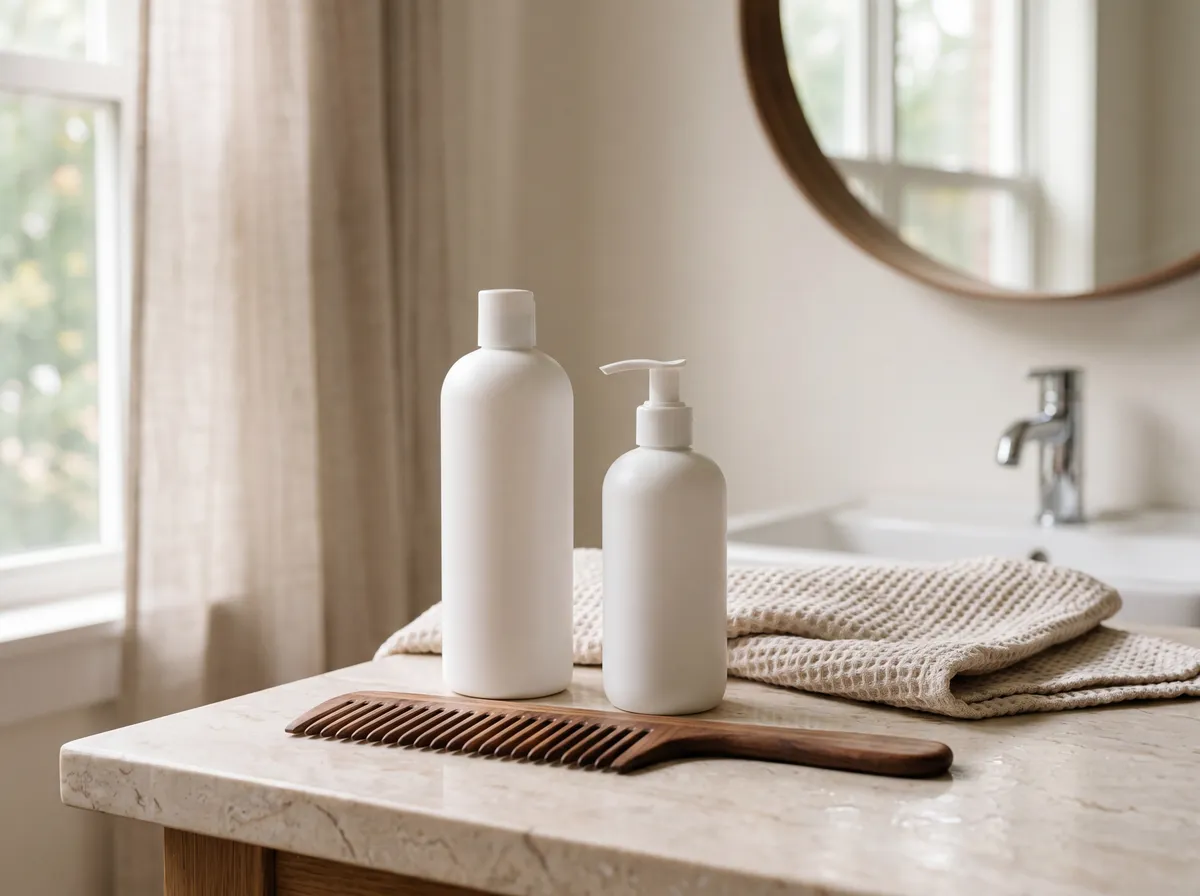
For people who currently use chemical relaxers or straighteners, the safer approach varies depending on hair type, goals, and preferences. Several categories of products avoid the most concerning ingredients while still offering manageability and styling flexibility.
Curl-Embracing Care
Products designed for curl care work with natural texture rather than chemically altering it. The clean ingredient brands in this category have grown substantially in the last five years.
- Adwoa Beauty Baomint Moisturizing Curl Defining Cream - clean ingredients, founder-owned.
- Pattern Beauty Hydration Shampoo - clean ingredient list.
- Mielle Organics Babassu & Mint Deep Conditioner - widely tested by curl community.
- Aunt Jackie’s Curls & Coils - sulfate-free curl care.
- As I Am Coconut CoWash - cleansing conditioner.
Smoothing Without Formaldehyde
For people who want some smoothing without the chemistry of traditional relaxers or formaldehyde-based keratin treatments:
- Innersense Hair Love Prep Spray - heat protectant, clean ingredients.
- Briogeo Farewell Frizz Smoothing Shampoo - clean formula, no formaldehyde.
- Olaplex No. 7 Bonding Oil - bond-repair without straightening chemistry.
Heat Tools as an Alternative
Mechanical straightening with heat tools (flat irons, blowouts) avoids the chemistry of relaxers entirely. Heat damage is a different concern, but it’s a more controllable and reversible category of hair stress than chemical structural change.
- GHD Platinum+ Styler - even heat distribution reduces damage.
- Dyson Airstrait Straightener - air-based straightening, no metal plates.
Ingredient Audit Tools
For checking specific products against a concerning-ingredient database:
- The Environmental Working Group’s Skin Deep database rates personal care products by ingredient hazard score.
- The Yuka app scans product barcodes and shows ingredient assessments.
For our broader personal care recommendations, see non-toxic personal care routine and non-toxic personal care complete guide.
What If You’ve Been a Frequent User
The Sister Study findings raise legitimate concerns for people who have used chemical hair straighteners frequently over years. The practical guidance from the broader medical literature:
- Talk to your doctor. Mention your hair product history during routine gynecological visits. Awareness of risk factors helps your provider tailor screening.
- Know the symptoms of uterine cancer. Abnormal uterine bleeding (especially after menopause), pelvic pain, unusual discharge, or unexplained weight loss should be evaluated.
- Keep the absolute numbers in view. A hazard ratio of 2.55 sounds dramatic, but the absolute cumulative incidence in the Sister Study was 4.05% by age 70 for frequent users versus 1.64% for never-users. That’s an elevated risk, not an inevitability.
- Consider reducing future exposure. For people using relaxers frequently, especially pre-menopausal women with other uterine cancer risk factors, reducing frequency or switching to formulations without formaldehyde releasers and phthalates is a reasonable personal precaution.
The American College of Obstetricians and Gynecologists has issued guidance on environmental factors and uterine health that addresses some of these concerns.
Who Is Suing Whom
Following the 2022 NIH publication, plaintiffs began filing lawsuits against multiple hair relaxer manufacturers. By 2024, the cases had been consolidated into a federal multidistrict litigation (MDL 3060) in the Northern District of Illinois. As of 2026, more than 9,000 cases have been filed in the MDL. The litigation is ongoing.
This article does not take a position on the litigation. The cases are working through the discovery and pretrial process, and outcomes will depend on evidence specific to individual products, manufacturer knowledge of risks, and individual plaintiff exposure histories. Plaintiffs and defendants have made competing arguments about the strength of the underlying science.
What is fact: the Sister Study findings are real, the dose-response relationship is documented, and the biological plausibility is supported by the chemistry of the products in question. What individual lawsuits will or won’t prove is being litigated.
What We Don’t Fully Know
Calibration matters here. Several important questions remain open.
- Which specific ingredients drive the association. The Sister Study measured product-category use, not ingredient-level exposure. Formaldehyde releasers, phthalates, parabens, and metals are all plausible candidates [mechanism proposed], but the data cannot single out which compound or combination is responsible.
- Whether recent formulation changes reduce the risk. Many brands have reformulated since 2015 to reduce or remove parabens, phthalates, and formaldehyde donors. The Sister Study exposure window largely predates those changes. Long-term data on reformulated products is limited.
- Replication in more diverse populations. The 2022 paper drew from a cohort of women with a sister who had breast cancer. Replication in other cohorts (including cohorts with more Black, Hispanic, and international participants) is still developing.
- The dose-response curve below the “frequent use” threshold. More than four uses per year was the threshold for the strongest signal. What risk, if any, one or two annual uses carry is not well-characterized.
- Individual susceptibility. Genetic, hormonal, and co-exposure factors may modify risk. These subgroup effects have not yet been mapped in detail.
Evidence is strongest at the category level and in frequent users. It is weakest at the ingredient level and for occasional use. Honest reading of the data holds both facts at once.
Final Verdict
The NIH Sister Study [human epidemiological] found a statistically significant association between frequent chemical hair straightener use and uterine cancer, with a hazard ratio of 2.55 for women who used these products more than four times per year. The absolute risk increase (from 1.64% to 4.05% cumulative incidence by age 70) is real but not a certainty. The mechanism is biologically plausible given the formaldehyde, phthalate, and paraben content in many formulations. Causation has not been proven and specific brands have not been implicated.
If you’ve been a frequent user of chemical hair straighteners, talk to your gynecologist about your product history and any screening considerations. If you’re considering whether to start, the current evidence supports caution for frequent or prolonged use. Safer hair care options exist in nearly every category, and the curl-embracing product market has grown substantially.
The FDA’s proposed formaldehyde rule, expected to be finalized in 2026, would remove formaldehyde and formaldehyde-releasing chemicals from the hair smoothing category. State PFAS bans (covered in our PFAS state ban tracker) are removing another concerning class.
For the broader picture of what’s in everyday personal care products, see our non-toxic personal care complete guide.
Frequently Asked Questions
Do hair relaxers cause uterine cancer?
The honest answer is that the 2022 NIH Sister Study [human epidemiological] found frequent chemical hair straightener use is associated with elevated uterine cancer risk (hazard ratio 2.55 for users of more than 4 times per year). That is an observational association, not proven causation. No regulatory body has declared a formal causal link, and the specific ingredient driving the association has not been confirmed.
Which hair relaxer brands are safe?
The Sister Study did not name specific brands. The category-level finding applies to chemical hair straighteners that contain formaldehyde, formaldehyde-releasing chemicals, or other endocrine-disrupting ingredients. For curl-embracing alternatives, brands like Adwoa Beauty, Pattern Beauty, Mielle Organics, Aunt Jackie’s, and As I Am have clean ingredient lists.
What’s the FDA doing about formaldehyde in hair products?
The FDA proposed a rule in 2024 to prohibit formaldehyde and formaldehyde-releasing chemicals in hair smoothing and straightening products. A final rule is expected in 2026. Once finalized, salon-applied keratin smoothing treatments containing these ingredients would no longer be legally marketed in the US.
How much higher is the risk for frequent users?
In the Sister Study [human epidemiological], frequent users (more than 4 times in the prior 12 months) had a hazard ratio of 2.55 for uterine cancer compared to never-users. In absolute terms, cumulative incidence by age 70 was 4.05% for frequent users versus 1.64% for never-users. Elevated risk, not certainty.
I’ve used relaxers for years. What should I do now?
Talk to your gynecologist about your hair product history during routine visits. Know the symptoms of uterine cancer (especially abnormal bleeding) and seek evaluation if they appear. Consider reducing frequency or switching to safer alternatives going forward.
Are “natural” or “organic” hair relaxers safer?
Some are, some aren’t. The labels “natural” and “organic” are not regulated for hair care in the US. Read ingredient lists. Avoid formaldehyde, formaldehyde-releasing preservatives (DMDM hydantoin, quaternium-15, imidazolidinyl urea), parabens, phthalates, and undisclosed fragrance. The EWG Skin Deep database is a useful screening tool.
You Might Also Like
- Bryan Johnson Just Admitted His Backyard Had Toxic Artificial Turf (Here’s What’s Actually in It)
- Microplastics in the Human Brain: What 2026 Studies Show (and How They Get There)
- Microplastics and Male Fertility: What 2026 Research Says About Sperm Count and Plastic Exposure
- Are Scented Candles Toxic? What the Air Quality Studies Show
- Do Stanley Tumblers Have Lead? Where the Lead Actually Is (and Why Independent Tests Show No Exposure)
Sources
- Chang CJ, O’Brien KM, Keil AP, et al. “Use of Straighteners and Other Hair Products and Incident Uterine Cancer.” Journal of the National Cancer Institute. 2022;114(12):1636-1645. https://academic.oup.com/jnci/article/114/12/1636/6759686
- Eberle CE, Sandler DP, Taylor KW, White AJ. “Hair dye and chemical straightener use and breast cancer risk in a large US population of black and white women.” International Journal of Cancer. 2020;147(2):383-391. https://onlinelibrary.wiley.com/doi/10.1002/ijc.32738
- US Food and Drug Administration. “Hair Smoothing Products That Release Formaldehyde When Heated.” https://www.fda.gov/cosmetics/cosmetic-products/hair-smoothing-products-release-formaldehyde-when-heated
- International Agency for Research on Cancer. “IARC Monographs on the Identification of Carcinogenic Hazards to Humans, Volume 100F: Formaldehyde.” https://publications.iarc.who.int/Book-And-Report-Series/Iarc-Monographs-On-The-Identification-Of-Carcinogenic-Hazards-To-Humans/Chemical-Agents-And-Related-Occupations-2012
- National Institute of Environmental Health Sciences. “Sister Study Background.” https://sisterstudy.niehs.nih.gov/English/index1.htm
- Environmental Working Group. “EWG’s Skin Deep Cosmetics Database.” https://www.ewg.org/skindeep/
- Trasande L, Zoeller RT, Hass U, et al. “Estimating burden and disease costs of exposure to endocrine-disrupting chemicals in the European Union.” Journal of Clinical Endocrinology & Metabolism. 2015;100:1245-1255. https://academic.oup.com/jcem/article/100/4/1245/2814822
This information is for educational purposes only and is not medical advice. If you are concerned about uterine cancer risk or have a personal history of frequent hair relaxer use, consult your gynecologist or healthcare provider.