The April 2026 EPA announcement about microplastics in drinking water sent everyone scrambling for a checklist. Most of the lists circulating online are either too vague to act on or too extreme to follow. After spending the last six months tracking the research, here’s what actually moves the needle, ranked by impact.
These nine habits are ordered by how much exposure each one reduces, based on the size of the documented entry route (water, food, air, dust). Start at the top.
At-a-Glance: The 9 Habits Ranked
| Rank | Habit | Cost to Start | Impact Level |
|---|---|---|---|
| 1 | Filter your drinking water with RO or carbon block | $$ | Very High |
| 2 | Quit bottled water | Free + bottle ($) | Very High |
| 3 | Replace plastic food storage with glass | $ | High |
| 4 | Stop microwaving food in plastic | Free | High |
| 5 | Replace nonstick cookware with stainless or cast iron | $ | High |
| 6 | Switch to natural-fiber clothing and bedding | Variable | Medium |
| 7 | Vacuum with a HEPA-filter vacuum | $$ | Medium |
| 8 | Run a HEPA air purifier in main rooms | $$ | Medium |
| 9 | Cut back on ultra-processed packaged food | Free (saves money) | Medium |
Why These Nine?
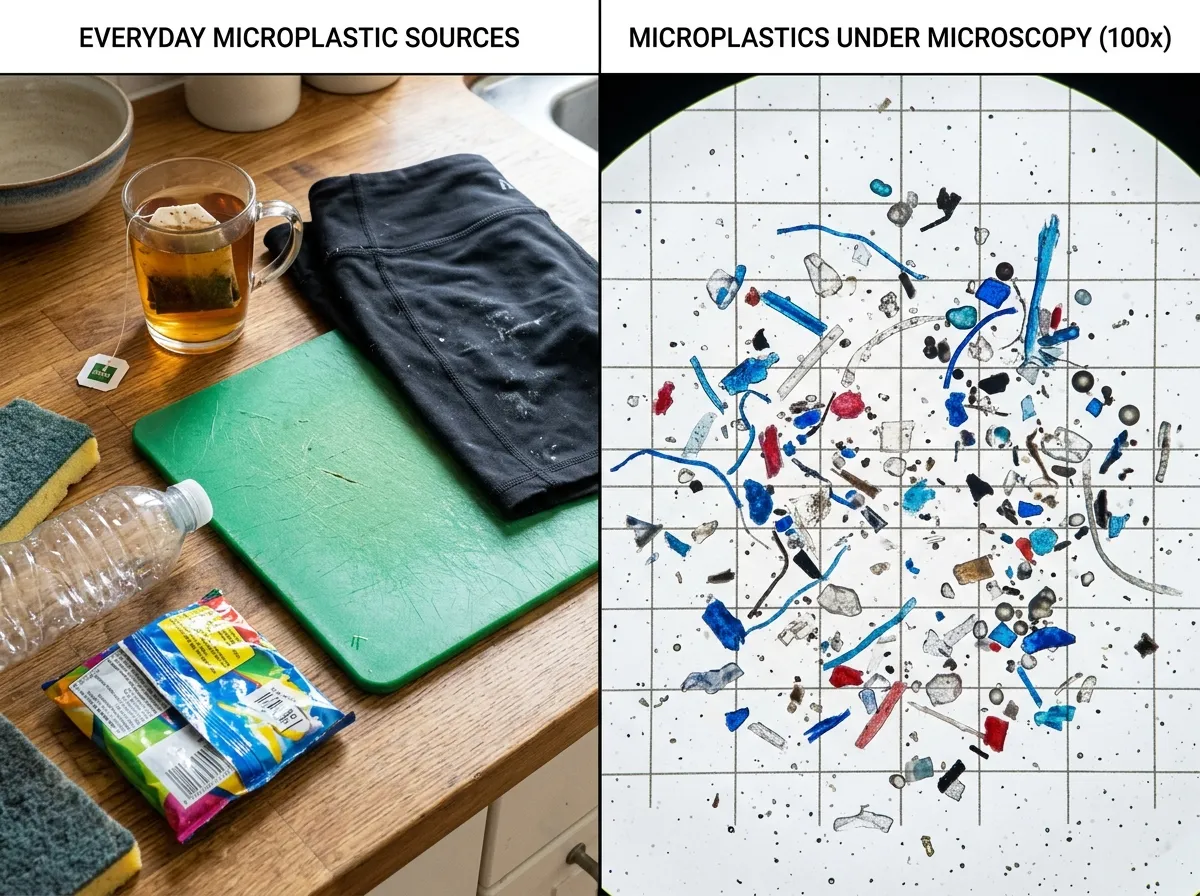
Microplastics enter the body through three main routes: drinking water, food, and inhaled dust. Each habit on this list reduces a documented exposure route. None of them require believing any single contested study. They reduce plastic chemical exposure regardless of whether the microplastic-specific causal questions get fully resolved.
According to NonToxicLab’s review of recent research, the highest-impact interventions all sit at the water-and-food layer. That’s where most of the documented exposure happens. Air and dust matter less, but they’re still worth addressing.
Habit 1: Filter Your Drinking Water
This is the single highest-impact habit on the list.
Tap water in the United States carries between 0 and 61 microplastic particles per liter depending on the region, with an average around 5 to 40. Add the chemicals microplastics carry (PFAS, phthalates, BPA), and the cumulative load is meaningful. A 2024 Columbia University study using stimulated Raman scattering microscopy found about 240,000 plastic particles per liter in bottled water, with 90% of them being nanoplastics small enough to enter cells.
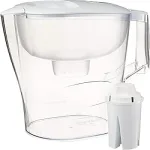
The three filtration types proven in independent testing to remove microplastics down to the nanoplastic range are reverse osmosis, certified ultrafiltration, and dense carbon block.
Dr. Peter Attia, the longevity-focused physician and author of Outlive, has called water filtration one of the highest-impact health interventions a person can make right now. He’s pointed to the 2024 Marfella NEJM study showing patients with detectable microplastics in their carotid artery plaque carried an approximately 4.5-fold higher associated risk of heart attack, stroke, or death.
Two systems we link to most often:
- AquaTru Classic Countertop RO - no plumbing, plug-and-play, NSF-certified for microplastics and PFAS.
- Clearly Filtered 3-Stage Under Sink - dense carbon block, removes microplastics and PFAS without removing minerals.
Full breakdowns: best water filters for PFAS removal and microplastics in drinking water.
Habit 2: Quit Bottled Water
PET plastic bottles release plastic particles into the water they contain. Heat, sunlight, time, and carbonation all accelerate it. A 2018 analysis by Sherri Mason at SUNY Fredonia (commissioned by Orb Media) tested 11 bottled water brands and found an average of 325 microplastic particles per liter, with the highest sample reaching over 10,000 per liter.
Filter your tap water at home and carry a refillable bottle:
- Hydro Flask Standard Mouth 24oz - food-grade stainless, no plastic liner.
- Klean Kanteen Classic 27oz - electropolished stainless interior.
- Purifyou Premium Glass Water Bottle 22oz - borosilicate glass with silicone sleeve.
For more options, see our best non-toxic water bottles roundup.
Habit 3: Replace Plastic Food Storage with Glass
Plastic food containers leach particles into food, especially when storing acidic, fatty, or hot food. A 2023 study in Environmental Science & Technology by researchers at the University of Nebraska found that even refrigerated storage in plastic containers released measurable microplastic levels into food over time.
Glass and silicone are the safe defaults:
- Pyrex Simply Store 18-Piece Glass Set - tempered glass, microwave and oven safe.
- Stasher Reusable Silicone Bag Set - food-grade platinum silicone, freezer to oven safe.
- Bee’s Wrap Variety Pack - cotton coated in beeswax, replaces plastic cling film.
- OXO Good Grips Glass Container Set - durable glass with leak-proof lids.
See our full best non-toxic food storage guide.
Habit 4: Stop Microwaving Food in Plastic
If you skip every other habit on this list, do this one.
A 2023 paper in Environmental Science & Technology by researchers at the University of Nebraska tested polypropylene baby food containers and reusable food pouches in the microwave. After three minutes of heating, samples released up to 4 million microplastic particles and 2 billion nanoplastic particles per square centimeter into the food.
The fix is free. Take food out of plastic before microwaving. Use a glass plate or a ceramic bowl instead.
If you reheat lunches at work, get a glass meal prep container with a separate plastic lid. Remove the lid before microwaving.
Habit 5: Replace Nonstick Cookware
A 2022 study by Cheng Fang and colleagues at Flinders University, published in Science of the Total Environment, found that scratched nonstick coatings can release thousands of microplastic particles per cooking session. Even intact coatings shed at lower rates when overheated.
Cast iron, stainless steel, carbon steel, and pure ceramic don’t have that problem.
- Caraway 12-Piece Cookware Set - ceramic-coated, the simplest entry point for replacing nonstick.
- Lodge 12-Inch Cast Iron Skillet - cheapest forever-pan available.
- Made In 10-Piece Stainless Clad Set - pro-grade stainless that lasts decades.
- Xtrema Versa Pan - 100% pure ceramic, zero coatings.
Full breakdown in our best non-toxic cookware guide.
Habit 6: Switch to Natural-Fiber Clothing and Bedding
Synthetic clothing (polyester, nylon, acrylic, spandex) sheds microfibers every time you wear and wash it. A 2024 study in Environmental Pollution found that a single load of synthetic laundry releases 700,000 fibers into wastewater. The fibers also shed into household air during normal wear.
Buy natural fibers when replacing wardrobe staples:
- Pact Men’s Organic Softspun Crew Neck T-Shirt 5-Pack - GOTS certified.
- Boll & Branch Organic Cotton Sheet Set - long-staple organic cotton.
- Coyuchi Organic Cotton Towels - GOTS-certified terry.
For synthetics you already own, wash them in a Guppyfriend Washing Bag. It traps microfibers before they reach wastewater.
Dr. Rhonda Patrick, the biochemist behind FoundMyFitness, has covered the synthetic fiber question on multiple podcasts. Her take: prioritize the items closest to your skin all day (underwear, sleepwear, sheets) first.
Habit 7: Vacuum with a HEPA Vacuum
Indoor dust contains microplastic fibers from carpet, upholstery, and clothing. You inhale them all day. A standard vacuum kicks the particles back into the air through the exhaust. A true-HEPA vacuum traps them.
- Miele Classic C1 Pure Suction - sealed system with HEPA filter.
- Shark Navigator Lift-Away with HEPA - mid-budget option with anti-allergen seal.
- Dyson V15 Detect - cordless, HEPA filtration, with a particle counter.
Vacuum at least twice a week, more if you have carpet or pets.
Habit 8: Run a HEPA Air Purifier in Main Rooms
Airborne microplastic fibers settle on every surface and end up back in your lungs. A HEPA air purifier captures fibers down to 0.3 microns. The smallest nanoplastics still slip through, but the bulk of the fiber load gets trapped.
- Coway Airmega AP-1512HH - the budget benchmark for true HEPA.
- Levoit Core 600S - large-room coverage, smart-home integration.
- IQAir HealthPro Plus - hospital-grade HyperHEPA, the high end of the category.
Run it in the bedroom and the room you spend the most time in. See our best non-toxic air purifier guide.
Habit 9: Cut Back on Ultra-Processed Packaged Food
This one feels indirect but the data is consistent. Ultra-processed food is packaged in plastic, often with multiple layers, and the food sits in that packaging through manufacturing, shipping, and shelf storage. A 2023 study in Environment International by researchers at Heriot-Watt University found that ultra-processed food contained roughly 5 to 10 times more microplastic particles per gram than minimally processed whole foods.
You don’t need to overhaul your diet. Just shift the ratio. More food bought in the produce section, the bulk bins, and the butcher counter. Less food bought in plastic bags, plastic-lined cans, and plastic-wrapped trays.
This is also the only habit on the list that saves money instead of costing it.
What This Looks Like in Practice
You don’t have to do all nine at once. Here’s a sequenced 30-day plan based on what most readers tackle first:
- Week 1: Buy a water filter (#1) and a refillable stainless or glass bottle (#2). These two alone address the largest single exposure route.
- Week 2: Replace the plastic food storage in your kitchen with glass (#3). Stop microwaving in plastic (#4). Both are cheap and immediate.
- Week 3: Replace your most-used nonstick pan with cast iron or stainless (#5). One pan is enough to start.
- Week 4: Order a Guppyfriend bag (#6), check that your vacuum has HEPA (#7), and put a HEPA air purifier in your bedroom (#8). Start watching ultra-processed food intake (#9).
After 30 days, you’ve addressed every major documented exposure route.
For a fuller swap order across all categories, see our non-toxic product swap priority list.
Our Take
Most “reduce your microplastics” lists end with vague advice. The data is now specific enough to do better than that. Filter your water, stop drinking from plastic, swap your food containers, stop microwaving in plastic, replace nonstick when it scratches. That’s most of the available impact. Everything else is incremental.
If you do nothing else from this list, do the first two.
Frequently Asked Questions
What’s the single best thing I can do to reduce microplastic exposure?
Filter your drinking water with reverse osmosis or a dense carbon block system, and stop drinking from plastic bottles. The water route is the largest documented exposure pathway, and these two changes address most of it.
Can I remove microplastics from my body?
There’s no proven medical method to remove microplastics already in tissue. The HHS announced a $144 million research program in April 2026 specifically to study this question, but no validated treatment exists today. Reducing future intake is the only intervention with current evidence behind it.
Does boiling water remove microplastics?
Partially. A 2024 study in Environmental Science & Technology Letters by researchers at Guangzhou Medical University found that boiling hard tap water can remove up to 84-90% of microplastics by binding them to limescale, which can then be filtered out. Soft water shows less effect, and boiling doesn’t remove PFAS or many other chemicals.
Are nanoplastics worse than microplastics?
For health effects, nanoplastics appear to be more concerning because they’re small enough to cross cell membranes, the gut wall, and the blood-brain barrier. Microplastics larger than 150 microns generally pass through the digestive tract. The 2024 Columbia University study suggested that for every microplastic particle in bottled water, there may be hundreds of thousands of nanoplastic particles alongside it.
Do I need to throw out all my plastic at once?
No. Replace items as they wear out, prioritized by exposure route. Water filter first, then food storage, then cookware. Doing this gradually over 6 to 12 months captures most of the benefit without the cost shock of a full kitchen overhaul.
How much does it cost to do all nine habits?
A baseline setup runs roughly $400 to $700 for water filter, refillable bottle, glass food storage, one new pan, one HEPA vacuum or air purifier, and a microfiber laundry bag. Spread over a year, that’s around $35 to $60 per month, less than most people spend on bottled water alone.
What we don’t fully know: Long-term data on low-level chronic exposure remains limited for many chemical categories, and evidence on some mixtures and exposure combinations is still emerging. Researchers continue to refine exposure thresholds as new data becomes available.
You Might Also Like
- Microplastics and Male Fertility: What 2026 Research Says About Sperm Count and Plastic Exposure
- Microplastics in the Human Brain: What 2026 Studies Show (and How They Get There)
- Microplastics in Your Home: Sources, Health Risks, and How to Reduce Exposure
- Are Plastic Cutting Boards Safe? (Microplastics and Bacteria)
- Is Polyester Clothing Safe? Microplastics, Dyes, and Your Skin
Sources
- Qian N, Gao X, Lang X, et al. “Rapid single-particle chemical imaging of nanoplastics by SRS microscopy.” Proceedings of the National Academy of Sciences. 2024;121:e2300582121. https://www.pnas.org/doi/10.1073/pnas.2300582121
- Mason SA, Welch VG, Neratko J. “Synthetic Polymer Contamination in Bottled Water.” Orb Media / SUNY Fredonia. 2018. https://orbmedia.org/plus-plastic/
- Hussain KA, Romanova S, Okur I, et al. “Assessing the Release of Microplastics and Nanoplastics from Plastic Containers and Reusable Food Pouches: Implications for Human Health.” Environmental Science & Technology. 2023;57:9782-9792. https://pubs.acs.org/doi/10.1021/acs.est.3c01942
- Luo YY, Xu BY, Hu XQ, et al. “Cooking with Nonstick Cookware Releases Microplastics.” Science of the Total Environment. 2022;806:151268. https://pubmed.ncbi.nlm.nih.gov/36030853/
- Marfella R, Prattichizzo F, Sardu C, et al. “Microplastics and Nanoplastics in Atheromas and Cardiovascular Events.” New England Journal of Medicine. 2024;390:900-910. https://www.nejm.org/doi/full/10.1056/NEJMoa2309822
- Yu Z, Li Q, Wang J, et al. “Drinking Boiled Tap Water Reduces Human Intake of Nanoplastics and Microplastics.” Environmental Science & Technology Letters. 2024;11:273-279. https://pubs.acs.org/doi/10.1021/acs.estlett.4c00081
- US Environmental Protection Agency. “Draft Sixth Contaminant Candidate List (CCL 6).” April 2026. https://www.epa.gov/ccl
This information is for educational purposes only and is not medical advice. Consult your healthcare provider for personal health decisions.