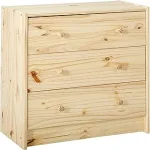
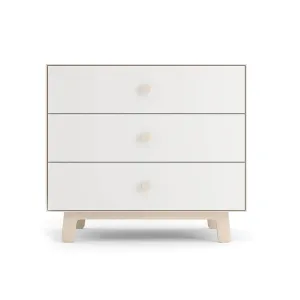
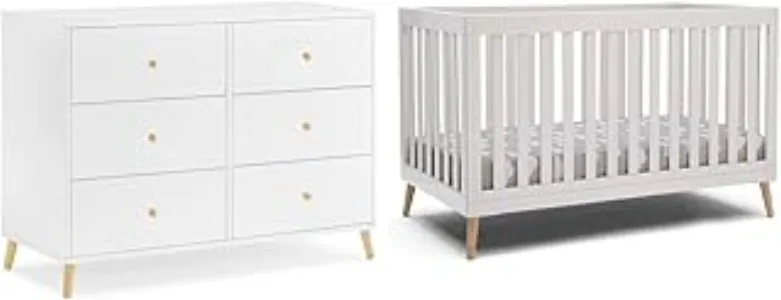
Most parents spend hours researching crib mattresses and then grab whatever dresser looks good on sale. I did that with my first kid. The problem is that new particle board and MDF furniture off-gases formaldehyde for up to two years at room temperature, and newborns spend 16 or more hours every day in that room. The dresser sitting three feet from the crib matters.
I reviewed 22 nursery dressers for this guide, looking specifically at construction materials, independent certifications, VOC finish data, and whether the manufacturer discloses enough for parents to actually evaluate safety. Most don’t pass even basic scrutiny. These five do. For a broader look at building a clean nursery, see our non-toxic crib and kids furniture guide.
What Makes a Nursery Dresser Non-Toxic?
The short answer: solid wood construction, a water-based finish, no MDF in the carcass, and ideally GREENGUARD Gold certification from UL to verify it all. GREENGUARD Gold sets limits on over 360 individual chemical compounds including formaldehyde, total VOCs, and individual solvents. It’s currently the strictest emissions certification available for nursery furniture.
Here’s what to evaluate in order of importance.
Formaldehyde from MDF and Particle Board
Formaldehyde is a colorless gas that new composite wood furniture releases at room temperature. IARC classifies it as a Group 1 human carcinogen at occupational exposure levels [regulatory review]. At the lower concentrations typical of household furniture, the evidence shifts to animal studies and epidemiological associations, but infants are meaningfully more vulnerable than adults because of their higher respiratory rate relative to body mass and immature detoxification systems.
The California Air Resources Board (CARB) sets two tiers. CARB Phase 1 allows up to 0.18 ppm formaldehyde emissions from hardwood plywood. CARB Phase 2, adopted federally as the Formaldehyde Standards for Composite Wood Products Act, tightens those limits significantly: 0.05 ppm for hardwood plywood, 0.09 ppm for particleboard, and 0.11 ppm for MDF. Most major retailers require CARB 2 compliance. GREENGUARD Gold goes further and tests actual emissions from finished products, not just the composite panels.
The cleanest option is solid wood with no composite panels at all. The second-best is CARB 2 compliant plywood or MDF with verified low-emission finishes. Avoid any dresser where the manufacturer can’t tell you the composite wood standard their materials meet.
VOC Finishes
Paint and stain are a secondary formaldehyde and VOC source. Water-based finishes emit significantly less than oil-based alternatives. A dresser with a solid wood carcass and an oil-based paint finish can still off-gas more than a well-made CARB 2 plywood dresser with a water-based finish. Ask the manufacturer specifically about the finish type if it isn’t listed.
Hardware
Metal drawer pulls and hinges on budget furniture occasionally contain cadmium or lead. EU REACH regulations set specific limits on these metals in accessible parts of children’s products. Products manufactured for the EU market or explicitly REACH-compliant are the safer assumption. Most U.S.-only brands don’t test or disclose hardware metals.
Anti-Tip Hardware
Dresser tip-overs kill about one child every two weeks in the United States, according to the Consumer Product Safety Commission (CPSC). This is a safety issue, not a toxicity issue, but it belongs here because parents shopping for a nursery dresser need to know before buying. Anti-tip straps are now required equipment. Look for dressers that include hardware, not just instructions to buy your own.
Nursery Dresser Materials: Trade-offs
There is no perfect material. Every option involves real compromises.
| Material | Main concern | Reality |
|---|---|---|
| Solid wood (pine, birch, beech) | Higher price, minor warp risk in humid rooms | Lowest formaldehyde and VOC source; no off-gassing risk from composite panels |
| Plywood, CARB 2 compliant | Still emits some formaldehyde | At CARB 2 levels, emissions are low and considered acceptable risk for most families |
| CARB 2 MDF | Higher baseline formaldehyde than plywood | Within regulatory limits but avoid for the first 12-24 months in a small, poorly ventilated nursery |
| MDF without CARB certification | Highest formaldehyde off-gassing | Unknown emission levels; avoid in any child’s room |
| Painted finishes | Varies widely; VOC content not always disclosed | Water-based finishes are meaningfully cleaner; oil-based alternatives can add 50-100+ VOC compounds |
Solid pine or birch construction sits in the best position for this use case. It costs more, but the formaldehyde and VOC baseline is lower, and for a room where a baby sleeps 16 hours a day, that margin matters.
The 5 Best Non-Toxic Nursery Dressers in 2026
Here are the picks that cleared our review criteria: disclosed materials, documented certifications, anti-tip hardware, and construction that holds up to real use.
Babyletto Hudson 3-Drawer Dresser: Best Overall
Price: $399-$499 | Material: Solid wood panels, water-based finish | Certification: GREENGUARD Gold
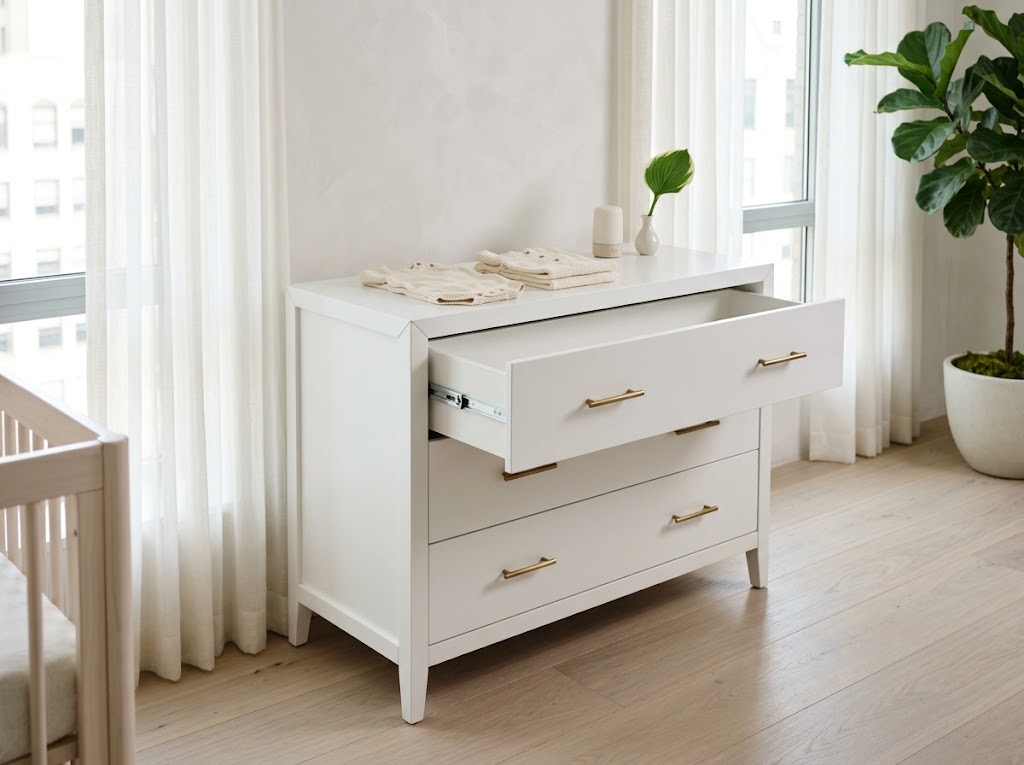
The Babyletto Hudson is the one I recommend first, and the reason is simple: it’s GREENGUARD Gold certified by UL, which means its actual emissions have been tested and verified, not just its materials. That’s a meaningful difference. Plenty of brands claim “no added formaldehyde” as a materials spec; fewer have submitted finished products to independent emissions testing.
The dresser uses solid New Zealand pine panels with a water-based finish. No MDF in the main carcass. The water-based paint is low-VOC and matched to the GREENGUARD testing. Babyletto is a brand that discloses more than most. When I’ve emailed their customer support with questions about specific finish compounds, they’ve responded with actual documentation rather than a boilerplate “meets all safety standards” brush-off.
Practically, the Hudson is well-built. The drawer glides are smooth, the dovetail joints hold up, and the finish doesn’t chip easily under normal nursery use. The three-drawer configuration is compact enough for smaller nurseries. The main honest limitation: three drawers is tight once you’re into 12-18 month clothing sizes. If storage matters, look at the DaVinci or Delta Children picks below.
Hardware tip: the Hudson uses metal drawer pulls. Babyletto states these meet CPSIA standards, but the company doesn’t publish REACH-level metals testing for hardware. In practice, the certified wood and finish are the main emission sources, so the hardware concern is lower-priority here.
Anti-tip strap is included. Use it on day one.
DaVinci Jayden 6-Drawer Double Dresser: Best Value
Price: $299-$399 | Material: Solid pine, non-toxic paint | Certification: GREENGUARD Gold
The DaVinci Jayden gives you GREENGUARD Gold certification, solid pine construction, and six drawers for $100-$150 less than the Babyletto. For most families, that’s the better value calculation.
DaVinci is owned by Million Dollar Baby Co., the same parent company as Babyletto. The certification and materials transparency are similar. The Jayden uses solid pine with a multi-step paint process. DaVinci describes this as “non-toxic” in their product documentation, and GREENGUARD Gold testing covers the finished product, so the claims are verifiable rather than just marketing.
Six drawers on a double dresser configuration makes this the most functional option on this list for families who need actual storage. The anti-tip hardware is included. Drawer glides are decent but not as smooth as the Babyletto. The finish is matte and tends to show fingerprints in darker colors; the white and natural options hold up better visually.
DaVinci is also frequently paired with their matching cribs, which is convenient if you want consistent certification documentation across multiple nursery pieces. Worth noting: the matching changing topper for the Jayden is sold separately and uses the same certified materials.
One real limitation: assembly takes 60-90 minutes and the instructions aren’t the clearest. Set aside a full evening and don’t attempt it with a newborn nearby.
IKEA HEMNES 8-Drawer Dresser: Best Budget
Price: $199-$229 | Material: Solid pine | Standard: CARB 2 compliant
The IKEA HEMNES is a solid pine dresser. That’s the key sentence. The HEMNES line uses real pine for the main structure, which means no MDF and no particle board in the carcass. That’s not true of most IKEA furniture, and it’s the reason the HEMNES stands apart at this price point.
IKEA applies CARB 2 compliance as a minimum standard across all of its children’s products sold in the United States. CARB 2 limits formaldehyde emissions significantly: 0.05 ppm for hardwood plywood, 0.09 ppm for particleboard. The HEMNES avoids both categories in its main panels. Where MDF or hardboard does appear (drawer bottoms, back panels), IKEA meets CARB 2 limits. IKEA’s global chemical restrictions policy also bans several substances beyond the CARB/TSCA requirements.
Is this the same as GREENGUARD Gold? No. CARB 2 compliance is a materials-level standard. GREENGUARD Gold is an emissions test on the finished product. For most families with healthy full-term babies, CARB 2 compliant solid pine is a reasonable choice and meaningfully safer than uncertified furniture. For families with premature infants, infants with respiratory sensitivities, or very small nurseries with limited ventilation, I’d prioritize a GREENGUARD Gold certified option.
Eight drawers at this price is genuinely useful. The anti-tip wall bracket is included. Assembly is simple by IKEA standards.
Practical note: the HEMNES paint finish uses a water-based lacquer. Off-gas it for two weeks before moving it into the nursery, ideally in a garage or well-ventilated room. At under $230, it’s the right call for parents who are budget-constrained but unwilling to buy uncertified furniture.
Oeuf Sparrow Dresser: Best Design
Price: $699-$799 | Material: Solid Baltic birch, zero-VOC finishes | Standard: CARB 2 compliant, JPMA certified
The Oeuf Sparrow is the cleanest materials story on this list. It uses solid Baltic birch throughout, zero-VOC water-based finishes, and no MDF anywhere in the construction. Oeuf is a design-forward brand out of New York that sources from European factories with stricter regulatory baselines than most U.S. manufacturing.
Zero-VOC is a meaningfully different claim than “low-VOC.” The EPA defines zero-VOC finishes as containing fewer than 5 grams of VOCs per liter (standard flat paint is typically 250-380 g/L; “low-VOC” is under 50 g/L; zero-VOC products are under 5 g/L). At these levels, the finish off-gassing is negligible under standard nursery ventilation.
Birch is a denser hardwood than pine, which means tighter grain and less tendency to dent or scratch. The Oeuf Sparrow will outlast the other options on this list physically. It’s also the most expensive by a significant margin. Whether $500 more than the DaVinci is worth it comes down to materials priorities and budget. There is no GREENGUARD Gold certification here, which is an honest limitation at this price point.
The Sparrow is worth the premium if you’re building a nursery with a clean-materials philosophy throughout and the price is manageable. If GREENGUARD Gold certification matters more than zero-VOC finishes, the Babyletto is the better pick.
Anti-tip strap is included.
Delta Children Farmhouse 6-Drawer Dresser: Best Large
Price: $249-$329 | Material: Engineered wood, water-based finish | Certification: GREENGUARD Gold
The Delta Children Farmhouse is the only engineered wood option on this list, and it’s here because the GREENGUARD Gold certification carries the load. Delta Children submits finished products to independent UL emissions testing. The actual tested emissions come in below GREENGUARD Gold thresholds, which is what matters for real-world nursery air quality.
“Engineered wood” as a category is wide. Delta Children doesn’t disclose whether the panels are plywood, MDF, or a combination. That lack of transparency is a real limitation compared to the brands that specify solid pine or birch. What Delta does provide is the certification documentation, which includes tested formaldehyde and VOC levels in the finished state. That’s more useful than a materials claim without testing.
For families who want GREENGUARD Gold at six-drawer capacity and a lower price than the DaVinci, this is the practical choice. The drawer glides and overall build quality are a step below the Babyletto and DaVinci. Expect smooth function for 3-5 years with normal use.
The Farmhouse style has a wide footprint. Measure your nursery before ordering. Anti-tip hardware is included and attaches to a wall stud; the instructions walk through this clearly.
What We’d Avoid
A few patterns that disqualify a nursery dresser regardless of price:
No certification and no materials disclosure. If a product page lists only “wood” or “manufactured wood” with no CARB compliance claim and no third-party certification, that’s not enough. Formaldehyde emissions from uncertified composite wood are unpredictable and can be significantly above CARB limits, particularly in cheaper furniture imported from factories with less quality control.
Oil-based paint or stain with no VOC data. Some brands that use solid wood undermine it with oil-based finishes that off-gas significantly. A CARB 2 solid-pine dresser with an oil-based finish can emit more VOCs than a CARB 2 engineered wood dresser with a water-based one.
No anti-tip hardware included. Any brand selling a dresser for a nursery without including anti-tip hardware in the box is cutting corners in a way that should make you skeptical of everything else they’re cutting corners on.
Brands that can’t answer basic questions. I’ve emailed several furniture brands asking for their finish VOC content or CARB compliance documentation. The ones that respond with actual data get serious consideration. The ones that respond with “our products meet all applicable safety standards” without specifics get cut.
Installation and Safety Tips
Get the dresser into the nursery two to four weeks before the baby arrives, if possible. Open all the drawers, ventilate the room by keeping a window cracked and a fan running. Even GREENGUARD Gold certified furniture off-gasses most heavily in the first few weeks after unboxing. Letting that happen before the baby moves in significantly reduces peak exposure.
Anchor it to a wall stud, not just drywall. Most anti-tip kits include both stud screws and drywall anchors, but only the stud connection provides meaningful resistance to a tip-over. Use a stud finder. If your walls are plaster or there’s no stud in the right spot, use a toggle bolt rated for the dresser’s weight.
Load heavier items in the bottom two drawers. Top-heavy dressers tip more easily even when anchored, and a bottom-heavy load reduces the lever arm if a child climbs the drawers. This matters more than it sounds.
Don’t use VOC-heavy air fresheners or cleaning products in the nursery during the first month. The combined load from new furniture, paint, and cleaning chemicals peaks in that window. A HEPA air purifier running on low is a reasonable addition if you’re concerned about indoor air quality. See our non-toxic air purifier guide for picks.
How Long Do These Dressers Last?
Solid pine and birch dressers, if not damaged, last 15-20 years or more with normal use. The Babyletto, DaVinci, IKEA HEMNES, and Oeuf are all solid wood constructions that a child can take to college, sell, or pass on. Resale value on GREENGUARD Gold certified solid wood nursery furniture is meaningful.
Engineered wood dressers like the Delta Children Farmhouse are more variable. With gentle use they hold up well for 5-10 years. Heavy use, humid environments, or repeated assembly and disassembly degrade the panel joints and drawer glides faster. Plan to replace rather than pass down.
Drawer glide maintenance is the most common failure point across all categories. Lubricate with a dry wax every year or two. If a glide breaks on a solid wood dresser, most can be repaired by a furniture shop. Engineered wood units with damaged glides are harder to repair and are often replaced.
What We Don’t Know Yet
The honest limitation here is that long-term emissions data from nursery furniture under real use conditions is thin. GREENGUARD Gold tests products in a controlled chamber at specific temperature and humidity. A real nursery runs warmer in summer, more humid in winter, and the dresser’s surface temperature varies. Some research suggests formaldehyde off-gassing rates can increase significantly with temperature, but there’s no standardized test that mimics an actual nursery across seasons.
We also don’t have good data on the cumulative effect of multiple new items in a nursery at once. A dresser, crib, changing table, and fresh paint all off-gas simultaneously. Individual product certifications don’t account for this combinatorial exposure. The practical takeaway is to ventilate aggressively before the baby arrives and prioritize the highest-certification products for the items closest to where the baby sleeps.
FAQ
Is IKEA furniture safe for a nursery?
The IKEA HEMNES specifically is a reasonable choice because it uses solid pine, not particle board, for the main structure. CARB 2 compliant, and IKEA’s internal chemical restrictions policy is stricter than many brands at this price. That said, it’s not GREENGUARD Gold certified, so for very small nurseries or infants with respiratory sensitivities, I’d prioritize the Babyletto or DaVinci. For most healthy full-term babies, the HEMNES is probably fine under normal use.
What is GREENGUARD Gold and why does it matter for baby furniture?
GREENGUARD Gold is an independent emissions certification from UL (Underwriters Laboratories). Products are tested in a controlled environmental chamber at conditions mimicking a child’s bedroom: 60% relative humidity, 23°C temperature, specific air exchange rates. Testing covers formaldehyde, total VOCs, and over 360 individual compounds. The Gold tier was designed for schools and healthcare environments, which means it’s stricter than the basic GREENGUARD certification. It’s the strongest available signal that a finished product actually emits within safe limits, not just that it was made with low-emission materials.
How long does formaldehyde off-gas from new furniture?
The bulk of off-gassing from composite wood furniture happens in the first 3-6 months. Research on building materials shows that initial emission rates are highest, declining roughly exponentially over time [regulatory review, OEHHA assessments]. MDF and particle board can continue to emit at lower levels for two years or more. Solid wood construction with water-based finishes clears much faster, typically within weeks to a few months. Ventilating aggressively in the first month, ideally before the baby moves in, addresses the peak exposure window.
Is solid pine safer than plywood for a nursery dresser?
For formaldehyde specifically, solid pine is better because it contains no urea-formaldehyde adhesives (the primary source in composite wood products). However, “safer than plywood” doesn’t mean risk-free. Pine still off-gasses naturally occurring terpene compounds, and the finish applied on top is a separate VOC source. A solid pine dresser with a water-based finish is a genuinely clean choice. A solid pine dresser with an oil-based finish can emit more VOCs than a CARB 2 plywood dresser with a water-based finish.
What does CARB 2 compliant mean?
CARB Phase 2 refers to the California Air Resources Board’s Airborne Toxic Control Measure for composite wood products, adopted federally in 2019 as the Formaldehyde Standards for Composite Wood Products Act. It sets maximum formaldehyde emission limits for three panel types: 0.05 ppm for hardwood plywood, 0.09 ppm for particleboard, and 0.11 ppm for medium-density fiberboard (MDF). Products sold in the United States are legally required to meet these limits. CARB 2 is the floor; GREENGUARD Gold is significantly more stringent because it tests the finished product under conditions designed to detect actual emissions into a room.
Can I get a non-toxic nursery dresser on a budget?
Yes. The IKEA HEMNES at $199-$229 is solid pine with CARB 2 compliance and is among the better choices at any price point for families who need to watch the budget. The Delta Children Farmhouse at $249-$329 adds GREENGUARD Gold certification at a price point well below the Babyletto and DaVinci. Neither is perfect: the HEMNES lacks GREENGUARD certification, and the Delta Children doesn’t fully disclose its panel composition. But both are meaningfully safer than uncertified furniture, and both are available options for families who can’t stretch to $400+.
Does the dresser-as-changing-table setup change anything chemically?
Somewhat. If you’re placing a changing pad on top of the dresser, the pad itself is a chemical consideration separate from the dresser. Vinyl changing pads off-gas phthalates; GREENGUARD Gold certified foam pads with organic cotton covers are the cleaner option. The dresser top surface isn’t a direct chemical exposure source for a baby being changed on it, but if the pad is vinyl, the baby’s skin is in contact with that surface for years. For specific changing pad picks, see our non-toxic changing pad guide.
Our Take
If you’re buying one nursery dresser and chemical safety is the priority, get the Babyletto Hudson. It’s GREENGUARD Gold certified, the company discloses more materials information than most, and it’s built to last. If you need more storage and want GREENGUARD Gold at a lower price, the DaVinci Jayden is the right call. Budget-constrained families who want solid wood construction should look at the IKEA HEMNES, ventilate it well before bringing it into the nursery, and use the money saved for a quality HEPA air purifier.
Avoid any dresser where the manufacturer can’t tell you what formaldehyde standard their panels meet. That information should be publicly available. If it isn’t, that’s a signal about the whole brand.
You Might Also Like
- The Zero-Compromise Nursery: A Protocol for Expecting Parents
- Best Non-Toxic Baby Sunscreen in 2026 (Mineral Only)
- Best Low VOC Paint for Baby Nursery (2026)
- Best Non-Toxic Paint for Your Home in 2026 (Zero VOC)
- The Non-Toxic Bedroom Furniture We’d Buy in 2026
- Best Non-Toxic Crib Mattress in 2026 (Organic, Certified)
- The Baby Clothes Our Editors Trust (Formaldehyde-Free, 2026)
- Every Non-Toxic Certification Ranked: Which Labels Actually Mean Something (2026)
- Best Non-Toxic Play Mat for Babies (No Foam, No PVC)
- Non-Toxic Product Certifications: The Complete Guide
- Best Non-Toxic Baby Wipes in 2026 (Fragrance-Free, Chemical-Free)
- Non-Toxic Baby Products: The Complete Safety Guide for New Parents
- The Baby Shampoos Our Editors Trust (Sulfate-Free, 2026)
Sources
- California Air Resources Board. “Airborne Toxic Control Measure for Composite Wood Products (ATCM).”
- UL GREENGUARD Certification Program. “GREENGUARD Gold Standard.”
- Consumer Product Safety Commission. “Tip-Over Incidents Involving Furniture, Televisions, and Appliances.”
- International Agency for Research on Cancer. “IARC Monographs: Formaldehyde, Vol. 88.” IARC, 2006.
- EPA. “Formaldehyde: Overview of EPA Activities.”
- OEHHA (Office of Environmental Health Hazard Assessment). “Formaldehyde Emission Rates from Furniture.”
- CPSC. “ASTM F2057 Furniture Tip Stability Standard.”