
You spend roughly a third of your life in your bedroom. That’s more time than you spend in your car, your kitchen, and your living room combined. And for most of those hours you’re breathing the air from the room’s smallest, most enclosed space, right next to the furniture that fills it.
I spent several months researching bedroom furniture materials, pulling certification data, cross-referencing EPA emissions limits, and talking to people who’ve dealt with chemical sensitivities triggered by new furniture. What I found: the bedroom is actually the highest-priority room to get right. Not because the risks are catastrophic under normal use, but because the exposure window is so long and so consistent.
Why the Bedroom Is Different From Every Other Room
Formaldehyde off-gasses from particleboard and MDF around the clock, but most people only spend a few hours in their living room or home office on a given day. In the bedroom, you’re in close contact with that off-gassing furniture for 7 to 9 hours straight, breathing at slower respiratory rates, often with the door and windows closed.
The EPA has set an indoor air guideline of 0.016 ppm formaldehyde as a long-term exposure reference concentration (EPA, 2024). New particleboard furniture can off-gas at 0.04 to 0.1 ppm in the first few months after purchase. That’s 2.5 to 6 times the reference level, in a room you occupy for a third of your day. The bedroom is where these numbers matter most.
Flame retardants add another layer. Many mattresses and upholstered headboards still use chemical flame retardants to meet flammability standards, though California’s TB 117-2013 update in 2014 made non-chemical compliance possible using a wool barrier or tight fabric encasement. If a brand hasn’t explicitly stated how they meet flammability standards, you don’t know what’s in it.
The good news is that solid wood furniture, low-VOC finishes, and a small set of certifications cut through most of the ambiguity. Here’s how each piece of the bedroom fits together.
The Three Certifications That Actually Matter
Not every certification is equal. Some are marketing language. Three are worth knowing:
GREENGUARD Gold is the most rigorous VOC and formaldehyde certification for furniture. It’s issued by UL (Underwriters Laboratories) and requires ongoing testing, not just a one-time pass. The “Gold” tier holds products to stricter limits than standard GREENGUARD, specifically because Gold-certified products are intended for use around children and in spaces like bedrooms and schools. Any piece of furniture with GREENGUARD Gold certification has been independently tested for formaldehyde, benzene, and hundreds of other VOCs.
GOTS (Global Organic Textile Standard) applies to textiles, not furniture frames. If you’re buying an organic cotton mattress cover, organic sheets, or a wool mattress layer, GOTS certification means the fiber was grown organically and processed without harmful dyes or finishes. No GOTS label on a mattress or sheet set means you’re relying on the brand’s word.
GOLS (Global Organic Latex Standard) applies specifically to natural latex. It certifies the latex itself is made from organically grown rubber tree sap, without synthetic petroleum-based latex blended in. Many brands say “natural latex” without GOLS certification, which doesn’t guarantee the ratio of natural to synthetic material.
For furniture frames and dressers: GREENGUARD Gold. For mattresses and bedding: GOTS plus GOLS if latex is involved. That combination covers the major exposure vectors.
What “Solid Wood” Actually Means on a Furniture Label
This distinction trips people up constantly, and it’s worth being precise about it.
Solid wood means the piece is made from lumber cut from a single tree. No glue-up panels, no reconstituted wood fibers, no MDF core with wood veneer over it. The formaldehyde risk from solid wood comes only from any finish applied on top, not the wood itself.
Engineered wood is a broad category that includes plywood, MDF (medium-density fiberboard), particleboard, and oriented strand board (OSB). All of these use urea-formaldehyde resin as a binder, though concentrations vary. Plywood typically has lower formaldehyde content than MDF or particleboard. The CARB Phase 2 standard (California Air Resources Board) caps formaldehyde emissions from these materials at 0.05 ppm for hardwood plywood, 0.09 ppm for particleboard, and 0.11 ppm for MDF.
“Wood” or “wood-look” on a furniture listing often means MDF or particleboard with a wood-grain laminate or veneer surface. This is the highest-risk category. A $300 dresser that says “wood finish” in the product title is almost certainly particleboard with laminate.
Bamboo sits in a gray zone. The stalks themselves are naturally formaldehyde-free, but bamboo furniture is almost always made from processed strand-woven bamboo, which uses adhesive resins. Formaldehyde content varies significantly by manufacturer and isn’t as standardized as CARB-certified wood products.
The practical rule: if the listing doesn’t say “solid pine,” “solid oak,” “solid walnut,” or name a specific hardwood species, assume there’s engineered wood in the structure and check for CARB Phase 2 or GREENGUARD Gold certification.
Bed Frames: Where to Start
The bed frame sits directly under you every night and often includes a headboard with fabric upholstery. Most bed frames in the $200 to $600 range are particleboard or MDF with a wood-look veneer or fabric covering that hides the substrate. The substrate is where the formaldehyde risk lives.
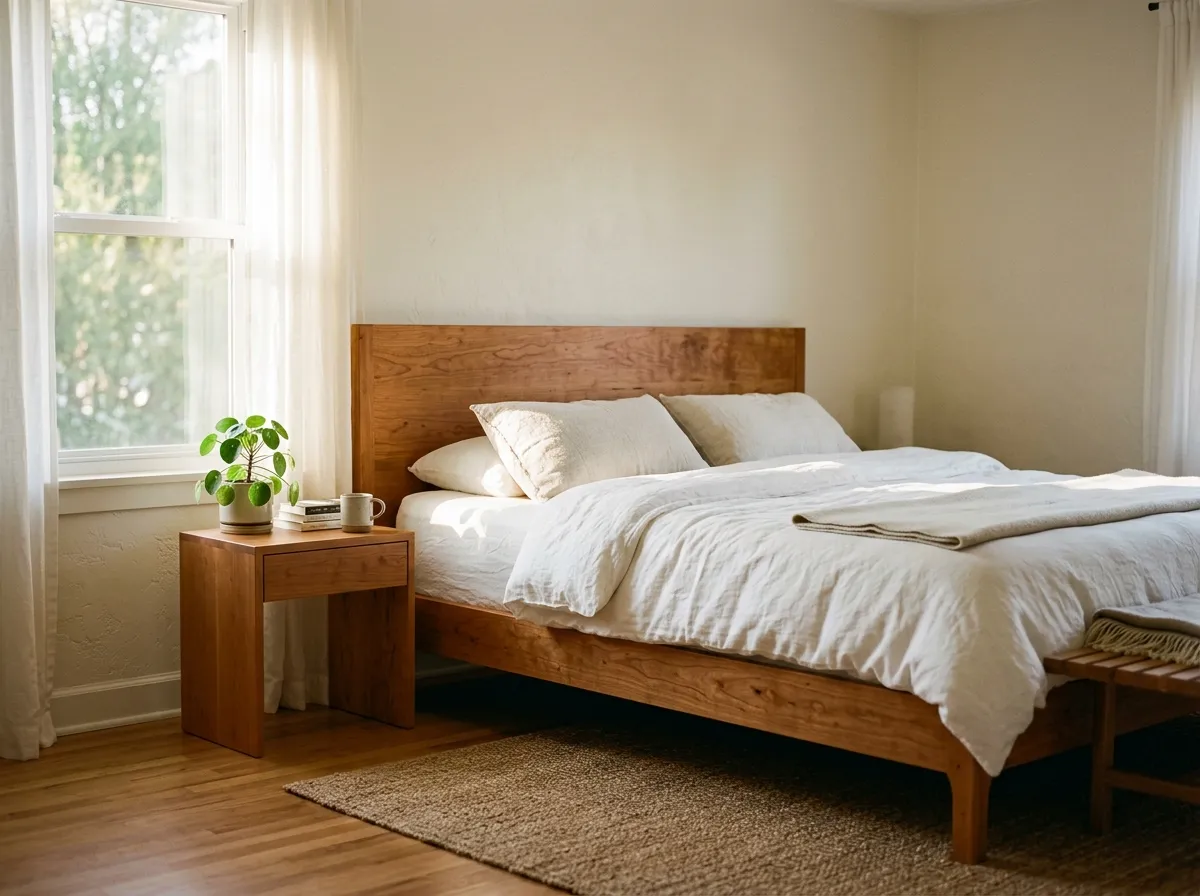
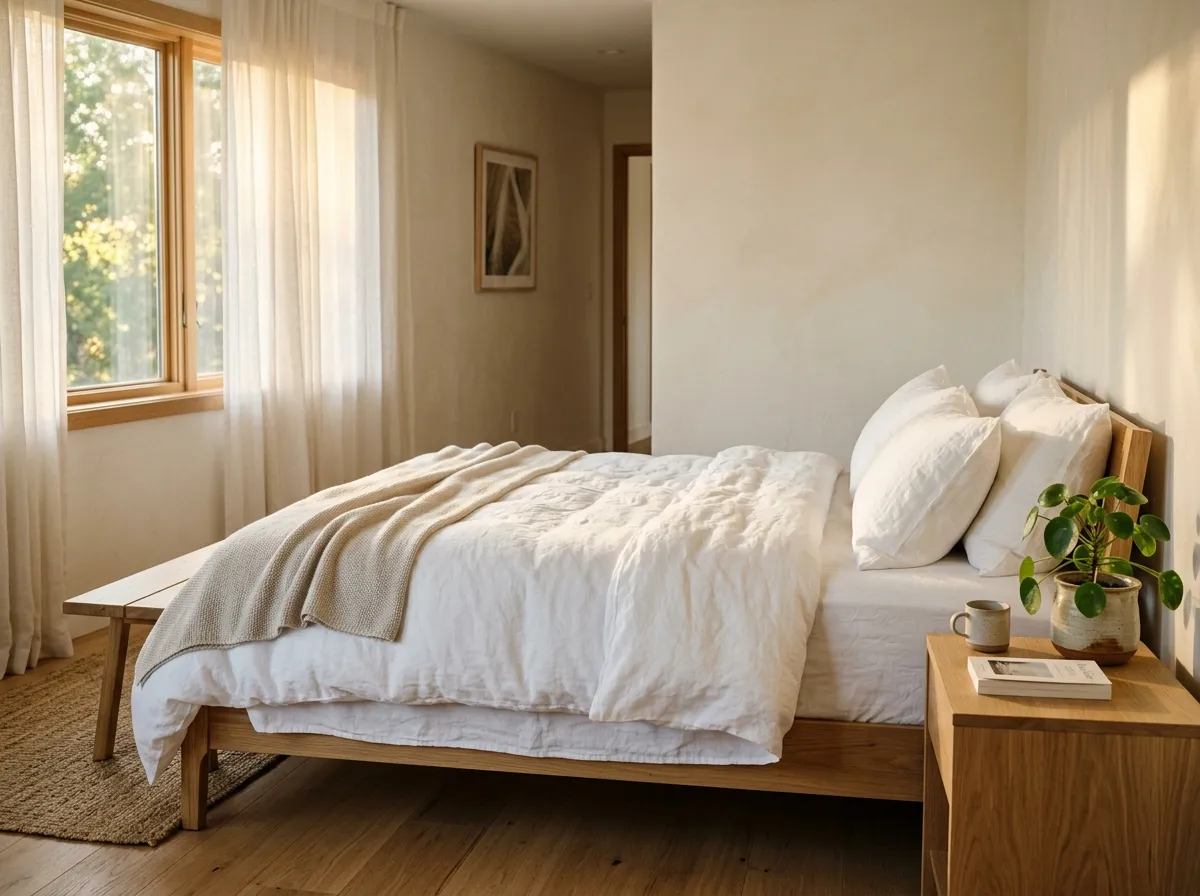
Our full best non-toxic bed frames roundup covers this category in depth. The short version: look for solid rubberwood, solid pine, or solid hardwood (cherry, walnut, oak) with a stated low-VOC or water-based finish. If the listing uses the word “engineered wood” without a GREENGUARD Gold certification, skip it.
Zinus Alexis Deluxe Wood Platform Bed: Best Amazon-Available Frame
The Zinus Alexis uses a solid pine frame with wood slats and requires no box spring. It assembles in under an hour, ships in a compact box, and is one of the few widely-reviewed solid wood platform frames on Amazon in the sub-$400 tier. Frame construction is solid pine, not particleboard, which is the key safety marker here.
It does not carry GREENGUARD Gold. The finish is manufacturer-stated as low-VOC but not third-party certified. At this price point, that tradeoff is reasonable for most buyers, and the materials themselves are inherently low-concern.
For buyers who want the higher-end version and don’t mind buying direct (not Amazon), Thuma’s The Bed is a solid upcycled rubberwood frame in the $995 to $1,295 range with a Japanese joinery assembly system. Thuma sells only through their own site, not Amazon, so there is no affiliate link to share.
Avocado Bed Frame: Best Certified Option
Avocado’s bed frame is GREENGUARD Gold certified solid wood with a zero-VOC water-based finish. It’s made in the USA and pairs naturally with the Avocado mattress. The price ($1,099 to $1,599 for queen) reflects the certification stack and domestic manufacturing. If you want the most complete documentation trail for your bed frame, this is it.
Floyd Bed Frame: Best Metal Option
If you want to avoid wood off-gassing concerns entirely, powder-coated steel frames are a practical alternative. Floyd’s bed frame uses powder-coated steel legs with birch plywood slats, which are CARB 2 compliant. Powder coating is a dry process with no liquid solvents, so VOC emissions from the metal components are negligible after the coating cures.
Mattresses: The Highest-Priority Piece
The mattress is the single most important piece of bedroom furniture to get right. You’re in contact with it for 7 to 9 hours each night. It’s the largest surface area of any single piece in the room. And conventional polyurethane foam mattresses can contain a cocktail of issues: petroleum-derived foam, chemical flame retardants, and VOCs from adhesives and cover fabrics.
Our dedicated best non-toxic mattresses guide covers every major brand with full certification breakdowns. Here’s the summary of what matters:
What Makes a Mattress Non-Toxic
Among the best-researched low-emission mattress materials are organic Dunlop or Talalay latex (GOLS certified), organic cotton and wool (GOTS certified), and natural pocketed coils. Wool meets flammability requirements naturally without chemical flame retardants, which is why GOLS and GOTS certified mattresses can credibly claim to be flame-retardant-free.
CertiPUR-US certification applies to polyurethane foam and is a meaningful step above conventional foam. It limits heavy metals, PBDE flame retardants, formaldehyde, and certain phthalates. But CertiPUR-US certified foam is still petroleum-derived polyurethane. It reduces the off-gassing concern, it doesn’t eliminate it. For the bedroom, where you’re sleeping on the mattress every single night, the full organic stack is worth the investment if your budget allows.
Avocado Green Mattress: The Full-Stack Benchmark
Avocado holds GOLS, GOTS, GREENGUARD Gold, and MADE SAFE certifications simultaneously. That combination has no peer in the mass-market mattress category. The mattress uses organic Dunlop latex layers, pocketed steel coils, and a GOTS-certified organic wool and cotton cover. No synthetic flame retardants.
The price is genuinely high: $1,699 to $2,499 for a queen. That’s not an easy sell. But consider that a mattress is a 10-year purchase, and you’re sleeping on it every night. Amortized over a decade, the premium over a mid-range foam mattress is about $30 to $50 per month.
The Avocado Green Mattress on Amazon links to their brand storefront.
Naturepedic and Birch: Strong Alternatives
Naturepedic holds GOTS, GOLS, and MADE SAFE certifications. Their Chorus model starts around $1,299 for a queen and is a strong option for anyone who wants full organic certification at a slightly lower entry price than Avocado.
Birch by Helix is GREENGUARD Gold and OEKO-TEX certified, made with natural latex and organic wool. It’s not GOLS certified (the latex isn’t organically sourced to GOLS standards), but it hits a solid mid-range price ($1,399 for queen) with meaningful third-party testing.
CertiPUR-US Alone: What to Know
If budget is the primary constraint, CertiPUR-US certified foam mattresses are significantly better than uncertified conventional foam. The certification limits formaldehyde to 0.5 ppm in emissions testing (the standard GREENGUARD threshold is much lower, but CertiPUR-US is still a real improvement over uncertified foam). For people without chemical sensitivities, a CertiPUR-US foam mattress is probably fine under normal use, particularly after the initial off-gassing period of 2 to 4 weeks.
Dressers: The Most Overlooked Formaldehyde Source
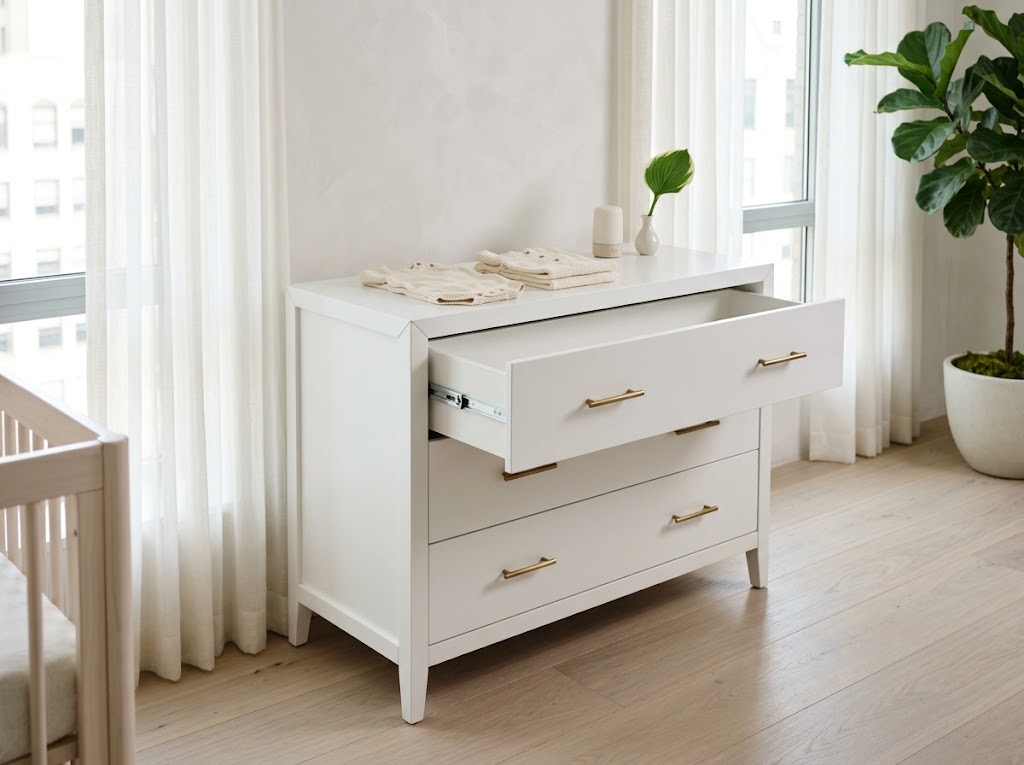
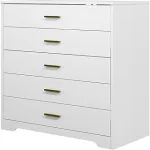
Dressers are underappreciated in the off-gassing conversation, and they shouldn’t be. A typical 6-drawer dresser has a lot of surface area inside those drawers: bottom panels, side panels, and back panels that are usually particleboard or MDF. Every time you open a drawer, you get a small dose of that enclosed air.
Most dressers in the $200 to $500 range are particleboard with laminate or painted MDF. Even “wood” dressers from big-box stores are typically engineered wood with veneer or paint. The interior drawer surfaces, where your clothes sit, are rarely disclosed separately from the exterior finish.
Our full [best non-toxic nursery dresser](/best-non-toxic-nursery-dresser/) guide covers this well, and the same logic applies to adult bedrooms. GREENGUARD Gold certification is the most reliable indicator for a dresser purchase.
DaVinci Jayden 6-Drawer Dresser: Best Certified Value
The DaVinci Jayden holds GREENGUARD Gold certification, uses solid pine for drawer boxes, and is made with New Zealand pine. It’s a double dresser with six full-depth drawers, anti-tip hardware included, and a non-toxic multi-step paint process. For $399 to $499, this is the best-value GREENGUARD Gold dresser available. The DaVinci Jayden dresser on Amazon is consistently well-reviewed with over well-reviewed.
IKEA HEMNES Dresser: Best Budget Option
IKEA’s HEMNES dresser uses solid pine in the main structure with no particleboard. IKEA’s IWAY chemical policy limits formaldehyde use and requires CARB Phase 2 compliance across product lines. The 8-drawer version runs $199 to $229. This isn’t the same as GREENGUARD Gold certification, but it’s a reasonable budget option if the DaVinci is out of reach.
The caveat: IKEA uses some engineered wood in the back panels and drawer bottoms of the HEMNES, so it’s not entirely free of particleboard. The main structure (sides, top, solid bottom) is pine. For the bedroom, I’d prioritize the DaVinci if you can stretch the budget by $200.
Copeland Furniture: Best Premium Option
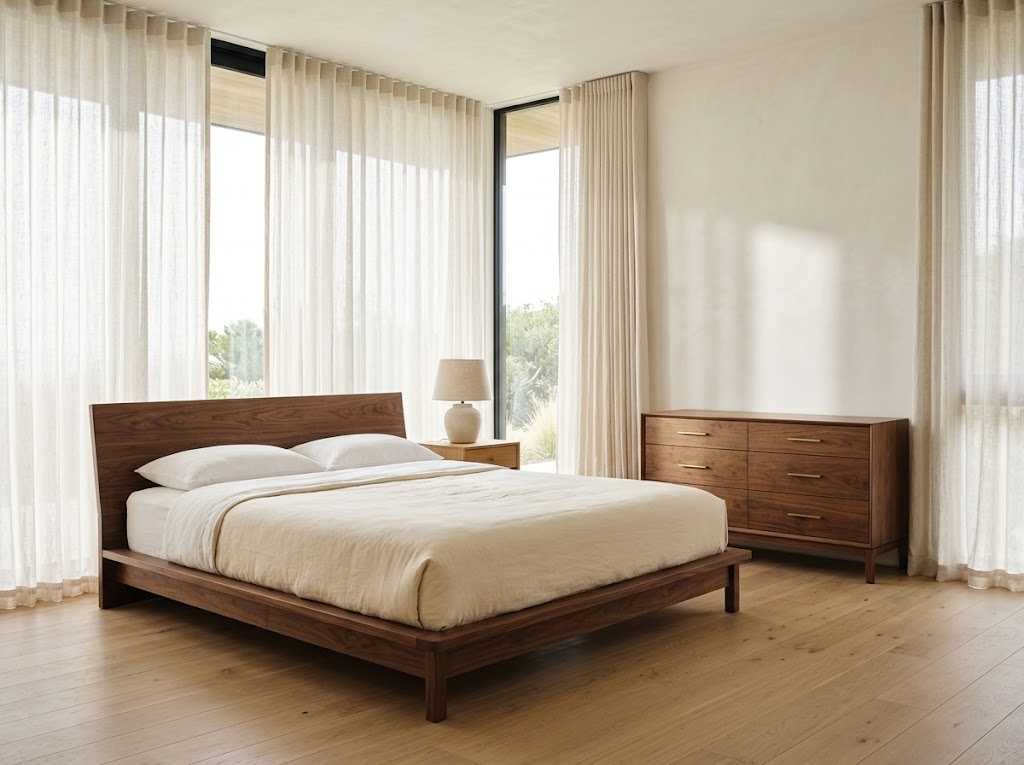
Copeland makes solid cherry and solid walnut bedroom furniture in Vermont with GREENGUARD Gold-certified water-based finishes. The price reflects the materials: a Copeland dresser runs $1,200 to $2,800 depending on size and wood species. If you’re building a bedroom around longevity and certified materials, Copeland is the answer. Their pieces are made to last decades, which changes the cost calculus.
Bookcases and Shelving: Don’t Overlook the Bookshelves
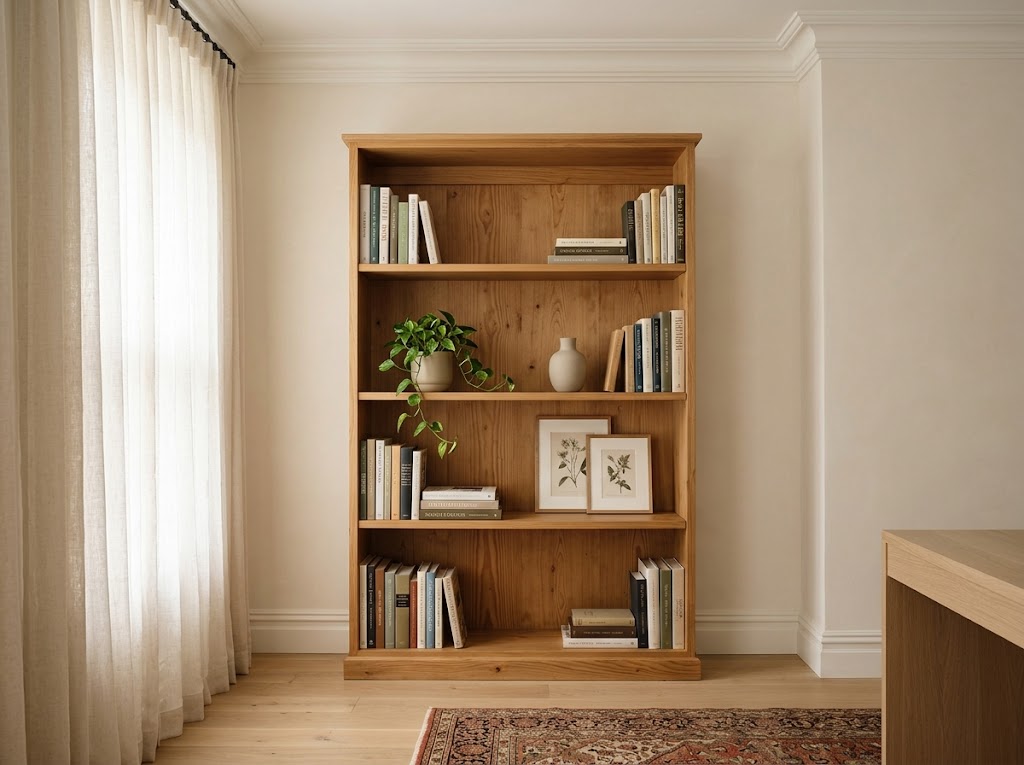
Most people don’t think about the bookcase when they’re building a non-toxic bedroom, but a particleboard bookshelf sitting against your wall is contributing to indoor formaldehyde levels around the clock. At the off-gassing rates typical of new particleboard (around 0.06 to 0.1 ppm in enclosed conditions), adding a bookcase to the equation matters.
Our detailed best non-toxic bookcase roundup covers this category with specific product recommendations. The short version:
IKEA HEMNES Bookcase is solid pine with no particleboard shelving panels and is the most accessible safe bookcase on the market at $149 to $259. The IKEA HEMNES bookcase on Amazon is the most searched option in this category.
Copeland Catalina Bookcase is solid cherry or walnut with a water-based low-VOC finish. It runs $899 to $1,399 and is the premium choice for people who want zero engineered wood in their bedroom.
Vintage and antique solid wood bookcases predate modern urea-formaldehyde adhesives. A solid oak bookcase from the 1950s or 60s has effectively zero modern formaldehyde risk, though lead paint (pre-1978) is worth testing for before refinishing.
Floors and Rugs: What Goes Under the Furniture
Bedroom flooring and rugs matter because you spend time barefoot on them and they trap particulates from the room, including anything off-gassed by nearby furniture. Our best non-toxic rugs guide covers this in full.
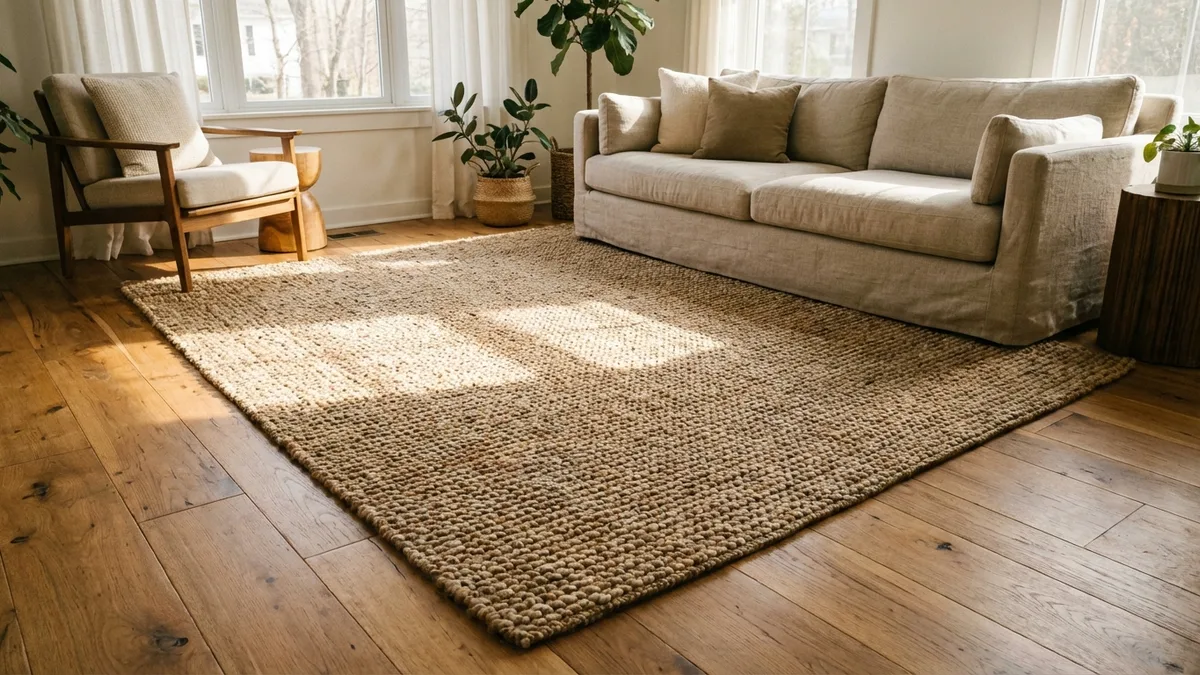
The natural fiber options that work best for bedrooms are wool, organic cotton, jute, and sisal. Wool rugs are naturally flame-resistant and don’t require chemical flame retardants. Cotton rugs can be machine-washed. Jute and sisal are the most affordable natural fiber options.
Synthetic rugs (polypropylene, nylon, polyester) off-gas VOCs when new. The off-gassing from carpet and rugs is less concerning than furniture for most people after the first few weeks, but in the bedroom, even low-level off-gassing adds to the total load.
For bedroom rugs specifically: look for GOTS-certified wool or organic cotton, or a rug labeled with OEKO-TEX Standard 100 certification, which limits harmful chemical content in textiles including synthetic dyes and heavy metals.
Bedding: The Last Layer
You’re in direct contact with your sheets every night, and most conventional cotton sheets are treated with formaldehyde-based “easy care” or “wrinkle-resistant” finishes. These finishes slowly leach formaldehyde into skin contact and the air over time [human observational, Flury et al., 2010].
Our best non-toxic bed sheets guide goes deeper on the options. The standard worth understanding: GOTS certification for sheets means the cotton was grown organically AND processed without harmful dyes, bleaching agents, or finish treatments. OEKO-TEX Standard 100 means the final product was tested for harmful residues, but doesn’t require organic growing practices.
Coyuchi Organic Percale Sheet Set
Coyuchi is GOTS certified and washes their sheets before shipping to remove manufacturing residues. The percale weave gives a crisp, cool feel that most people find comfortable year-round. Their queen sets run $179 to $259. The Coyuchi organic percale sheets on Amazon are the most reviewed GOTS-certified sheet set on the platform.
For people on a tighter budget, OEKO-TEX certified sheets from brands like Parachute and Pottery Barn’s organic line are a practical middle ground. They won’t be GOTS certified, but OEKO-TEX Standard 100 does limit formaldehyde content in the final product to 75 mg/kg for items in contact with skin.
Wood Finishes: What’s on the Surface Matters
If you’re buying raw or unfinished wood furniture, or refinishing vintage pieces, the finish you choose affects your bedroom air quality for years. Our non-toxic wood finish guide covers the main options.
For bedroom furniture, the hierarchy looks like this:
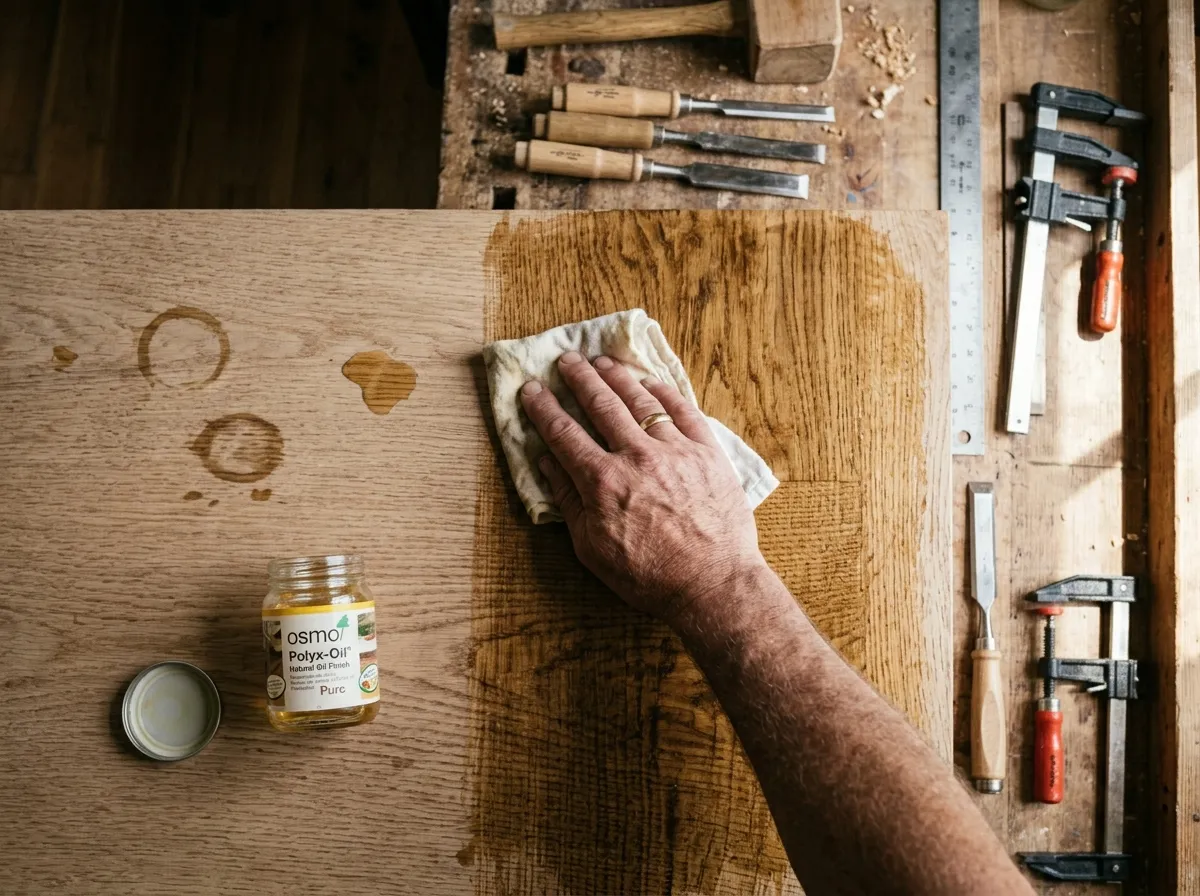
Hardwax oil (Rubio Monocoat, Osmo) is among the best-researched safe options. These penetrating oils cure into the wood surface and don’t form a film that can peel or trap VOCs. Once cured, VOC emissions are negligible. The tradeoff is lower surface protection compared to polyurethane.
Water-based polyurethane is significantly lower-VOC than oil-based polyurethane (typically 50-150 g/L vs. 350-400 g/L) but is still a film-forming finish. Once fully cured (usually 30 days), off-gassing is minimal.
Shellac (amber or dewaxed clear) is a natural resin dissolved in ethyl alcohol. It’s food-safe once cured, but the alcohol solvent does off-gas during application and drying. For bedroom furniture you’re refinishing, shellac is a good option if you apply it with good ventilation and allow 2 to 3 days before moving the piece into a sleeping space.
Solvent-based polyurethane is the most common finish on mass-market furniture. It off-gasses heavily for the first 30 to 90 days and contains phthalates as plasticizers in some formulations. Avoid this on furniture that will live in your bedroom if you have any alternatives.
Bedroom Furniture Safety: The Trade-offs Table
No material is perfect. This table gives you the honest comparison so you can make the call based on your priorities, budget, and sensitivities.
| Material | Main concern | Primary tradeoff |
|---|---|---|
| Solid pine | Soft, dents and scratches easily | Lowest VOC risk of any wood option at any price |
| Solid oak or walnut | Expensive, $$$$ for basic pieces | Extremely durable, minimal off-gassing, lasts decades |
| Particleboard (CARB Phase 2) | Formaldehyde, lower than standard but still present | Cheap and widely available, but worse in enclosed bedroom |
| MDF with low-VOC finish | Formaldehyde (higher than particleboard) | Avoid in bedroom if solid wood alternatives exist |
| Bamboo (strand-woven) | Processing adhesives vary, inconsistent formaldehyde data | Good alternative if manufacturer discloses formaldehyde content |
| Vintage solid wood (pre-1965) | Lead paint risk in pre-1978 pieces | Zero modern adhesive off-gassing, test before refinishing |
| Organic latex (GOLS certified) | Price, not widely available at budget retail | Genuinely no petrochemical foam, no flame retardants |
| CertiPUR-US foam | Still polyurethane-based, petroleum-derived | Significant improvement over uncertified foam; fine for most people |
What We’d Buy at Each Budget
This is the honest version, based on what actually clears the bar, not just what sounds good.
Under $500
The IKEA HEMNES line (bed frame, dresser, bookcase) is the most defensible budget approach. The solid pine construction avoids the formaldehyde-dense particleboard and MDF that fills most furniture in this price range. IKEA’s IWAY chemical standards are real, not marketing language.
For the mattress at this budget: a CertiPUR-US certified foam mattress (Zinus, Tuft and Needle, or similar) is meaningfully better than uncertified alternatives. It won’t be organic, but it limits the most concerning flame retardants and has passed third-party VOC testing. Open it in a different room and let it off-gas for 3 to 7 days before moving it into the bedroom.
For bedding: OEKO-TEX Standard 100 certified sheets are available from Target and Amazon in the $40 to $80 range. They won’t be GOTS certified, but they’ve been tested for formaldehyde residue in the finished product.
Total for a reasonable under-$500 bedroom: HEMNES dresser ($229) + HEMNES bookcase ($149) + CertiPUR-US mattress ($300 to $500) + OEKO-TEX sheets ($50 to $80).
$500 to $2,000
This budget unlocks GREENGUARD Gold certified dressers (DaVinci Jayden) and a proper solid wood platform bed frame (Thuma). Add a Birch or Naturepedic mattress and GOTS-certified sheets (Coyuchi or Boll and Branch), and you have a legitimately well-certified bedroom.
At this range, I’d spend the most budget on the mattress (the highest-contact, highest-exposure piece) and the dresser (the most under-rated formaldehyde source). The bed frame can wait for a future upgrade if needed.
$2,000 and Up
The full certified bedroom: Avocado mattress (GOLS, GOTS, GREENGUARD Gold, MADE SAFE) plus Copeland solid hardwood furniture plus Coyuchi or Brooklinen organic sheets. This is the complete stack with documented certifications at every layer.
The Avocado mattress alone runs $1,699 to $2,499. Copeland furniture runs $1,200 to $2,800 per piece. You’re not going to build this bedroom for $2,000 total, but at this level every piece has an independent certification trail and the bedroom air quality reflects it.
What to Avoid
These patterns are red flags on any bedroom furniture listing:
“Wood finish” without naming a species. This almost always means particleboard or MDF with laminate. The word “finish” here refers to the surface appearance, not the underlying material.
“Engineered wood” without CARB Phase 2 or GREENGUARD certification. Engineered wood is fine if it meets emissions standards. Without a certification, you’re buying on trust.
Foam mattresses without CertiPUR-US or organic certification. Some budget foam mattresses still use flame retardant chemicals including TDCPP (a probable human carcinogen) [regulatory review, EPA, 2020].
Upholstered headboards without stated flammability compliance method. California TB 117-2013 allows brands to meet flammability requirements with a tight-weave fabric barrier instead of flame retardant chemicals. But you have to ask. If the brand doesn’t disclose it, assume chemicals.
Bamboo furniture without formaldehyde disclosure. “Bamboo” sounds natural, but strand-woven bamboo products use adhesive resins. Ask the manufacturer directly for their formaldehyde content data before buying.
How We Evaluated Each Piece
| Criteria | What We Checked |
|---|---|
| Wood species and construction | Named species vs. vague “wood” language |
| Certification | GREENGUARD Gold (furniture), GOLS/GOTS (mattress/bedding) |
| Finish type | Water-based, oil-based, solvent-based |
| Formaldehyde compliance | CARB Phase 2 at minimum, GREENGUARD Gold preferred |
| Flame retardant disclosure | How brand meets flammability standards |
| Off-gassing timeline | Time to negligible emissions based on material |
| Price transparency | No bait-and-switch pricing on sizes |
| Third-party review quality | Amazon rating above 4.4, 50+ reviews minimum |
FAQ
What is the biggest off-gassing risk in the bedroom?
The mattress and the dresser, in that order. The mattress has the most surface area of any single piece and sits under you for 7 to 9 hours nightly. The dresser is the most overlooked: particleboard drawer interiors off-gas into the enclosed drawer space, and every time you open a drawer you get a concentrated dose of that air. Both pieces should be the top priority for upgrading to certified alternatives.
Is GREENGUARD Gold enough for bedroom furniture?
For furniture pieces like dressers, bed frames, bookcases, and nightstands, yes. GREENGUARD Gold requires ongoing emissions testing by UL and holds products to the most stringent VOC and formaldehyde limits in the furniture category. For mattresses, GREENGUARD Gold alone isn’t enough. You also want GOLS certification for the latex and GOTS certification for the cotton and wool cover to confirm organic sourcing and processing.
How long does new furniture off-gas formaldehyde?
Particleboard peaks in months 1 through 3 and tapers over 6 to 12 months, though background emissions continue indefinitely at lower levels. Solid wood with a low-VOC water-based finish is typically negligible after 2 to 4 weeks, once the finish has fully cured. MDF off-gasses more heavily than particleboard and takes longer to taper. If you’re moving new particleboard furniture into a bedroom, a practical step is leaving it in a garage or well-ventilated room for the first 4 to 6 weeks before moving it into the sleeping space.
Is IKEA furniture non-toxic enough for the bedroom?
IKEA’s solid pine HEMNES line is a reasonable option for the bedroom. It uses real pine, not particleboard, for the main structure, and IKEA’s IWAY chemical standards restrict formaldehyde across all product lines. The HEMNES isn’t GREENGUARD Gold certified, so it’s not the most rigorously documented choice, but it’s genuinely better than most furniture in its price range. Avoid IKEA’s particleboard-heavy lines (KALLAX, BILLY, PAX) in the bedroom if you’re trying to reduce formaldehyde exposure. These are CARB Phase 2 compliant but still emit measurable formaldehyde.
Should I worry about vintage furniture in the bedroom?
Vintage solid wood furniture built before 1965 is actually among the lowest-risk options for off-gassing: zero modern urea-formaldehyde adhesives, no synthetic foam, and construction methods that relied on solid joinery rather than glued engineered panels. The one real concern is lead paint. Before 1978, lead-based paint was common in household furniture and is still present on many vintage pieces. Test with a $5 lead swab kit before refinishing or sanding. If lead is present, encapsulate (paint over) rather than sand.
What We Don’t Know Yet
Formaldehyde off-gassing from furniture is well-characterized at the material level, but long-term data is limited on actual personal exposure in furnished bedrooms under real sleeping conditions. Most emissions testing happens in sealed chambers at standardized temperature and humidity, not in a room with variable airflow, seasonal temperature swings, and multiple furniture pieces interacting. Cumulative exposure from several CARB Phase 2 compliant pieces in the same enclosed bedroom hasn’t been well-studied.
The health effects of low-level chronic formaldehyde exposure below regulatory thresholds are also not fully established. Most of the carcinogenicity evidence comes from occupational exposure studies at much higher concentrations than typical consumer furniture off-gassing [human epidemiological, IARC, 2012]. Whether the sub-threshold exposures common in newly furnished bedrooms carry meaningful long-term risk is genuinely uncertain. The precautionary case for solid wood and certified materials is reasonable, but it’s worth being honest that we don’t have clear dose-response data at the concentrations most people actually encounter.
Our Take
The bedroom matters more than any other room for chemical exposure, and the priorities are clear. Start with the mattress and dresser: these two pieces have the most surface area and the most direct contact with your body and the air you breathe for hours every night. If the full organic certification stack is out of reach, GREENGUARD Gold certified furniture and a CertiPUR-US mattress are a meaningful improvement over uncertified alternatives.
Solid pine is the most accessible starting point for furniture that won’t off-gas at concerning levels. The IKEA HEMNES line is the easiest budget entry. The DaVinci Jayden dresser is the best-value GREENGUARD Gold piece on the market. And if you’re building a long-term bedroom, Copeland hardwood furniture paired with an Avocado mattress is the most complete non-toxic setup you can build.
Don’t wait for the perfect budget to make any change. Replacing one piece at a time, starting with whichever piece is newest (and therefore off-gassing most actively), is a reasonable path.
You Might Also Like
- Best Non-Toxic Dining Tables and Chairs
- Best Non-Toxic Kids Furniture: Cribs, Dressers, and Toddler Beds
- Best Non-Toxic Patio Furniture in 2026 (No PFAS, FSC-Certified Wood)
- Is Pottery Barn Furniture Non-Toxic? (What We Found)
- Is IKEA Furniture Non-Toxic? What to Know
- Best Non-Toxic Crib Mattress in 2026 (Organic, Certified)
- Non-Toxic Furniture Brands: Complete Guide
Sources
- EPA: Formaldehyde and Indoor Air Quality - EPA reference concentration, indoor air guidelines, and exposure data.
- GREENGUARD Certification Program - UL - Certification methodology, VOC and formaldehyde testing standards for Gold tier.
- California Air Resources Board: Airborne Toxic Control Measure for Composite Wood Products (CARB) - CARB Phase 2 formaldehyde emission limits for particleboard, MDF, and plywood.
- GOTS: Global Organic Textile Standard - Certification scope, organic fiber and processing chemical requirements.
- GOLS: Global Organic Latex Standard - Latex certification criteria and organic sourcing requirements.
- California Department of Consumer Affairs: TB 117-2013 - Flammability standard allowing non-chemical compliance with tight fabric barrier.
- de Groot AC, Maibach HI (2010). Does allergic contact dermatitis from formaldehyde in clothes treated with durable-press chemical finishes exist in the USA? Contact Dermatitis. - Human observational evidence on formaldehyde release from textile finishes.
- EPA: TDCPP Assessment - EPA regulatory review of TDCPP flame retardant, classified as probable human carcinogen.
- MADE SAFE Certification Standards - Multi-ingredient and chemical hazard screening program, Avocado mattress certification documentation.