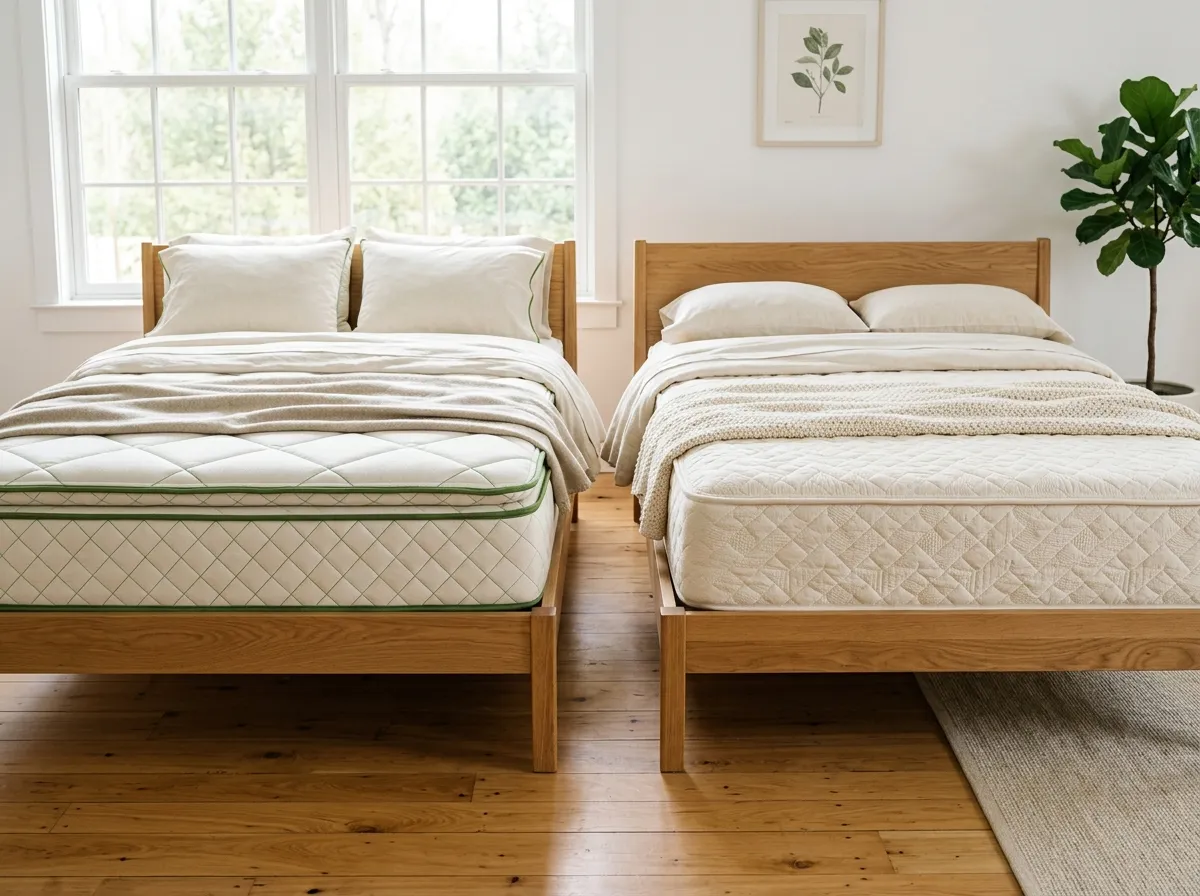
Most Purple vs Avocado articles compare firmness, motion transfer, and trial periods. That’s useful if you’re choosing between mattress feels. But if you’re reading on a site called NonToxicLab, you probably want to know something else entirely: what’s actually in these mattresses, what’s off-gassing while you sleep, and whether the difference in materials is meaningful or marketing.
The short answer is that the difference is real. Avocado and Purple take completely different approaches to what a mattress is made of, and the gap in chemical transparency is significant.
The Short Answer
Avocado wins on chemical safety, and it’s not close. The Avocado Green Mattress holds six simultaneous finished-product certifications: GOLS (organic latex), GOTS (organic cotton and wool), GREENGUARD Gold (full mattress emissions), OEKO-TEX Standard 100 Class I, MADE SAFE, and EWG Verified. It uses no polyurethane foam anywhere in the mattress, and it meets federal flammability standards using natural wool rather than chemical flame retardants.
Purple is not a bad mattress on chemical safety relative to most foam competitors. Its GelFlex Grid is a food-contact-grade thermoplastic elastomer with low inherent toxicity. It uses no fiberglass and no added chemical flame retardants. But the mattress still uses polyurethane foam for its base and transition layers, carries CertiPUR-US on the foam but no GREENGUARD Gold on the finished assembled product, and has no organic materials of any kind.
Who should get Purple instead: People who want to stay on Amazon for convenience, who prefer the unique grid feel over natural latex, or who want lower upfront cost. Purple is meaningfully better than conventional foam mattresses. It’s just not in the same category as Avocado for chemical safety.
Check Avocado: Avocado Green Mattress store on Amazon (full mattress DTC at avocadogreenmattress.com)
Check Purple: Purple Original Mattress on Amazon
Why This Comparison Is Different
Every other comparison article you’ll find covers sleep feel: firmness ratings, bounce, motion transfer, edge support. Those are real considerations. But most people spending $1,300-$2,000 on a mattress don’t realize they’re also choosing between fundamentally different material categories.
You spend roughly 2,900 hours per year on your mattress, with your face a few inches from the surface. If that surface is off-gassing volatile organic compounds, you’re breathing low-level chemical exposures every night. Whether that matters for your health depends on your sensitivity, ventilation, and overall body burden.
This comparison focuses on what each mattress is made of, what the certifications actually verify (they differ a lot), and what the real-world off-gassing difference looks like between a polyurethane foam mattress and a natural latex organic mattress.
How We Compared Them
We reviewed published material disclosures from both brands, verified certification status against issuing databases (CertiPUR-US directory, GOTS database, UL’s GREENGUARD product catalog), analyzed independent testing data where available, and cross-referenced with consumer reports on off-gassing and off-gassing duration. Our existing deep-dive on Purple’s materials and Avocado’s full review provided baseline research for both.
Side-by-Side: Purple vs Avocado Mattress
| Feature | Purple Original | Avocado Green |
|---|---|---|
| Comfort layer material | GelFlex Grid (TPE polymer) | GOLS-certified organic Dunlop latex |
| Support/base layers | Polyurethane foam | Pocketed recycled steel coils |
| Flame retardant method | Non-woven fire barrier fabric | Organic wool (natural fire resistance) |
| Chemical flame retardants | None added | None |
| Fiberglass | No | No |
| GREENGUARD Gold | No (CleanAir Gold on grid only) | Yes, on finished mattress |
| CertiPUR-US | Yes (foam layers) | N/A (no foam) |
| GOLS (organic latex) | N/A | Yes |
| GOTS (organic textiles) | No | Yes |
| OEKO-TEX Standard 100 | Not confirmed | Class I (strictest tier) |
| MADE SAFE | No | Yes |
| Off-gassing severity | Moderate (polyurethane foam) | Minimal (natural latex, no foam) |
| Off-gassing duration | 2-4 days typically | 1-3 days (natural latex smell) |
| Queen price | $$$$ | $$$$ |
| Trial period | 100 nights | 365 nights |
| Warranty | 10 years | 25 years |
| Buy | Check on Amazon | Check Avocado store |
The Purple Grid: What It Actually Is
Purple’s marketing leans heavily on the GelFlex Grid as something new and different in the mattress world, which it is. But “different” doesn’t automatically mean “safer,” and understanding what the grid is made of matters if you’re buying on chemical safety grounds.
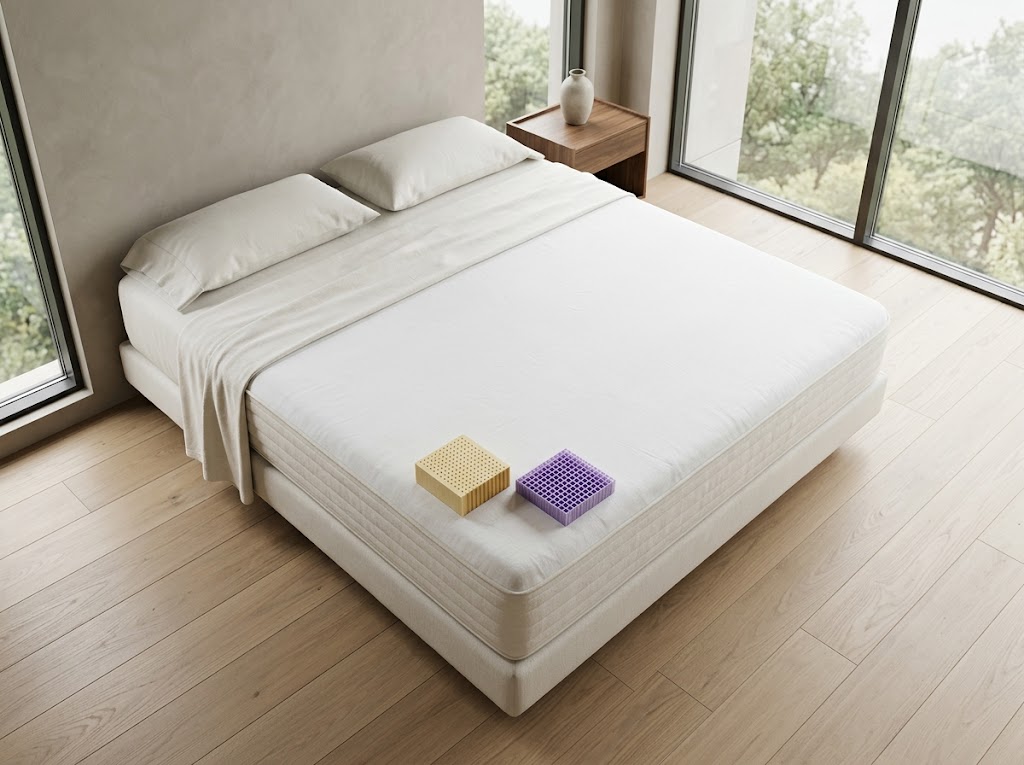
The Purple GelFlex Grid is made from a polyether-based thermoplastic elastomer (TPE). Purple describes the material as “food-contact grade,” meaning it meets FDA 21 CFR standards for materials that contact food. That’s a meaningful baseline. TPE is generally considered a low-toxicity material. It doesn’t use the blowing agents that polyurethane foam relies on, which reduces its off-gassing profile relative to the foam layers below it.
Purple also holds Intertek’s CleanAir Gold certification specifically for the GelFlex Grid material, which confirms low VOC emissions from the grid itself. That’s a real data point.
But here’s what the marketing doesn’t emphasize: the GelFlex Grid is only the top comfort layer. Under it sits polyurethane foam. Purple’s base layer, transition layer, and (in higher models) additional comfort layers are all conventional polyurethane foam certified under CertiPUR-US. This matters because polyurethane foam is the primary source of the “new mattress smell” that most people associate with foam mattresses. The foam uses blowing agents in its manufacture, and residual chemicals from that process drive most VOC off-gassing.
CertiPUR-US is the industry standard for foam certification, and it’s meaningful. It confirms the foam has low VOC emissions (under 0.5 ppm), no ozone-depleting substances, no PBDEs, no TDCPP (chlorinated tris), no mercury or lead, no formaldehyde, and no prohibited phthalates. What CertiPUR-US does not do is test the finished, assembled mattress as a complete product in a simulated room environment. GREENGUARD Gold does that test. Purple has CertiPUR-US on the foam but not GREENGUARD Gold on the full mattress.
For healthy adults in well-ventilated rooms, a Purple mattress is probably fine. The no-fiberglass and no-chemical-flame-retardant commitments are genuine positives over many competitors. The TPE grid has a lower inherent toxicity than polyurethane foam. But if your standard is “GREENGUARD Gold certified as a complete mattress,” Purple doesn’t meet it.
Check the Purple Original on Amazon
Avocado Green Mattress: What Six Certifications Actually Mean
Avocado’s certification stack is genuinely unusual in the mattress industry. Most brands have one, maybe two certifications. Avocado has six simultaneously applied to the finished product.
Here’s what each one tests, because they’re not redundant:
GOLS (Global Organic Latex Standard): Confirms the Dunlop latex contains at least 95% certified organic raw material, from rubber tree cultivation through processing. This also sets limits on chemical additives and requires safe working conditions at production facilities.
GOTS (Global Organic Textile Standard): Confirms the cotton cover and wool layers meet organic standards from field through manufacturing. GOTS covers the entire supply chain, not just the raw materials.
GREENGUARD Gold: Certified by UL Environment, this tests the complete assembled mattress (not raw components in a lab) in an emissions chamber simulating a real room. It must meet California’s strict indoor air quality standards for schools and healthcare facilities. This is the most rigorous finished-product emissions test available for consumer mattresses.
OEKO-TEX Standard 100 Class I: Independently tests every component material, including threads, zippers, and internal layers, for harmful substances including pesticides, heavy metals, formaldehyde, and phthalates. Class I is the strictest tier, designed for products that contact infant skin.
MADE SAFE: Screened by the nonprofit Made Safe organization for 6,500+ known or suspected toxic substances across 13 categories including carcinogens, endocrine disruptors, and neurotoxins.
EWG Verified: Environmental Working Group’s verification program that screens for EWG’s health concerns list.
None of these certifications overlap significantly. Each tests something different. Together they give you the deepest third-party chemical safety picture available for any mainstream mattress.
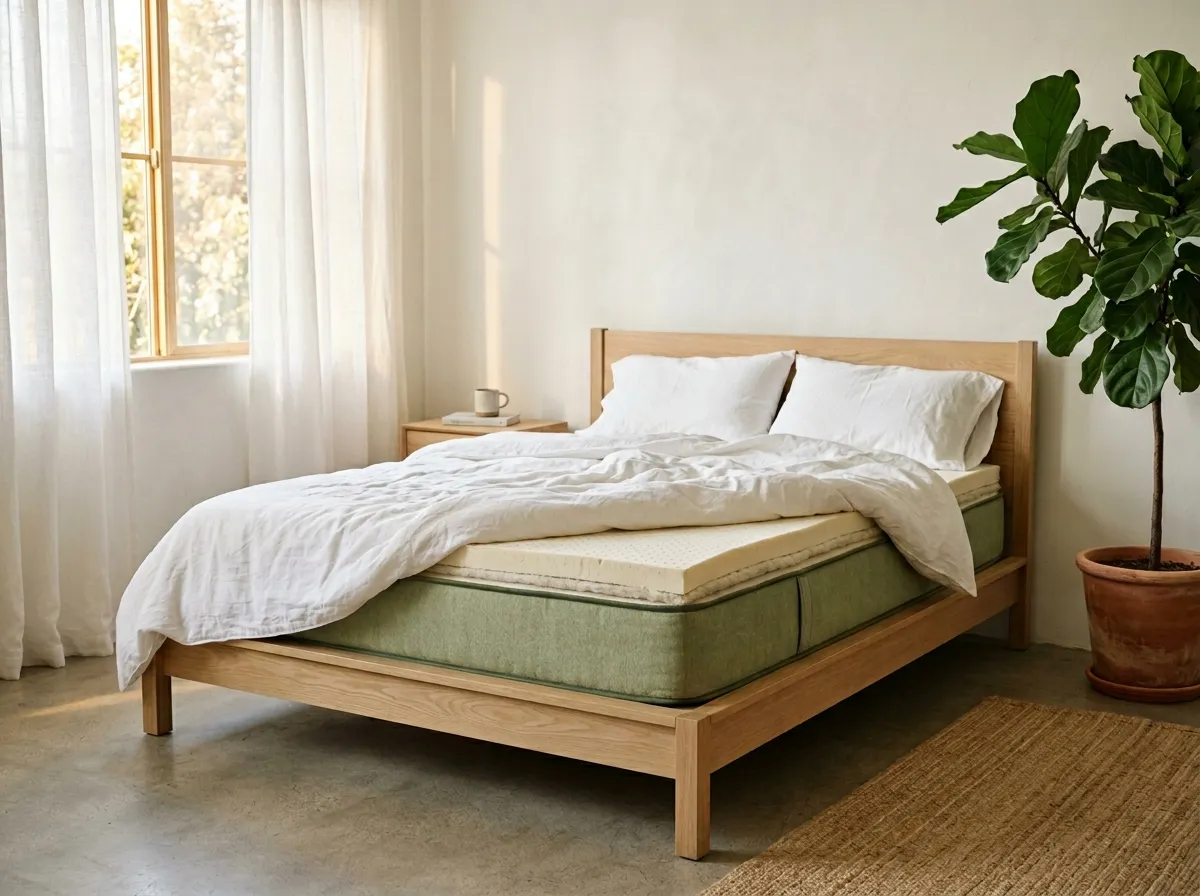
The materials under those certifications: GOLS-certified organic Dunlop latex as the comfort layer, organic wool as a natural flame barrier (no chemical flame retardants needed), pocketed recycled steel coils as the support system, and a GOTS-certified organic cotton cover. There is no polyurethane foam anywhere in the mattress.
On off-gassing: Avocado’s GREENGUARD Gold certification means the full assembled mattress has been tested in a chamber environment and confirmed to meet strict emission limits. Natural latex does produce a faint smell when new (most owners describe it as a mild rubber scent). It dissipates within 1-3 days. This is categorically different from polyurethane foam off-gassing, which involves synthetic VOCs from blowing agents and other manufacturing chemicals.
On flame retardants: Wool chars rather than burns. Avocado meets the federal flammability standard (16 CFR Part 1633) entirely through its organic wool layer, with no chemical treatment. This is one of the most important material advantages the Avocado has over conventional mattresses, which typically meet flammability requirements through brominated or chlorinated chemical treatments that [human biomonitoring studies, Shaw et al., 2010] have found accumulate in house dust, breast milk, and body fat.
Check the Avocado Green Mattress store on Amazon
The Avocado vs Purple Price Reality
This comparison is closer on price than most people expect. At current pricing:
- Purple Original Queen: $1,099-$1,499 depending on sales
- Avocado Green Queen: $1,399 standard, $1,999 with pillow top
The base Avocado is roughly $100-300 more than Purple. For a mattress you’ll keep for 15-20 years (Avocado’s realistic lifespan, supported by a 25-year warranty versus Purple’s 10-year warranty), that’s a small premium. Purple’s warranty is 10 years.
On a per-year cost basis, accounting for typical lifespan differences between natural latex and polyurethane foam:
- Avocado at $1,399 over 15 years: about $93/year
- Purple at $1,299 over 8 years (typical polyurethane foam lifespan): about $162/year
The math favors Avocado if longevity holds, though real-world lifespans vary.
The Trade-offs
| Avocado Green | Purple Original | |
|---|---|---|
| Main concern | Firm feel without pillow top; DTC-only (not sold as full mattress on Amazon) | Polyurethane foam base; no GREENGUARD Gold on assembled product; no organic materials |
| Primary tradeoff | Best chemical safety stack at the price; side sleepers need $$$ pillow top add-on | Lower upfront cost, unique grid feel; foam layers off-gas like other foam mattresses |
| Best for | Anyone prioritizing certified organic materials, minimal off-gassing, or chemical sensitivities; back and stomach sleepers; building a non-toxic bedroom | People who want better-than-average foam safety without going full organic; grid feel enthusiasts |
| Not ideal for | Side sleepers on a tight budget (pillow top required); anyone who wants soft memory foam feel | Those with chemical sensitivities; children’s rooms where GREENGUARD Gold on finished product matters; anyone who wants certified organic materials |
What We Don’t Fully Know
For Purple: The finished mattress hasn’t been tested under GREENGUARD Gold conditions, so we don’t have emissions data for all layers combined. The cover fabric’s treatment status (antimicrobial, stain-resistant chemicals) isn’t fully disclosed. The fire barrier fabric is described in general terms but not fully specified. These are common gaps across the mattress industry, not Purple-specific failures.
For Avocado: GOLS and GOTS certifications confirm organic sourcing and processing standards. They don’t certify zero-VOC off-gassing for every individual. A small percentage of people have a sensitivity to natural latex compounds that can persist beyond the typical 1-3 day smell window. Long-term dose-response data on chronic low-level natural rubber compound exposure from sleeping surfaces is limited. The GREENGUARD Gold certification provides a meaningful safety floor, but it would be honest to note the data doesn’t extend decades out.
According to NonToxicLab’s assessment: the gaps in Purple’s chemical profile are structural (no GREENGUARD Gold, polyurethane foam base). The gaps in Avocado’s profile are at the frontier of knowledge (long-term low-dose natural latex data). Those are meaningfully different categories of uncertainty.
Durability: Which Mattress Lasts Longer
This is where the material difference becomes financial, not just chemical.
Avocado: Natural Dunlop latex is one of the most durable mattress materials available. It springs back after compression rather than developing the body impressions that foam is prone to. Most Avocado owners can realistically expect 15-20 years of solid performance. The 25-year warranty reflects this. Pocketed steel coils hold up well, and the organic cotton cover is the first thing to show cosmetic wear, though that doesn’t affect support or safety. Rotate every 6 months for the first two years, use a mattress protector, and keep it on a proper slatted frame.
Purple: Polyurethane foam degrades over time in a way that natural latex does not. The foam softens and develops impressions, typically showing meaningful performance degradation around years 6-9. Purple’s 10-year warranty covers defects but is shorter than Avocado’s by 15 years. The GelFlex Grid layer itself is durable and resilient (TPE doesn’t break down the same way foam does), but the foam beneath it is still the limiting factor. Budget-minded buyers often replace Purple mattresses once or twice over the period an Avocado would still be performing well.
On a per-year cost basis: an Avocado Queen at $1,399 over 15 years works out to roughly $93 per year. A Purple Original at $1,299 over 8 years (conservative foam lifespan) works out to roughly $162 per year. The “cheaper” mattress ends up costing more.
What We’d Pick
For chemical safety as the primary criterion, Avocado. The certification stack is real, independently audited, and annually renewed. No polyurethane foam, no chemical flame retardants, GREENGUARD Gold on the finished product. If you’re building a non-toxic bedroom or have chemical sensitivities, or if children will sleep on this mattress, the Avocado’s material profile is in a different league.
For side sleepers: Get the Avocado with the pillow top, or look at the Naturepedic Serenade, which is softer and available directly on Amazon with GOTS certifications and GREENGUARD Gold.
For Purple: If you’re upgrading from a conventional memory foam mattress and want something meaningfully better on chemical safety without the full organic price, Purple is a legitimate step up. No fiberglass, no added chemical flame retardants, low-toxicity grid material. It’s just not an organic mattress, and it shouldn’t be compared to one.
If budget is the binding constraint: The Brentwood Home Crystal Cove offers GOTS and GOLS certifications at a lower price point than Avocado, and it’s a real organic hybrid. Check our full best non-toxic mattress guide for the full field.
FAQ
Which is safer, Purple or Avocado?
Avocado is safer by every measurable chemical safety metric. It holds GOLS, GOTS, GREENGUARD Gold (on the finished assembled mattress), OEKO-TEX Standard 100 Class I, MADE SAFE, and EWG Verified certifications. It uses no polyurethane foam and no chemical flame retardants. Purple’s GelFlex Grid is a relatively low-toxicity thermoplastic elastomer, but the mattress uses polyurethane foam for its base and transition layers, and the finished product doesn’t carry GREENGUARD Gold certification. For someone weighing chemical exposure during sleep, that’s a meaningful difference.
What is the Purple GelFlex Grid made of?
The Purple GelFlex Grid is a polyether-based thermoplastic elastomer (TPE). Purple describes it as food-contact grade, meaning it meets FDA 21 CFR standards for materials that contact food. TPE is generally considered a low-toxicity material. It doesn’t use the blowing agents that polyurethane foam does, so its off-gassing profile is lower than the foam layers beneath it. Intertek’s CleanAir Gold certification covers the grid specifically for low VOC emissions.
Does the Avocado mattress have a chemical smell?
The Avocado has a mild natural latex smell when first unboxed. Most owners describe it as a faint rubber scent that dissipates within 1-3 days. This is not the same as the chemical VOC off-gassing from polyurethane foam, which involves synthetic chemicals from the foam manufacturing process. The Avocado holds GREENGUARD Gold certification for low chemical emissions, confirming it meets strict indoor air quality limits even in settings like schools and hospitals.
Does Purple mattress have fiberglass?
No. Purple states their mattresses do not use fiberglass fire barriers. They use a non-woven fire barrier fabric instead, which avoids the risk of microscopic glass fiber release if the inner cover is compromised. This puts Purple ahead of many budget and mid-range foam mattresses that do use fiberglass barriers.
Is Avocado mattress worth the higher price compared to Purple?
That depends on what you’re optimizing for. On chemical safety, the premium is justified. The Avocado uses fundamentally different materials (organic latex, organic wool, organic cotton) versus synthetic foam, and those materials have been independently tested at the finished-product level. The 25-year warranty versus Purple’s 10-year warranty also changes the per-year cost math significantly. If you’re comparing pure sleep feel without factoring in materials or longevity, the choice is more personal.
Is the Purple mattress safe for children?
Purple mattresses carry CertiPUR-US certification on their foam and don’t use fiberglass or added chemical flame retardants, which puts them ahead of many conventional options. However, for children, we generally recommend mattresses with GREENGUARD Gold certification on the finished product, since children are more sensitive to chemical exposures and spend more hours sleeping. See our guide to best non-toxic crib mattresses for younger children.
You Might Also Like
- Avocado vs Birch Mattress: Which Organic Mattress Is Better?
- Casper vs Avocado Mattress: Which Is Actually Safer to Sleep On?
- Saatva vs Avocado Mattress: Organic Mattress Showdown
- Birch Mattress Review: A Year of Sleeping on Organic Latex
- Naturepedic Mattress Review: Is the Premium Price Justified?
- Avocado vs Naturepedic: Which Organic Mattress Is Better?
Sources
- CertiPUR-US certification directory and standards for flexible polyurethane foam
- Avocado Green Mattress certifications page: GOTS, GOLS, GREENGUARD Gold, OEKO-TEX Class I, MADE SAFE, EWG Verified
- Purple support: Does the Purple mattress off-gas?
- Purple blog: About the CertiPUR-US program
- UL Environment. GREENGUARD Gold Certification Criteria. Covers emissions testing methodology.
- Shaw SD, et al. Halogenated flame retardants: Do the fire safety benefits justify the risks? Reviews on Environmental Health, 2010. [human biomonitoring]
- Consumer Product Safety Commission. 16 CFR Part 1633: Standard for the Flammability of Mattresses.
- FDA. 21 CFR Part 177.2600: Food contact materials regulations.
- Global Organic Latex Standard (GOLS). Standard requirements for organic latex.
- Global Organic Textile Standard (GOTS). General description and certification criteria.