The best non-toxic baby wipes are WaterWipes Original. They contain just two ingredients: 99.9% purified water and a drop of fruit extract (grapefruit seed extract). No fragrance, no phenoxyethanol, no parabens, no methylisothiazolinone, and no preservatives that raise safety flags. Our team at NonToxicLab rates WaterWipes as the gold standard for families who want the absolute simplest, cleanest wipe available.
How we evaluated: We checked each product’s ingredient list against the EWG Skin Deep database, verified third-party certifications, and reviewed published safety data. Full methodology For families balancing cost and ingredient quality, Seventh Generation Free & Clear wipes offer a solid ingredient profile at roughly half the per-wipe cost of WaterWipes. They are unscented, plant-based, and skip the worst offenders on the ingredient list.
Quick Comparison: Best Non-Toxic Baby Wipes
| Baby Wipe | Price Per Wipe | Fragrance-Free | Phenoxyethanol-Free | Paraben-Free | MIT-Free | Cloth Material |
|---|---|---|---|---|---|---|
| WaterWipes Original | $ | Yes | Yes | Yes | Yes | Water-based nonwoven |
| Honest Company | $ | Yes | No | Yes | Yes | Plant-based cloth |
| Pampers Aqua Pure | $ | Yes | No | Yes | Yes | Cotton-enhanced |
| Seventh Generation | $ | Yes | Yes | Yes | Yes | FSC-certified plant-based |
| Bambo Nature | $ | Yes | Yes | Yes | Yes | Organic cotton blend |
Ingredients to Avoid in Baby Wipes
Baby wipes are a high-frequency contact product. Most families go through thousands of wipes per year, each one applied directly to a baby’s skin, often on sensitive areas, multiple times per day. The ingredient list matters more here than on almost any other baby product because of the volume of exposure and the skin it contacts.
Fragrance
Fragrance is the easiest ingredient to avoid. On a label, the single word “fragrance” or “parfum” can represent a blend of dozens of individual chemicals, many of which are never disclosed because fragrance formulations are protected as trade secrets. These blends commonly include phthalates (used to make scent last longer), synthetic musks, and various allergens.
Dr. Shanna Swan has identified phthalates as endocrine disruptors that interfere with hormonal signaling, particularly during early development. Her research connects prenatal phthalate exposure to reproductive changes in male infants. Since baby wipes with fragrance apply these chemicals directly to a baby’s skin during every diaper change, eliminating fragrance is one of the simplest and most impactful steps.
Every wipe on this list is fragrance-free. Not “unscented” (more on that distinction below), but truly fragrance-free.
Phenoxyethanol
Phenoxyethanol is a preservative that replaced parabens in many “clean” baby products. It prevents bacterial and fungal growth in wet wipes, which is a legitimate function. The concern is that phenoxyethanol is a glycol ether that can be absorbed through the skin, and the EU’s Scientific Committee on Consumer Safety flagged it for restricted use in products for children under three, particularly in the diaper area.
At the concentrations used in baby wipes (typically under 1%), phenoxyethanol is considered acceptable by most regulatory bodies. But for families who want to minimize preservative exposure on babies with sensitive or eczema-prone skin, phenoxyethanol-free options exist.
WaterWipes, Seventh Generation, and Bambo Nature all skip phenoxyethanol. Honest Company and Pampers Aqua Pure include it.
Methylisothiazolinone (MIT) and Methylchloroisothiazolinone (MCI)
MIT and MCI are preservatives that were commonly used in wet wipes until widespread reports of allergic contact dermatitis. The European Commission restricted MIT in leave-on products (including wipes) in 2014, and many manufacturers reformulated. However, some budget and store-brand wipes still use these preservatives.
If you see methylisothiazolinone or methylchloroisothiazolinone on a baby wipe ingredient list, choose a different product. None of the wipes on this list contain either compound.
Parabens
Parabens (methylparaben, propylparaben, butylparaben) are preservatives that mimic estrogen in the body. Dr. Leonardo Trasande has noted that parabens are detectable in the urine of the vast majority of the U.S. population, and that early-life exposure to endocrine-disrupting chemicals contributes to lifelong health effects. While the direct link between paraben exposure from baby wipes and specific health outcomes is still being studied, avoiding them is a simple precaution.
All five wipes on this list are paraben-free.
Sodium Lauryl Sulfate (SLS) and Sodium Laureth Sulfate (SLES)
These surfactants are added to some wipes for cleaning power but can irritate sensitive skin and strip natural oils. They are more common in adult cleansing wipes than in baby-specific products, but check the label.
Polyethylene Glycol (PEGs)
PEGs are used as emulsifiers and can be contaminated with 1,4-dioxane (a probable carcinogen) as a manufacturing byproduct. Look for “PEG” followed by a number on the ingredient list.
”Unscented” vs. “Fragrance-Free”: Why It Matters
These two terms sound interchangeable but mean different things:
Fragrance-free means no fragrance ingredients were added to the product. The product smells like whatever its base ingredients smell like.
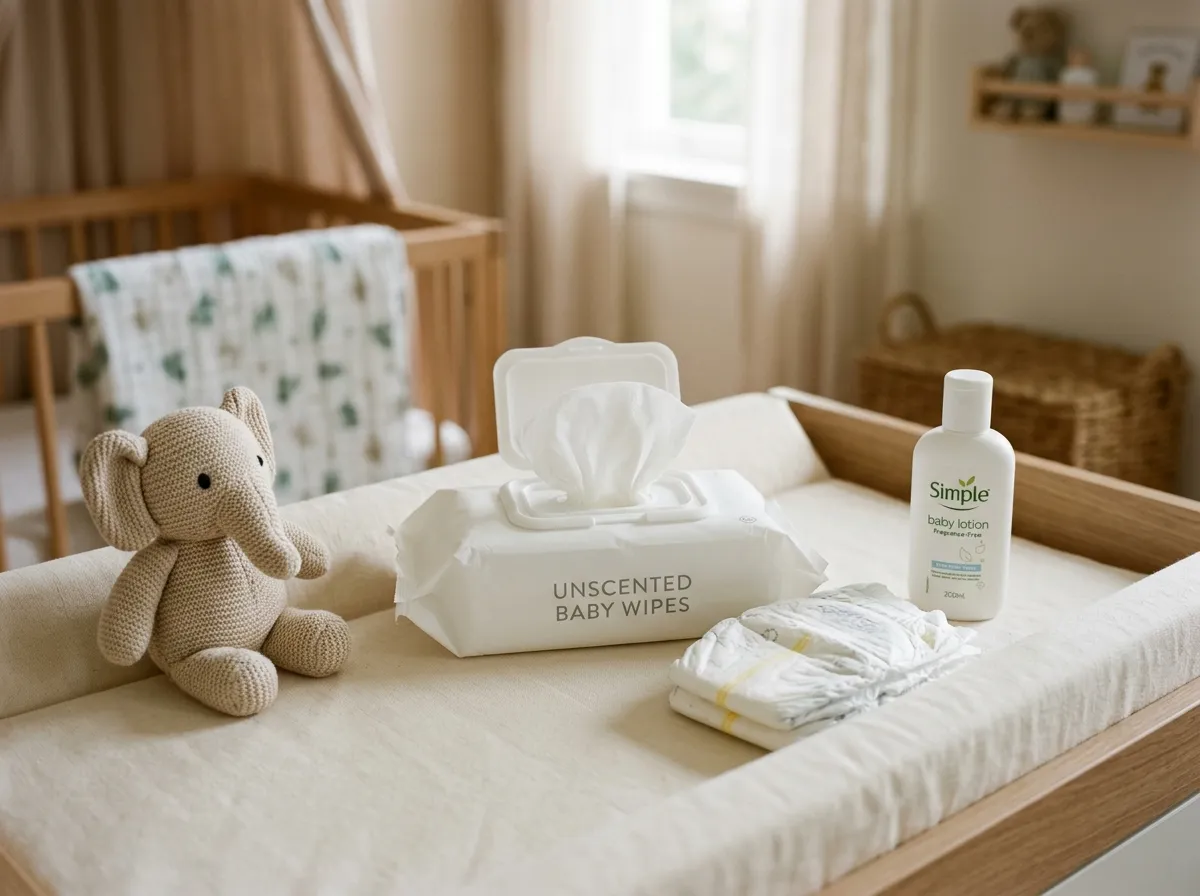
Unscented means the product has no noticeable scent, but manufacturers may have added masking fragrances to neutralize the smell of other ingredients. An “unscented” product can still contain fragrance chemicals on the ingredient list.
Always choose “fragrance-free” over “unscented” for baby wipes. If the label says “unscented,” check the ingredient list for the word “fragrance” or “parfum.”
NonToxicLab’s [editorial analysis] found this labeling distinction trips up even well-informed parents. The term “unscented” sounds safer, but it can actually mean the opposite of what you expect.
Detailed Reviews
WaterWipes Original
Price: $0.04-$0.06/wipe | Ingredients: 2 | Best for: Purest ingredients
WaterWipes built their entire brand around minimal ingredients: 99.9% purified water and 0.1% grapefruit seed extract. That is genuinely it. No preservatives, no surfactants, no emulsifiers. The trade-off is a shorter shelf life (the manufacturer recommends using within 4 weeks of opening) and they do not clean as aggressively as wipes with surfactants.
Ingredient highlights:
- 99.9% purified water
- 0.1% grapefruit seed extract (Citrus Grandis)
- No preservatives of any kind
- No phenoxyethanol, no parabens, no MIT
What to know: Because there are no preservatives, these wipes can grow bacteria if stored improperly. Keep the package sealed, store at room temperature, and use within a month of opening. Some parents find them less effective for particularly messy diaper changes because there are no surfactants to break down oils.
WaterWipes are available at most major retailers and are frequently on subscription deals that bring the per-wipe price closer to $0.04.
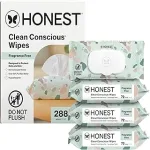
Honest Company Baby Wipes
Price: $0.03-$0.05/wipe | Ingredients: ~10 | Best for: Plant-based cloth with effective cleaning
Honest Company wipes use a plant-based cloth with a hypoallergenic formula that includes purified water, aloe, chamomile, and a modest preservative system. They clean more effectively than WaterWipes due to the inclusion of mild surfactants and are thicker than most budget wipes.
Ingredient highlights:
- Plant-based, hypoallergenic formula
- No fragrance, no parabens, no MIT
- Contains phenoxyethanol (as a preservative)
- Includes mild plant-derived cleansing agents
What to know: Honest Company has reformulated their wipes several times over the years, and the current formula is significantly cleaner than earlier versions. The main compromise versus WaterWipes or Bambo Nature is the inclusion of phenoxyethanol. At the concentrations used, this is within regulatory safety limits, but families avoiding all synthetic preservatives will want to choose differently.
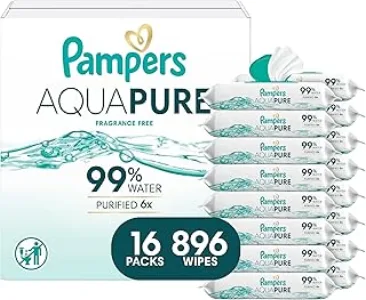
Pampers Aqua Pure
Price: $0.03-$0.04/wipe | Ingredients: ~8 | Best for: Mainstream availability
Pampers Aqua Pure wipes are the easiest non-toxic option to find. They are stocked at virtually every grocery store, pharmacy, and big box retailer. The formula is 99% purified water with a cotton-enhanced cloth that is notably softer than the standard Pampers wipe.
Ingredient highlights:
- 99% purified water
- Cotton-enhanced cloth
- No fragrance, no parabens, no MIT
- Contains phenoxyethanol
- Contains citric acid (pH adjuster)
What to know: These are a solid “good enough” option for families who do not want to hunt for specialty products. The phenoxyethanol inclusion puts them behind WaterWipes and Bambo Nature on ingredient purity, but the widespread availability and lower cost make them practical for everyday use.
Seventh Generation Free & Clear
Price: $0.02-$0.04/wipe | Ingredients: ~6 | Best for: Best value with clean ingredients
Seventh Generation Free & Clear wipes offer the best balance of ingredient quality and price in this roundup. The cloth is FSC-certified, plant-based, and the formula skips fragrance, phenoxyethanol, parabens, and MIT. They use a combination of gentle plant-based cleansers and a mild preservation system.
Ingredient highlights:
- Plant-based, FSC-certified cloth
- No fragrance, no phenoxyethanol, no parabens, no MIT
- Includes mild plant-derived cleansing agents
- Uses tocopherol (vitamin E) as an antioxidant
What to know: At the lowest per-wipe cost in this roundup, Seventh Generation punches above its price class on ingredient quality. The cloth is thinner than Honest Company or Bambo Nature wipes, so you may use two where one thicker wipe would suffice. But even at double usage, the cost stays competitive.
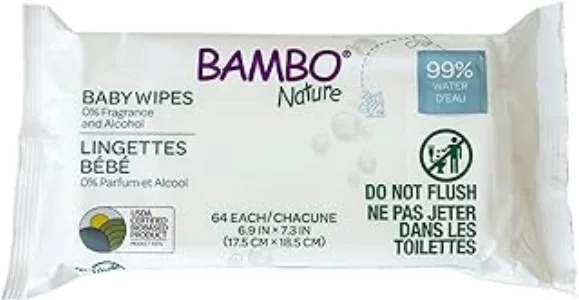
Bambo Nature Baby Wipes
Price: $0.06-$0.08/wipe | Ingredients: ~6 | Best for: Organic-certified, most transparent brand
Bambo Nature wipes are USDA Organic and NSF Certified, with a complete ingredient disclosure policy that goes beyond what any other wipe brand provides. They publish third-party test results for every batch, including heavy metals, pesticides, and contaminant testing.
Ingredient highlights:
- USDA Organic certified
- NSF Certified
- Organic aloe and chamomile
- No fragrance, no phenoxyethanol, no parabens, no MIT
- Third-party tested with published results
What to know: Bambo Nature is competitively priced option on this list, and the premium is largely for certification and transparency. The functional experience is similar to other high-quality plant-based wipes. For parents who want the highest level of documented ingredient safety, the certification and published test results justify the cost difference.
What About Cloth Wipes?
Reusable cloth wipes eliminate ingredient concerns entirely because you control what goes on them (water, or water with a drop of gentle soap). They are the most non-toxic option available, though they require more laundry. Many families use cloth wipes at home and disposable wipes in the diaper bag.
If you go this route, choose organic cotton or bamboo cloth wipes and wash them with a fragrance-free, dye-free detergent. For diaper choices that pair well with a cloth wipe setup, see our non-toxic diaper guide.
How to Read a Baby Wipe Ingredient List
When evaluating any baby wipe not on this list, scan the ingredient list for these red flags:
- “Fragrance” or “Parfum.” Reject immediately.
- Methylisothiazolinone or Methylchloroisothiazolinone. Reject immediately.
- Any paraben (methylparaben, propylparaben, butylparaben). Avoid.
- Phenoxyethanol. Acceptable for most families; avoid if your baby has sensitive skin or eczema.
- PEG compounds. Potentially contaminated with 1,4-dioxane.
- Polysorbate 20. Also potentially contaminated with 1,4-dioxane.
- DMDM hydantoin or bronopol. Formaldehyde-releasing preservatives. Avoid.
Dr. Rhonda Patrick has discussed on her podcast how the skin is not an impermeable barrier and that chemicals applied topically can enter the bloodstream, particularly through thin skin and in areas with higher blood flow. Baby skin is thinner and more permeable than adult skin, which makes ingredient quality in wipes especially relevant.
For a deeper understanding of parabens and why they show up in so many personal care products, our paraben guide covers the science in detail.
Building a Complete Non-Toxic Baby Routine
Baby wipes are one piece of a larger chemical exposure picture. If you are reducing your baby’s chemical load, pair these wipes with:
- Non-toxic diapers that skip chlorine bleaching and fragrance. See our non-toxic diaper guide.
- A thoughtful baby registry that prioritizes low-chemical products across every category. Our non-toxic baby registry guide maps this out.
- Safer baby products overall. Our complete non-toxic baby products guide covers feeding, sleeping, bathing, and everything in between.
How the Options Compare: Tradeoffs at a Glance
Every wipe type involves a real tradeoff. There’s no option that wins on every dimension simultaneously.
| Option | Main concern | Primary tradeoff |
|---|---|---|
| Unscented water wipes (WaterWipes) | No preservatives means faster bacterial growth if left open | Must use within 4 weeks of opening; cleans less aggressively without surfactants |
| Plant fiber wipes (Seventh Generation, Honest) | Mild preservative or surfactant system still required | Better cleaning power but slight chemical addition vs. pure water options |
| Organic cotton wipes (Bambo Nature) | Highest cost per wipe ($) | Organic certification adds cost; cleaning performance similar to other plant-based options |
| Conventional wipes (store brands) | MIT, parabens, or fragrance still common in some formulas | Lower cost but higher chemical load on high-frequency contact skin |
| Reusable cloth wipes | Requires regular hot-water laundering to prevent contamination | Zero ingredient concerns but more household work and not practical for travel |
Durability and Longevity
Baby wipes aren’t a product you evaluate for years-of-use the way you would furniture. But shelf life and storage durability matter, because most families buy in bulk.
Preservative-free wipes like WaterWipes have a shorter usable window after opening. The manufacturer recommends using them within four weeks of first opening a package. Sealed packages are stable for two to three years if stored at room temperature away from direct sunlight. If you buy a large case and leave a pack open in the diaper bag for weeks, there is a real risk of microbial growth - that’s a genuine limitation to plan around.
Preservative-containing wipes (Honest, Pampers Aqua Pure, Seventh Generation) remain stable for a longer period after opening. The typical guidance is three to four months for opened packages stored in normal conditions. Sealed packaging generally carries a two-year shelf life.
For bulk buyers: if you’re stocking up, preservative-free wipes require a tighter rotation schedule. Buying a month’s supply at a time is more practical than buying a year’s worth.
What We Don’t Fully Know
Phenoxyethanol is a dose-dependent concern, not a binary one. The FDA issued a safety communication in 2008 advising caution with phenoxyethanol in nipple creams after reports of infant respiratory depression, and the EU’s Scientific Committee flagged restricted use around the diaper area for children under three. But the concentrations in baby wipes are significantly lower than the products studied. Whether this translates to meaningful risk with repeated wipe use is not fully established. Long-term data on cumulative preservative exposure through wipe use specifically is limited.
What we also don’t fully know: how much chemical absorption occurs through the diaper-area skin specifically, at the frequencies typical families use wipes. Baby skin is more permeable than adult skin, but quantified absorption rates for preservative-free versus preserved wipes under real-world use conditions are not well-characterized in published literature.
Your Questions Answered
Are WaterWipes really just water?
Nearly. WaterWipes contain 99.9% purified water and 0.1% grapefruit seed extract (Citrus Grandis fruit extract). The fruit extract serves a mild antimicrobial function. There are no synthetic preservatives, surfactants, or additives. This simplicity is both the selling point and the limitation, as they clean less aggressively than wipes with added surfactants.
Is phenoxyethanol in baby wipes safe?
At the concentrations used in baby wipes (typically under 1%), phenoxyethanol is considered safe by the FDA and most regulatory bodies. The EU’s Scientific Committee on Consumer Safety has flagged it for restricted use in products for children under three, particularly around the diaper area. If your baby has eczema or sensitive skin, phenoxyethanol-free options like WaterWipes, Seventh Generation, or Bambo Nature are available.
What is the difference between “unscented” and “fragrance-free” wipes?
“Fragrance-free” means no fragrance ingredients were added. “Unscented” means the product has no noticeable scent but may contain masking fragrances to neutralize the smell of other ingredients. For baby wipes, always choose “fragrance-free” and verify by checking the ingredient list for the word “fragrance” or “parfum.”
Can baby wipes cause diaper rash?
Yes. Wipes containing fragrance, MIT, alcohol, or harsh surfactants can irritate baby skin and contribute to or worsen diaper rash. Switching to a minimal-ingredient, fragrance-free wipe often resolves wipe-related irritation. If rash persists after switching wipes, the diaper or a food sensitivity may be the underlying cause.
Are organic baby wipes worth the extra cost?
USDA Organic certification (like Bambo Nature) verifies that the plant-based ingredients were grown without synthetic pesticides and that the product meets organic processing standards. Whether this justifies double the per-wipe cost depends on your priorities. From a direct chemical exposure standpoint, a non-organic wipe with a clean ingredient list (like WaterWipes or Seventh Generation) is very similar in practical safety.
How many baby wipes does a family use per year?
Most families use between 2,000 and 4,000 wipes per year per child during the diapering years. At the budget end (Seventh Generation at $0.02/wipe), that is $40-$80 per year. At the premium end (Bambo Nature at $0.08/wipe), that is $160-$320 per year. The difference in annual cost between the cheapest and most expensive option on this list is meaningful, which is why value matters alongside ingredient quality.
You Might Also Like
- Best Non-Toxic Car Seats
- Best Non-Toxic High Chairs
- Best Non-Toxic Stroller
- Best Non-Toxic Baby Shampoo and Body Wash (2026)
- Naturepedic vs Newton Baby Crib Mattress: Which Is Safer?
- Best Non-Toxic Crib Mattress in 2026 (Organic, Certified)
- The Baby Clothes Our Editors Trust (Formaldehyde-Free, 2026)
- The Baby Shampoos Our Editors Trust (Sulfate-Free, 2026)
Sources
- EU Scientific Committee on Consumer Safety (SCCS). “Opinion on Phenoxyethanol.”
- European Commission. “Regulation on Methylisothiazolinone in Cosmetic Products.” 2014.
- Swan SH. “Count Down.” Scribner, 2021.
- Trasande L. “Sicker, Fatter, Poorer.” Houghton Mifflin Harcourt, 2019.
- FDA. “Fragrances in Cosmetics.”
- Environmental Working Group (EWG). “Baby Wipe Ingredient Database.”
- Landrigan PJ, et al. “Children’s Vulnerability to Environmental Toxicants.” The Lancet, 2018.