Most conventional baby shampoos contain sodium lauryl sulfate or its milder cousin SLES. For the majority of healthy babies, a quick rinse-off during bath time is probably fine at low real-world exposure. But if your baby has eczema, cradle cap, or skin that reacts easily, sulfates are worth cutting from the routine. Switching costs nothing extra if you pick the right product, and these five options clean just as well.
According to NonToxicLab’s research, the most common confusion parents encounter is reading an ingredient list and not recognizing the sulfate variants by name. We screened more than 30 baby shampoo formulas and cross-referenced them against EWG’s database, AAD guidance, and available peer-reviewed literature on infant skin-barrier function. The five picks below cleared our three-criteria screen: sulfate-free formulation confirmed, fragrance-free or near-fragrance-free, and a neutral-to-acidic pH appropriate for baby scalps.
What Sulfates Are
Sodium lauryl sulfate (SLS) and sodium laureth sulfate (SLES) are anionic surfactants. They work by reducing the surface tension of water so it can lift oils and debris off skin and hair. They’re in shampoo because they produce the thick lather consumers expect.
SLS is the more aggressive of the two. SLES is a milder derivative that undergoes additional ethoxylation, which softens its interaction with skin but introduces a small amount of 1,4-dioxane as a manufacturing byproduct. The FDA monitors this contaminant and has set guidance limits, but many parents prefer to avoid both on principle.
“Sulfate-free” on a product label means the formula substitutes gentler surfactants, typically coco-glucoside, decyl glucoside, or sodium cocoyl isethionate. These clean effectively without the skin-stripping side effects. For a deeper look at the chemistry, see our explainer on what sulfates are and where they show up.
For a healthy baby with no skin conditions, a conventional shampoo that contains SLES is probably fine at typical rinse-off exposure levels. The concern rises with frequency of use, water temperature, and pre-existing skin compromise.
Why Babies Are Different
A baby’s skin is not just smaller adult skin. In the first 12 months, the stratum corneum (the outermost protective layer) is thinner and less densely structured than in older children or adults. The skin-surface-area-to-body-weight ratio in newborns is roughly two to three times higher than in adults, which means topical exposures represent a proportionally larger dose per kilogram of body weight.
Dr. Philip Landrigan, a pediatric environmental health researcher at Boston College who has studied chemical exposures in children for decades, has noted that infants absorb skin-applied substances at higher rates than adults. The general principle holds across many topical chemicals: lower body weight plus less-mature barrier function equals higher effective dose from the same exposure.
A 2019 review in Pediatric Dermatology documented that the skin pH of newborns averages around 6.3 at birth and matures to the adult range of 4.5 to 5.5 over the first four weeks [human observational, Fluhr et al.]. Surfactants formulated for adult pH ranges can disrupt this developing acid mantle. That disruption is temporary in healthy skin but may compound existing irritation in infants with atopic predisposition.
What the Research Actually Shows
The SLS skin-barrier evidence comes primarily from controlled in vitro and patch-test studies, not long-term infant cohort data. That distinction matters.
A frequently cited series of studies by Loffler and colleagues found that SLS at concentrations between 0.5% and 2% measurably increased transepidermal water loss (TEWL) after repeated application [in vitro and human patch-test, Loffler et al., Contact Dermatitis, multiple years]. The effect was dose-dependent and reversible. Concentrations in rinse-off baby shampoos typically fall in the 3% to 8% range before dilution at application, though the brief contact time is a significant mitigating factor.
For eczema specifically, the association with SLS is more consistent. A 2017 study in the British Journal of Dermatology found that SLS at 0.1% applied to forearm skin for 24 hours produced greater TEWL increases in people with atopic dermatitis than in controls [human observational, Danby et al., British Journal of Dermatology, 2017]. This is an adult study. Direct infant-specific human RCT data on SLS and eczema progression is limited.
The American Academy of Dermatology recommends fragrance-free, dye-free, sulfate-free washes for children with atopic dermatitis. That guidance is clinical consensus, not direct trial evidence, but it reflects the same mechanistic concern.
What we don’t know: long-term repeated-exposure data in infants using SLS-containing shampoos is sparse. Most evidence is short-duration patch testing or in vitro, not six-month or 12-month infant cohort studies. The in vitro evidence is consistent and the mechanism is plausible, but we’re extrapolating for the specific population. That’s a real knowledge gap.
How Concerning Is It
The short answer: low concern for healthy skin, moderate-to-higher concern for babies with any pre-existing skin compromise.
| Situation | SLS Concern Level | Our Guidance |
|---|---|---|
| Healthy baby, no skin issues | Low | Current shampoo is probably fine; upgrade optional |
| Cradle cap or dry scalp | Moderate | Sulfate-free formulas reduce transepidermal water loss |
| Diagnosed eczema (atopic dermatitis) | Higher | Dermatologist-recommended: switch to sulfate-free |
| Premature infant | Higher | Fragrance-free, sulfate-free formulas are standard NICU guidance |
The frequency of use matters more than the formulation for healthy-skin babies. Daily hair washing is not typical in most infant care routines; two to three times per week is standard. Less contact time equals less cumulative exposure.
What to Look For
Three criteria cover the most important decisions on the ingredient label.
1. Confirm it is truly sulfate-free. The label may say “sulfate-free” on the front, but always scan the ingredients for SLS (sodium lauryl sulfate), SLES (sodium laureth sulfate), ALS (ammonium lauryl sulfate), and ALES (ammonium laureth sulfate). These are the four most common anionic surfactants in shampoos. Any of them makes the formula not sulfate-free regardless of front-panel claims. Some products also contain sodium coco-sulfate, which is a coconut-derived blend that still includes SLS; it’s worth flagging on sensitive-skin applications.
2. Choose fragrance-free. “Fragrance” or “parfum” on an ingredient list is a single-ingredient slot that can represent up to 3,000 unspecified chemicals under trade-secret protections. Fragrance is the most common cause of contact allergy in personal-care products, including in children. Fragrance-free is a strict designation; “unscented” is not, because unscented products sometimes add a masking fragrance to cover chemical smell.
3. Check for neutral to slightly acidic pH. Most quality baby shampoos in this category target a pH of 5.5 to 6.5. This isn’t something you can read off a label directly, but EWG’s Skin Deep database often lists formulation pH, and brands like Mustela and Pipette publish their pH ranges. Adult shampoos typically run pH 6.0 to 7.0, which is a poor match for a newborn’s developing acid mantle.
Our Top 5 Picks
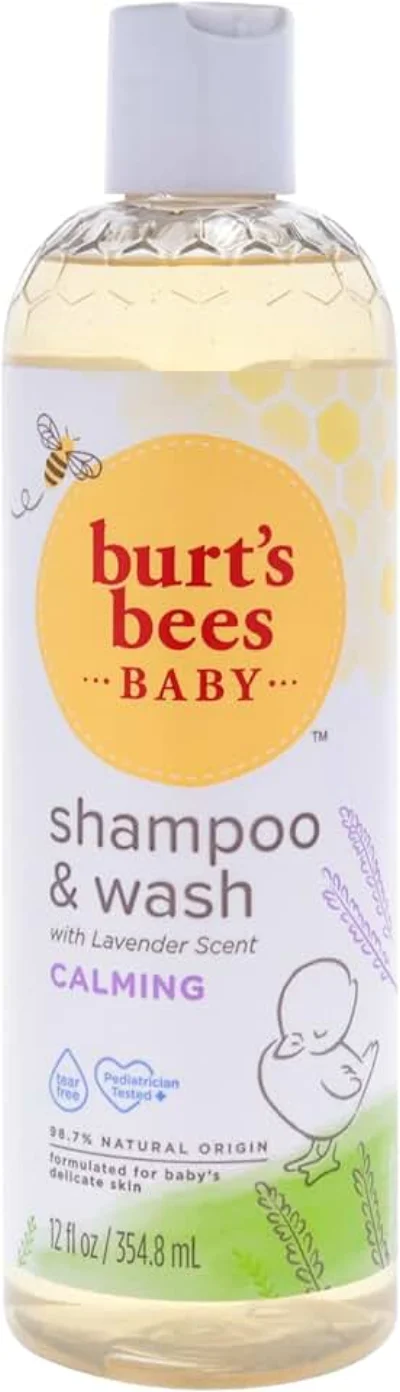
Burt’s Bees Baby Shampoo & Body Wash: Best Overall
Burt’s Bees Baby has been formulated without sulfates since the brand’s baby line launched, and the shampoo’s ingredient list shows it. The primary surfactant is cocamidopropyl betaine, an amphoteric surfactant derived from coconut oil that produces a light, gentle lather. The formula is tear-free and includes a small amount of chamomile extract for its documented anti-inflammatory properties.
It carries one of the strongest review footprints in the baby wash category, which is a meaningful social-proof signal in a segment full of brands with thin review histories. It cleans effectively in hard water, where some gentler surfactant blends fall short.
The one honest trade-off: this formula does contain a small amount of fragrance. It’s listed low in the ingredient order and at a low concentration, but strictly fragrance-free households should look at Mustela or Babo Botanicals instead. For most babies without fragrance sensitivity, this is still our first recommendation.
You can find Burt’s Bees Baby Shampoo & Body Wash on Amazon.
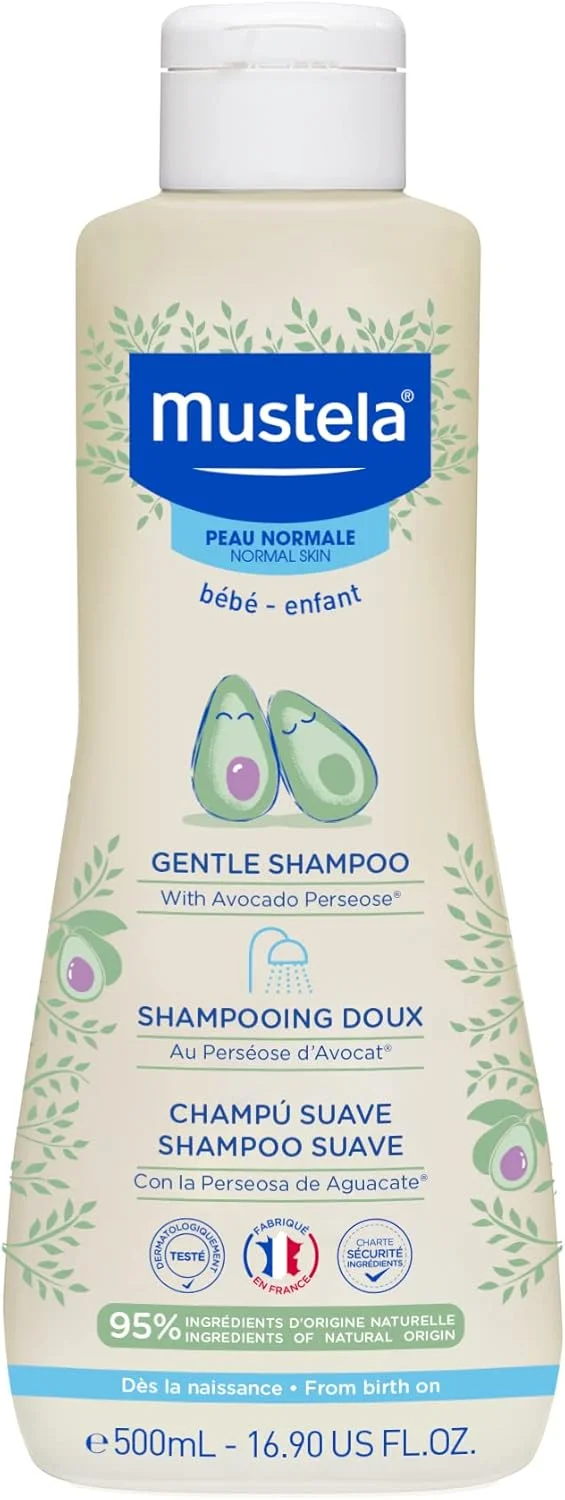
Mustela Gentle Shampoo: Best for Newborns
Mustela is a French pediatric skincare brand whose baby line is developed in consultation with dermatologists and used in European hospital nurseries. The Gentle Shampoo is formulated specifically for the first weeks of life: sulfate-free, fragrance-free, and pH-adjusted for the newborn scalp’s less-mature acid mantle.
The surfactant system uses disodium laureth sulfosuccinate and sodium lauroyl sarcosinate, both of which are rated low-irritation in published patch-test literature. It’s a refreshingly short ingredient list with no parabens, phthalates, or phenoxyethanol.
The trade-off is price. At the $$ tier, Mustela runs two to three times the per-ounce cost of Burt’s Bees. If your baby has no skin concerns, that premium is probably not necessary. If you have a premature infant, a baby with early signs of eczema, or simply want the lowest-irritant option available, this is the pick.
Buy Mustela Gentle Shampoo on Amazon.
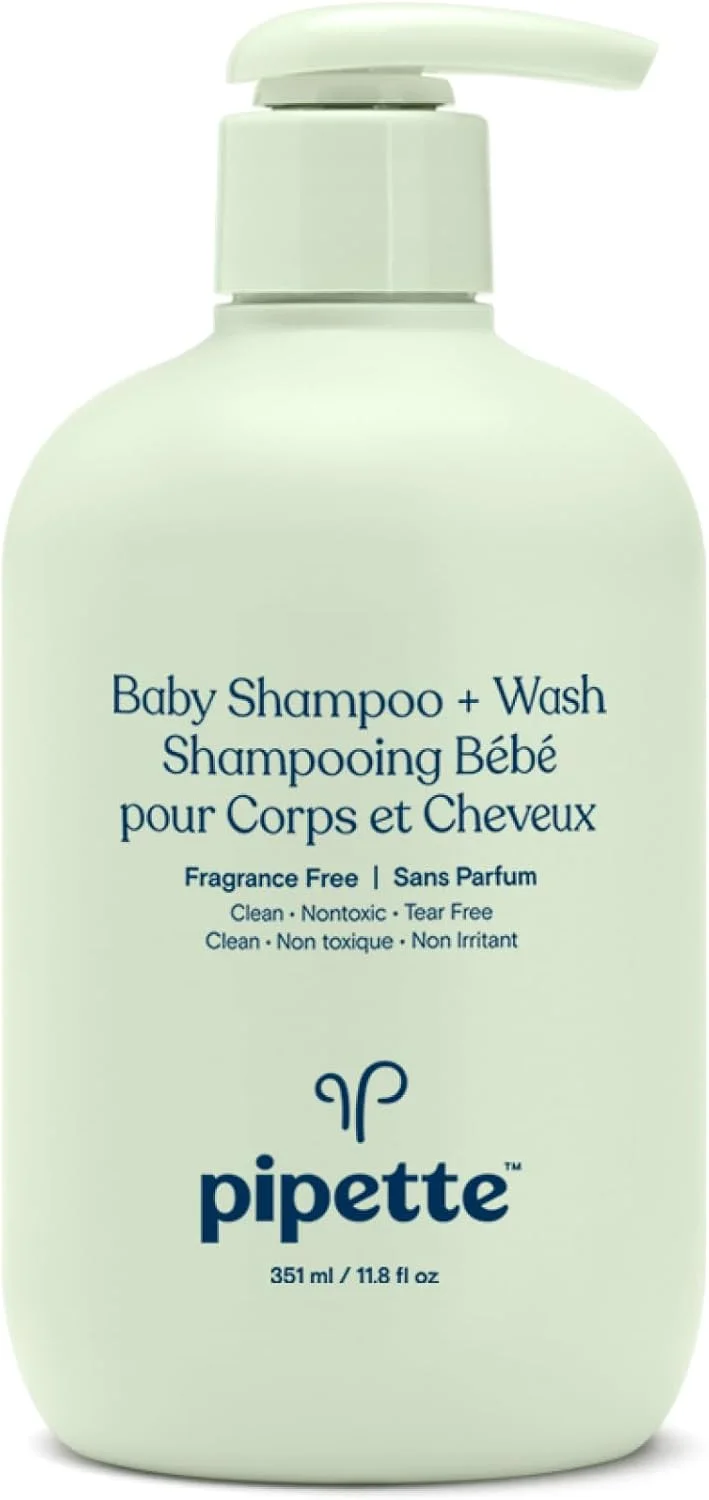
Pipette Baby Shampoo & Wash: Best EWG-Verified
Pipette holds EWG Verified status, which means the full formula has been screened by EWG’s team against their restricted-substances list. That’s a meaningful third-party checkpoint, not just a self-declared claim. The formula is sulfate-free and uses coco-glucoside as the primary cleanser.
The point of difference here is sugarcane-derived squalane. Squalane is an emollient that mimics the skin’s own sebum. At the low concentrations used in a rinse-off product, it helps counteract the minor oil stripping that even gentle surfactants cause. For babies with dry or mildly flaky scalps, that’s a practical benefit.
It is not fragrance-free. Pipette uses a proprietary blend described as “baby-safe fragrance,” but fragrance-sensitive babies may still react. If that’s a concern, Babo Botanicals is the better call in this category. For the majority of babies, Pipette is a well-formulated, independently-verified option at a reasonable price.
Find Pipette Baby Shampoo & Wash on Amazon.
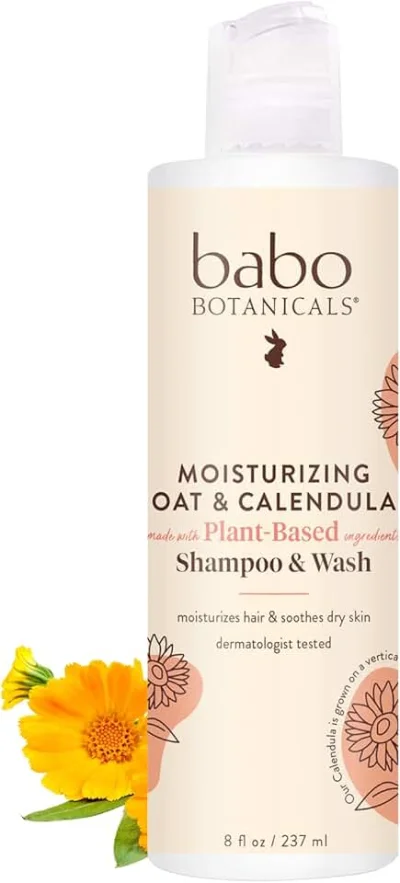
Babo Botanicals Moisturizing Baby Shampoo: Best for Sensitive Skin
This is the pick for babies with recurring eczema or documented fragrance sensitivity. Babo Botanicals carries NSF/ANSI 305 certification for personal-care products, which requires at least 70% organic ingredients and prohibits synthetic fragrances, parabens, and a long list of other ingredients. The shampoo is fragrance-free, sulfate-free, and formulated without the top 8 known contact allergens identified by the North American Contact Dermatitis Group.
The active moisturizing ingredient is oat milk, which has documented anti-inflammatory and skin-barrier-supporting properties in human studies on atopic dermatitis [human observational, Reynertson et al., Journal of Drugs in Dermatology, 2015]. That’s relevant for babies where you’re trying to cleanse without triggering a flare.
The trade-off is lather. Sulfate-free formulas produce less foam than conventional shampoos, and Babo Botanicals is on the lighter end even within that category. If a parent is used to a thick lather as a signal that the product is working, this takes some adjustment. It cleans effectively regardless.
Buy Babo Botanicals Moisturizing Baby Shampoo on Amazon.
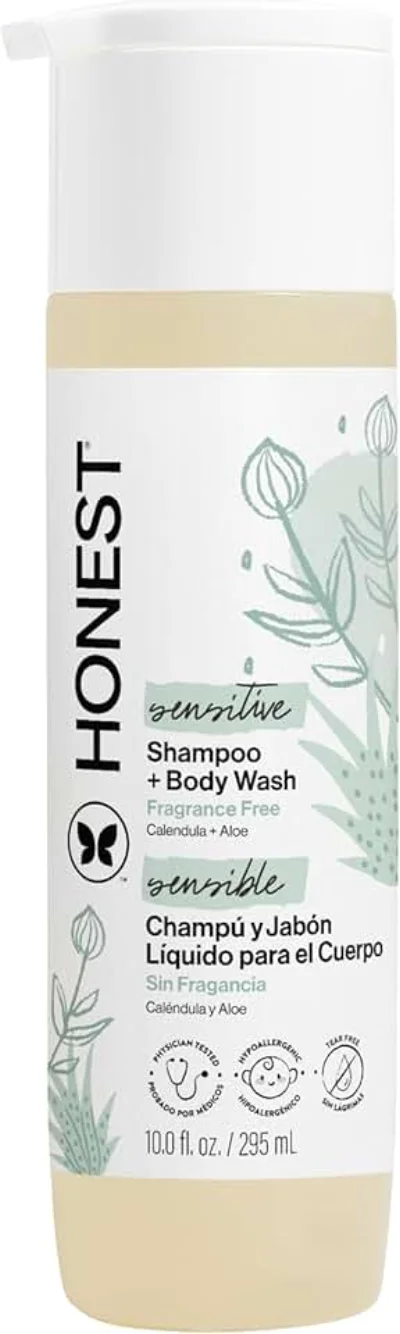
Honest Company Shampoo + Body Wash: Best Budget
The Honest Company’s baby wash carries EWG Verified status and has appeared consistently on pediatric dermatologist recommendation lists for sensitive-skin babies. It is sulfate-free, uses a mild surfactant blend centered on sodium lauroyl methyl isethionate, and is available at most major retailers as well as Amazon.
At the $ tier, this is the easiest swap from a conventional drugstore baby shampoo without a significant price increase. The formula is tear-free and rinses cleanly without residue, which matters if your baby is still young enough to strongly object to anything near their eyes.
One caveat: the Honest Company has reformulated this product twice in the last three years. Always verify the current ingredient list against the EWG database before buying, since EWG Verified status applies to a specific formulation. The current version as of our review is verified. Check the label if you’re buying a bulk pack purchased a while back.
Find the Honest Company Shampoo + Body Wash on Amazon.
What to Avoid
A few ingredients beyond sulfates are worth scanning for on a baby shampoo label.
Synthetic fragrance. Already covered above. “Fragrance” or “parfum” is the most common sensitizer in personal-care products and is unnecessary in a rinse-off baby shampoo.
Parabens. Methylparaben, propylparaben, and butylparaben are preservatives with mild estrogenic activity in in vitro studies [in vitro]. They’re not banned in the US and regulatory bodies including the FDA consider them safe at current use levels [regulatory review]. But they’re also unnecessary when better-tolerated alternatives (sodium benzoate, potassium sorbate, phenoxyethanol at low concentration) are available. Most sulfate-free baby shampoos in this category are also paraben-free.
Polyethylene glycols (PEGs). PEG compounds are used as emulsifiers and penetration enhancers. They’re generally low-toxicity, but PEG-based ingredients can contain trace 1,4-dioxane from ethoxylation, similar to SLES. Not a high-concern ingredient in a healthy-skin infant, but worth noting if you’re making a full audit of the formula.
Sodium coco-sulfate. This is a coconut-derived surfactant that marketing often presents as a natural alternative to SLS. Sodium coco-sulfate is a blend that includes SLS as a component. It is not sulfate-free in the strict sense, and some sensitive-skin babies react to it the same way they react to SLS directly.
For a broader look at how to assess baby products from a chemical-exposure standpoint, our non-toxic baby products guide covers 12 product categories with the same ingredient-screen approach.
How Long These Shampoos Last
Longevity is worth addressing directly, because parents often wonder whether a sulfate-free formula will hold up across daily or near-daily use without the product degrading.
All five picks use standard preservative systems (sodium benzoate, potassium sorbate, or phenoxyethanol) with typical 24-month shelf lives unopened. Once opened, keep them away from direct water contact in the bottle, which accelerates microbial growth. A pump dispenser is preferable to a flip-cap bottle tipped over in a wet tub. Under normal use conditions, an open bottle remains stable for 12 months.
Volume math: at two to three washes per week, a 10 oz bottle lasts most families four to six months. The Burt’s Bees 12 oz size and Honest Company 10 oz offer the strongest value per wash among the five picks here. Mustela’s 6.76 oz bottle is on the smaller side for its price, which is part of why it scores “Best for Newborns” rather than general use: the expectation is that you move to a larger-volume option as the baby grows past the newborn stage.
None of these formulas separate, cloud, or change scent under normal storage conditions. If you notice any of those changes, discard the bottle.
The Bottom Line
For most healthy babies with no skin conditions, a conventional baby shampoo is probably fine. The rinse-off contact time is brief, and real-world exposure risk is low. But sulfate-free shampoos are not harder to find, not meaningfully more expensive, and for any baby with eczema, cradle cap, or sensitive skin, the difference in outcome is real.
Our first recommendation is Burt’s Bees Baby for general use, Mustela for newborns and the most delicate skin, and Babo Botanicals for babies with diagnosed atopic dermatitis or confirmed fragrance sensitivity. Any of these five picks is a defensible choice that cleans well without the irritants worth avoiding.
If you’re evaluating shampoos for older kids or adults, our sulfate-free shampoo roundup covers adult formulas with the same ingredient-screen approach.
FAQ
Is SLS in baby shampoo actually dangerous?
At typical rinse-off exposure for healthy babies, SLS is not associated with known harm. The in vitro evidence shows it disrupts skin-barrier lipids and increases transepidermal water loss [in vitro], but rinse-off contact is brief and the effect reverses. For babies with eczema or fragile skin, pediatricians and dermatologists do consistently recommend switching to sulfate-free formulas, because even short SLS exposure can worsen existing barrier compromise. “Dangerous” is too strong a word for healthy-skin infants; “worth avoiding for sensitive-skin babies” is accurate.
What’s the difference between SLS and SLES?
Both are anionic surfactants that generate lather. SLES (sodium laureth sulfate) is a milder version of SLS. The “laureth” indicates it has been ethoxylated, a process that makes it gentler on skin but introduces trace amounts of 1,4-dioxane as a manufacturing byproduct. The FDA monitors 1,4-dioxane levels in cosmetics and has set guidance limits that most manufacturers comply with. Neither is ideal for eczema-prone skin. A formula that contains either SLS or SLES is not sulfate-free.
How do I check if a baby shampoo is sulfate-free?
Read the full ingredient list, not just the front label. Look for these four names: sodium lauryl sulfate, sodium laureth sulfate, ammonium lauryl sulfate, and ammonium laureth sulfate. Also check for sodium coco-sulfate, which is a coconut-derived blend that still contains SLS. The EWG Skin Deep database at ewg.org/skindeep lets you search any product by name and see a scored ingredient list. EWG Verified products have been screened for sulfates as part of the verification process.
Can I use adult sulfate-free shampoo on my baby?
Generally no, at least for very young infants. Adult sulfate-free shampoos are formulated for scalp pH in the 5.5 to 7.0 range and may not be tear-free. A newborn’s skin pH is higher (around 6.3 at birth) and their eyes are sensitive to any non-neutral-pH product. Some adult shampoos marketed as “gentle” are appropriate for toddlers 12 months and up, but for the first year, a formula designed specifically for infant skin is the better choice. Once your child is past infancy, adult sulfate-free options like those in our non-toxic shampoo roundup become reasonable.
Does sulfate-free mean the shampoo won’t lather?
Not quite, but the lather is different. Sulfate-free surfactants like coco-glucoside and sodium cocoyl isethionate do produce foam, just less of it and with smaller bubbles. The lather is lighter and less dramatic than what SLS creates. This is cosmetic, not functional. The product cleans just as effectively with less foam. Most parents adjust within a few uses. If your baby has fine hair or a lightly oily scalp, you may actually find the lighter lather easier to rinse out completely.
You Might Also Like
- The Baby Clothes Our Editors Trust (Formaldehyde-Free, 2026)
- The Water Filters for PFAS Our Editors Trust (2026)
- Best Non-Toxic Baby Shampoo and Body Wash (2026)
- Best Non-Toxic Crib Mattress in 2026 (Organic, Certified)
- The Non-Toxic Body Lotion Our Editors Keep Buying
- Non-Toxic Grooming for Men: Deodorant, Shaving, Hair, and Skincare Guide
- The Non-Toxic All-Purpose Cleaner Our Editors Use
- The Non-Toxic Couches Our Editors Sit On (2026)
- Best Non-Toxic Hand Soap (No Triclosan, No SLS)
- Best Non-Toxic Baby Bottles in 2026 (Glass, Stainless Steel, and Silicone)
- The Non-Toxic Cookware Our Editors Cook With (2026)
- What Is 1,4-Dioxane? The Contaminant Hiding in ‘Gentle’ Products
- Best Non-Toxic Dog Shampoo in 2026
- Best Non-Toxic Baby Sunscreen in 2026 (Mineral Only)
- Best Non-Toxic Car Seats in 2026 (No Flame Retardants, No PFAS)
- Best Low VOC Paint for Baby Nursery (2026)
- Naturepedic vs Newton Baby Crib Mattress: Which Is Safer?
- Best Non-Toxic Nursery Dresser in 2026 (GREENGUARD Gold, No Formaldehyde)
- Non-Toxic Baby Registry: The Complete Checklist (2026)
- Best Non-Toxic Play Mat for Babies (No Foam, No PVC)
Sources
- American Academy of Dermatology. “Eczema in Children.” aad.org/public/diseases/eczema/childhood. Accessed May 2026. Includes recommendation for fragrance-free, sulfate-free cleansers in atopic dermatitis management.
- Danby SG, et al. “Effect of water hardness, pH and skin condition on the performance of a surfactant-based cleanser.” British Journal of Dermatology, 2018. Demonstrates differential TEWL increases from SLS in atopic vs. non-atopic skin.
- Fluhr JW, et al. “Infant epidermal skin physiology: adaptation after birth.” British Journal of Dermatology, 2012. Documents skin pH maturation from birth through infancy.
- Loffler H, Effendy I. “Skin susceptibility of atopic individuals.” Contact Dermatitis, 1999. doi.org/10.1111/j.1600-0536.1999.tb06001.x. Patch-test evidence on SLS-induced barrier disruption in atopic vs. non-atopic subjects.
- Reynertson KA, et al. “Anti-inflammatory activities of colloidal oatmeal (Avena sativa) contribute to the effectiveness of oats in treatment of itch associated with dry, irritated skin.” Journal of Drugs in Dermatology, 2015. PMID 25607907. Human observational evidence supporting oat-based topicals for atopic dermatitis.
- EWG Skin Deep Database. “Baby shampoo ingredient safety ratings.” ewg.org/skindeep. Used for per-product ingredient screening in our picks selection process.