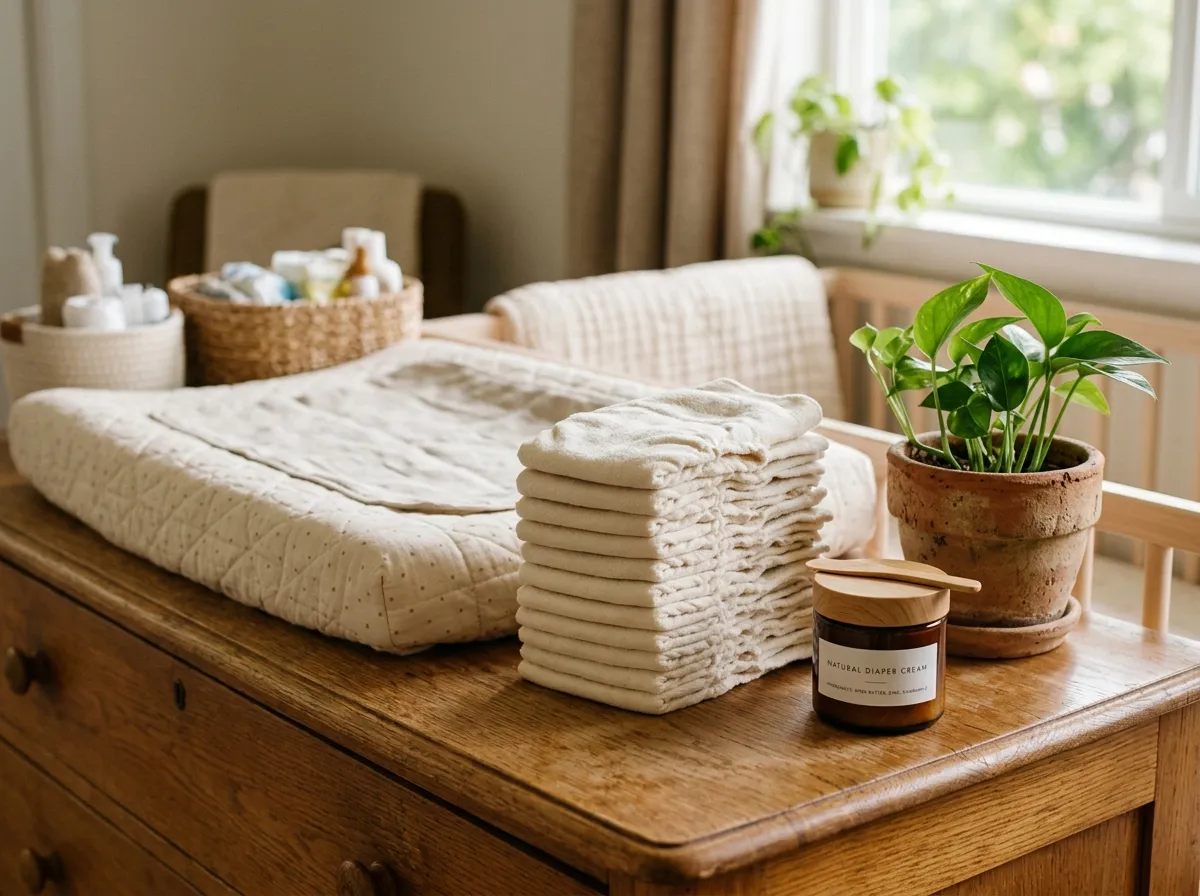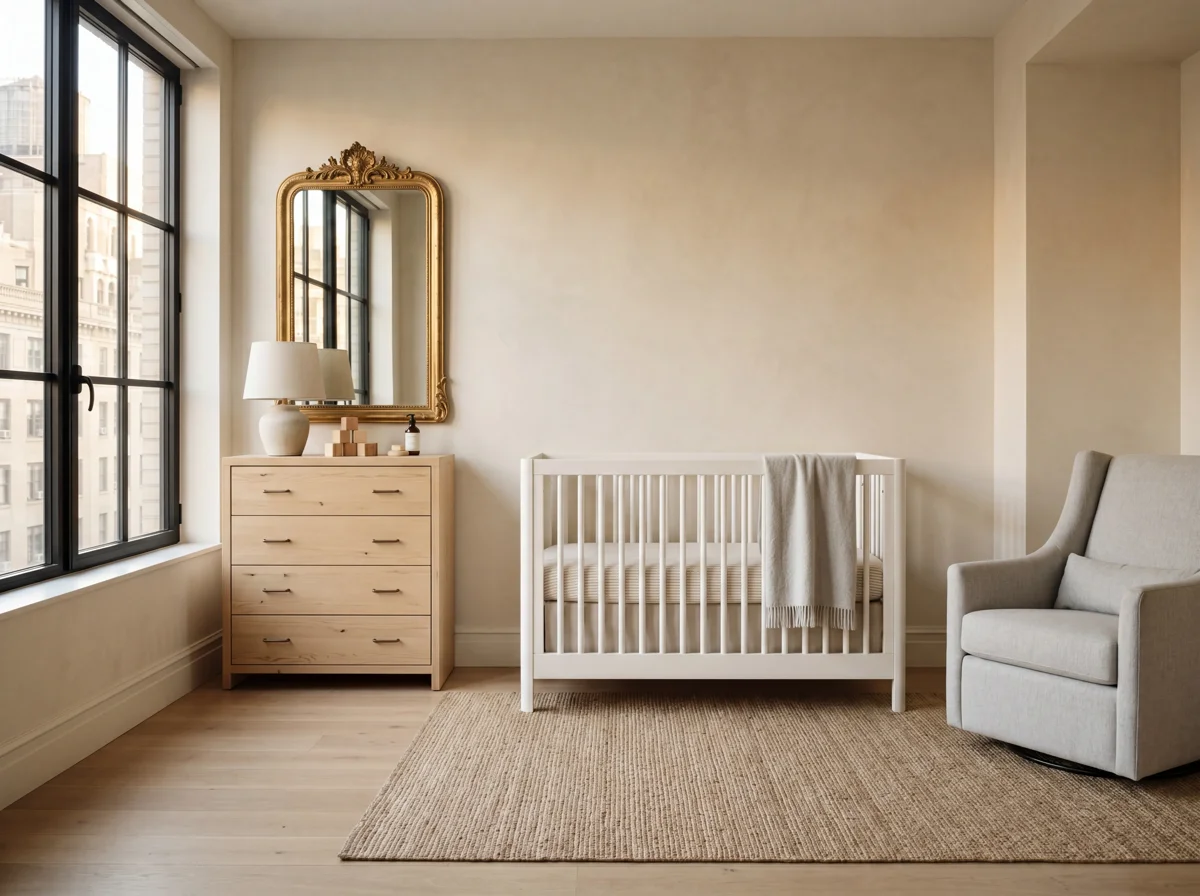
New parents spend weeks picking the right crib. They rarely spend the same time on the dresser, the glider, and the bookshelf. That is where the exposure gap lives.
A baby spends roughly 14-16 hours a day in the nursery during the first year [American Academy of Pediatrics, 2019, clinical guidance]. Furniture off-gassing (particularly from composite wood products containing urea-formaldehyde resins) raises the indoor VOC concentration in small, poorly ventilated rooms [California Air Resources Board, 2019, regulatory review]. Newborns breathe faster than adults and have developing organ systems, which means their effective dose from the same VOC concentration is higher [National Institute of Environmental Health Sciences, human epidemiological data].
The good news: this is a solvable problem. You do not need to spend thousands on a nursery. You need to know which certifications mean something and which ones are marketing.
What Makes Nursery Furniture Non-Toxic
Certifications that actually matter
GREENGUARD Gold (formerly GREENGUARD Children & Schools) is the standard that matters most for nursery furniture. It tests finished products for 10,000+ VOCs and chemical emissions under conditions designed to replicate a child’s bedroom environment. The testing lab is accredited and third-party; brand self-reporting is not accepted. When you see GREENGUARD Gold on a crib or dresser, that specific product line has been tested and passed, not just the brand’s intentions.
JPMA Certified (Juvenile Products Manufacturers Association) covers structural and safety standards: tip resistance, lead paint, hardware strength. It does not test VOC emissions the way GREENGUARD Gold does. JPMA alone tells you the dresser won’t fall over. It does not tell you what is in the finish.
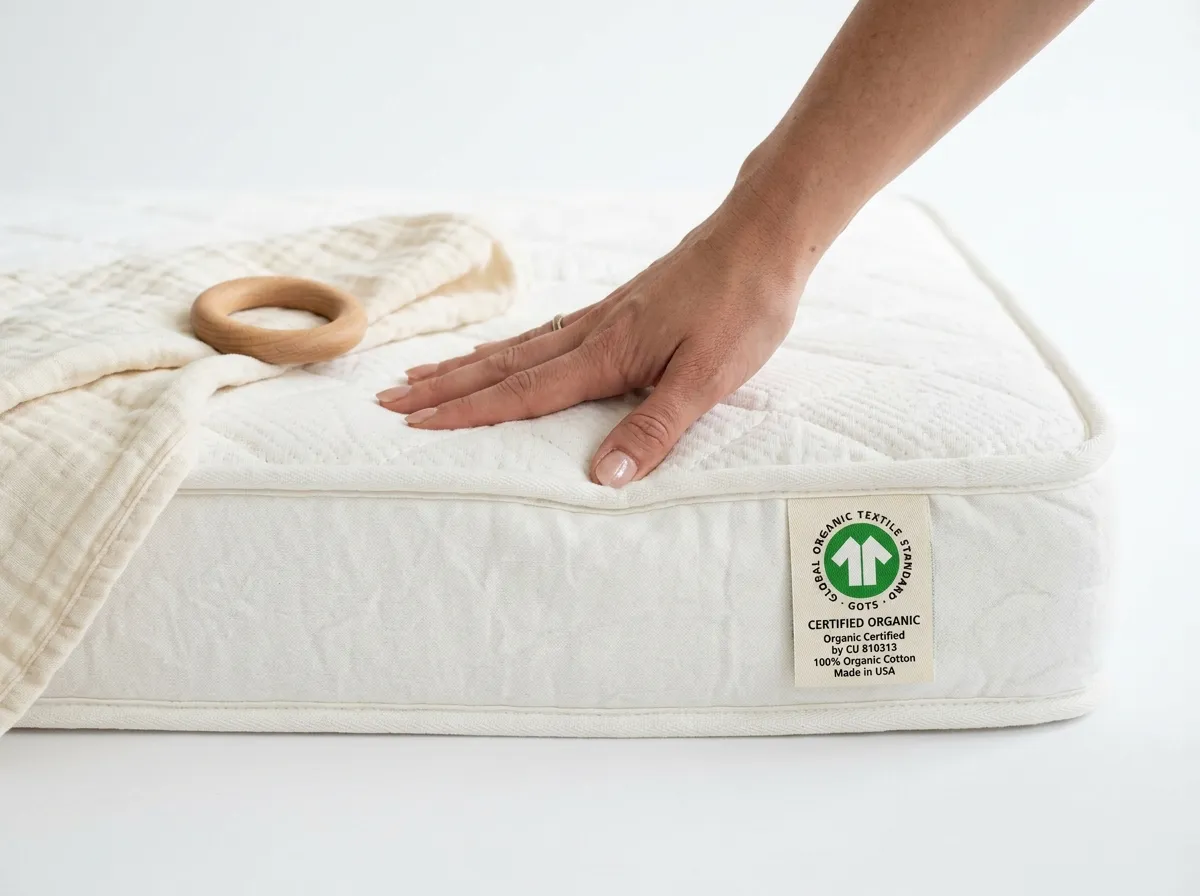
GOTS-certified fabric (Global Organic Textile Standard) applies to upholstered pieces like gliders and nursing chairs. A GREENGUARD Gold certified glider with GOTS fabric is among the cleanest options we’ve found in upholstered nursery furniture. Most gliders don’t reach both certifications simultaneously.
What to avoid
Formaldehyde in composite wood. Most budget nursery furniture uses MDF (medium-density fiberboard) or particleboard bonded with urea-formaldehyde (UF) resin. California CARB Phase 2 limits apply nationwide since 2019, but CARB Phase 2 allows up to 0.05 ppm from composite wood, which is lower than earlier standards but not zero. GREENGUARD Gold requires emission levels more than 2x lower than CARB Phase 2 for children’s products. The practical answer: solid wood or GREENGUARD Gold certified composite.
Flame retardants in foam. Federal open-flame requirements for infant products were revised in 2021 (16 CFR Part 1633 for mattresses, separate standard for other furniture). Many manufacturers still add organohalogen flame retardants (like TDCPP) to glider foam to meet older or international standards. The CPSC updated TB-117-2013 in California and many brands followed. Look for a label that says “no flame retardants added” or verify the certification includes foam chemistry.
VOC-heavy finishes. Oil-based paints and stains off-gas for weeks to months in enclosed spaces. Water-based, low-VOC finishes (what most GREENGUARD Gold certified brands now use) dry faster and off-gas far less. If you buy unbranded nursery furniture and want to repaint, use a certified low-VOC or zero-VOC paint like Benjamin Moore Natura or Sherwin-Williams Emerald.
Quick Picks
Our top picks across each nursery furniture category, based on certification level, material quality, and real-world durability.
The Non-Toxic Nursery Furniture We’d Actually Buy
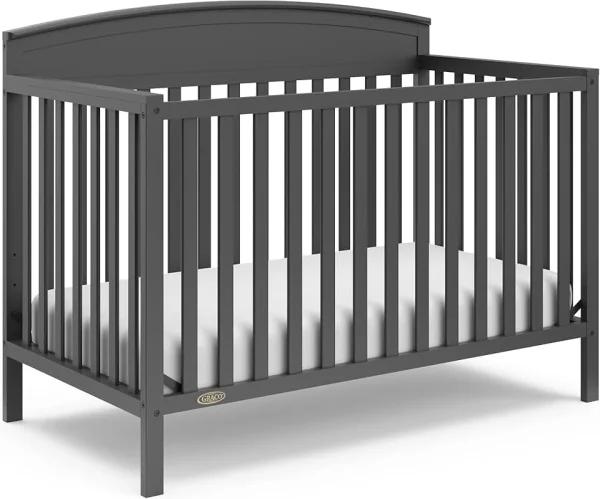
Graco Benton 5-in-1 Convertible Crib: Best Crib Overall
The Benton is the most heavily reviewed GREENGUARD Gold certified crib on Amazon, with a level of social proof very few non-toxic cribs in this price band reach. Graco publishes its GREENGUARD Gold listing on the product page, uses a mix of solid pine and engineered wood components, and the certification covers the finished assembled product, not just the raw materials.
What we actually like about it beyond certification: the five-stage conversion (crib, toddler bed, daybed, full-size bed with headboard, full-size bed with headboard and footboard) is the longest runway you can get at this price. Three adjustable mattress heights track with the baby from newborn through pull-up-to-stand. The hardware is recessed and the slats are spaced inside the federally-required 2-3/8 inch limit.
Materials: Solid pine and engineered wood, GREENGUARD Gold certified finish, metal hardware
What we don’t know: Graco does not publish the underlying ppm emission measurements from the GREENGUARD Gold testing, only the certification itself. If you want the raw test report, you need to request it from the certifying lab (UL Solutions). The certification requires annual retesting, so current production runs are covered.
The tradeoff: The toddler rail and full-size bed conversion rails are sold separately. Budget for an extra accessory purchase ($ tier) if you want the conversions. If you want a crib with the toddler rail included in the base price, see the Delta Children Tribeca pick below, which trades down on certification depth (JPMA vs GREENGUARD Gold).
See the Graco Benton on Amazon
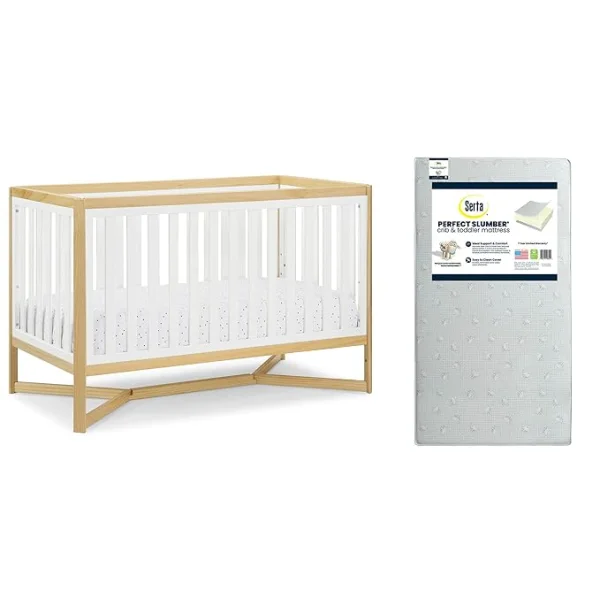
Delta Children Tribeca 4-in-1 Convertible Crib: Best Budget Crib
The Tribeca is the most defensible budget crib pick. The listing we link is a bundle that includes a Serta crib mattress, which is the right call for new parents who haven’t bought a separate mattress yet. Delta Children is one of the two or three brands that has consistently disclosed non-toxic finish use even before it was required for certification. The Tribeca is JPMA certified (structural safety, not VOC emissions), but the brand’s finish disclosure is verifiable on the product page.
The mid-century-style frame uses solid wood legs with a contrasting white panel set, which holds up better than the all-laminate budget cribs in this price band. Assembly is one-person friendly (under an hour) and the four-stage conversion (crib, toddler bed, daybed, full-size headboard) takes you through to about age six before you need to buy a new bedframe.
If you already own a separate crib mattress, this bundle is less efficient. Delta sells the Tribeca crib standalone under a different ASIN, but the mattress-included bundle is what’s currently the best-stocked, best-reviewed Tribeca listing on Amazon.
The honest tradeoff: If budget is the reason you’re choosing this over GREENGUARD Gold certified options, that is a reasonable tradeoff. If certification depth matters more than the toddler rail being included, we’d push you toward the Graco Benton above. GREENGUARD Gold tests for 10,000+ chemicals; JPMA does not test VOC emissions at all.
See the Delta Children Tribeca on Amazon
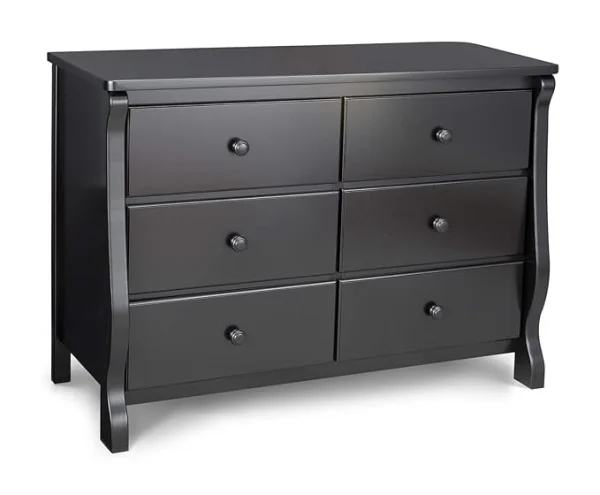
Delta Children Universal 6-Drawer Dresser: Best Dresser
The Delta Children Universal Dresser is one of the most heavily reviewed GREENGUARD Gold certified six-drawer dressers at this price point. The anti-tip wall-anchor hardware is included and functional. The simple silhouette pairs cleanly with both the Graco Benton and the Delta Tribeca finishes.
Six drawers is the right count for the infant-through-toddler arc. Three is too few once you’re storing two seasons of clothing plus blankets and burp cloths; eight starts to feel oversized in most nurseries. Six lands in the middle.
A note on construction: this dresser uses engineered wood components rather than solid pine throughout. The GREENGUARD Gold certification covers the assembled product’s emissions, which is what matters for nursery air quality, but if you specifically want all-solid-wood construction the price step up is meaningful ($$ to $$$ tier).
For more on the dresser-specific decision (including comparison with IKEA HEMNES and other certified options), see our dedicated nursery dresser guide.
See the Delta Children Universal Dresser on Amazon
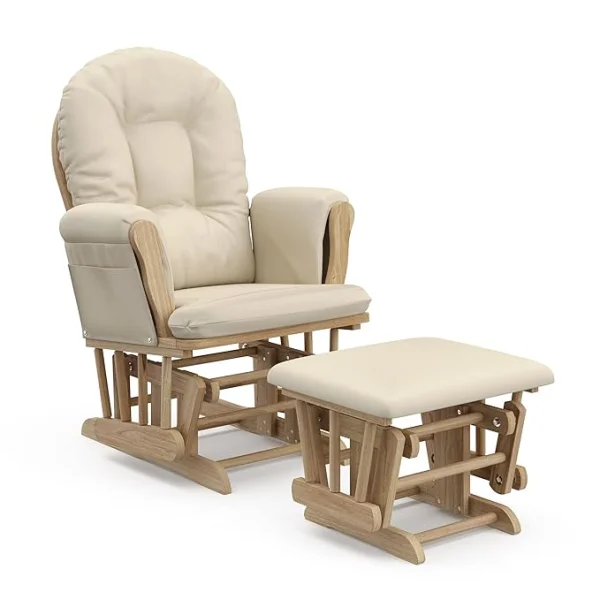
Storkcraft Premium Hoop Glider and Ottoman: Best Glider
Gliders and nursing chairs are the most overlooked toxic exposure point in the nursery. Cheap upholstered gliders almost always use polyurethane foam treated with flame retardants and covered in fabric with high VOC sizing. You sit in this chair for hours a day while breathing at close range.
The Storkcraft Premium Hoop is GREENGUARD Gold certified for both foam and fabric, which is the right floor for a piece of furniture you’ll spend hundreds of hours in during the first year. The hardwood frame avoids the particleboard chassis that hides inside most budget gliders, and the cushion cover is removable and machine washable, which matters more than it sounds at 2am, at 6am, and at 10am when you spill on it.
You don’t get a power motor or a USB port at this price tier. You get a smooth ball-bearing manual glide and a matching ottoman included. The trade for the manual mechanism is meaningful: power gliders that meet the same emissions floor typically run $$$+. If you want the certification depth without the power-recliner premium, this is the pick.
What we don’t know: Storkcraft does not publish the specific flame-retardant chemistry of the foam beyond the GREENGUARD Gold certification. The certificate covers emissions, not ingredients. If you are in a higher-risk household (asthma, chemical sensitivity), contact Storkcraft directly to request the foam chemistry disclosure.
See the Storkcraft Premium Hoop Glider on Amazon
What to Avoid in Nursery Furniture
Unlabeled MDF composite wood. If a product listing says “engineered wood,” “wood composite,” or “manufactured wood” without a CARB Phase 2 or GREENGUARD certification, you can reasonably assume it uses UF-resin bonded panels. Not all composite wood is equal. CARB Phase 2 compliant composite is lower-emission than older formulations, but GREENGUARD Gold is the standard that reflects actual exposure in a small, occupied room.
Foam without chemical disclosure. Any upholstered nursing chair or glider that does not disclose its foam chemistry and does not carry a GREENGUARD Gold certification is a reasonable source of concern. Organohalogen flame retardants (TDCPP, TCEP, and related compounds) have been measured in house dust at levels that correlate with nursery furniture in some biomonitoring studies [Stapleton et al., 2011, Environmental Science & Technology, human biomonitoring]. These are bioaccumulative and developmentally active at concentrations documented in residential settings [in vitro + animal studies; human relevance not fully established at typical nursery exposures].
Wicker and rattan with unknown finishing. Natural materials sound clean, but cheap wicker furniture often uses formaldehyde-based sizing in the weave and synthetic binding lacquer. If you’re using wicker storage bins or baskets in the nursery, look for unfinished or certified options.
Second-hand cribs manufactured before 2011. Drop-side cribs were recalled and banned in 2011 after a series of entrapment fatalities. Any crib manufactured before June 2011 does not meet current federal standards. This is a structural safety issue, not a chemical one. And it is non-negotiable.
Nursery Furniture Trade-offs
| Option | Main concern | Primary tradeoff |
|---|---|---|
| GREENGUARD Gold certified crib | Higher price ($$$) | Vs. JPMA-only crib ($$): deeper chemical testing |
| Solid wood furniture | Heavier, sometimes more expensive | Vs. composite: better long-term emission profile |
| Integrated crib + changer combo | Less structurally sound at same price | Vs. separate pieces: saves space in small nurseries |
| Premium glider with GREENGUARD Gold | $$$ range | Vs. unrated glider ($$): known foam and fabric emission levels |
| Budget crib with brand disclosure | No independent certification | Vs. GREENGUARD Gold: relies on manufacturer self-reporting |
What We Don’t Know
Long-term human studies on nursery furniture VOC exposure and developmental outcomes are limited. Most evidence linking indoor formaldehyde to health effects in children comes from epidemiological studies where formaldehyde was one of many co-exposures [WHO, 2010; IARC, human epidemiological review]. Isolating nursery furniture as a distinct causal factor is methodologically difficult.
That said: the precautionary direction is clear and inexpensive. Choosing GREENGUARD Gold certified furniture costs more than uncertified alternatives but less than the health system costs of respiratory conditions linked to chronic VOC exposure. Given the dose-amplification effect for newborns (higher breathing rate, immature metabolic clearance), the exposure-reduction rationale is sound even where the causal evidence is not definitive.
How to Set Up a Lower-Exposure Nursery
A few practical steps that compound the benefit of choosing certified furniture:
Ventilate before occupancy. New furniture off-gasses most heavily in the first 4-6 weeks. If possible, set up the nursery 6-8 weeks before the baby arrives and run an air purifier with a HEPA + activated carbon filter during that window. Open windows when weather permits.
Choose hard flooring where you can. Carpet traps and re-emits VOCs from furniture, cleaning products, and outdoor air. Hard flooring with low-VOC or zero-VOC finish is easier to clean and doesn’t accumulate the same way.
Avoid air fresheners and scented products in the nursery. Fragrance in enclosed spaces (from plug-in fresheners, scented candles, or dryer sheets used on baby laundry) contributes to the total VOC load independently of the furniture. See our piece on whether scented candles are toxic for the mechanism.
Consider an air purifier. A HEPA + carbon unit in the nursery helps during the off-gassing window. After 6-8 weeks, the benefit is reduced but still real. We’ve compared our picks in the air purifiers for home guide.
FAQ
Is GREENGUARD Gold certification required for nursery furniture?
No, it is not required; it is voluntary. Federal law requires CARB Phase 2 compliance for composite wood products, which limits formaldehyde emissions but at a higher threshold than GREENGUARD Gold allows for children’s products. GREENGUARD Gold is the tighter, more relevant standard for a nursery environment, but furniture can legally ship without it.
Can I buy second-hand nursery furniture?
For soft goods (gliders, cushions, foam pieces), we don’t recommend second-hand unless you can verify the original brand and year. Foam deteriorates and off-gases more as it ages. For hard wood furniture (cribs, dressers) manufactured after 2011, second-hand is generally fine as long as the crib has no visible hardware damage and the drop-side ban is respected. Always confirm a second-hand crib’s model and manufacture date against the CPSC recalls database before use.
Does IKEA nursery furniture off-gas?
IKEA uses CARB Phase 2 compliant composite wood in most products, which is better than non-compliant alternatives but not equivalent to GREENGUARD Gold. The HEMNES dresser (solid pine) is among the cleaner IKEA options because it uses significantly less composite wood. IKEA does not pursue GREENGUARD Gold certification. For most families, off-gassing IKEA nursery furniture in a ventilated room for 4-6 weeks before occupancy reduces the practical exposure risk substantially.
How long does nursery furniture off-gas?
Most VOC off-gassing from new furniture is front-loaded in the first 2-4 weeks, with meaningful emissions continuing at lower rates for 3-6 months depending on the product, the finish, and ventilation. GREENGUARD Gold tested products emit at levels below the certification threshold as shipped, meaning even before ventilation. Uncertified products may benefit more from an airing-out period.
Is painted nursery furniture safe?
It depends on the paint. Lead paint has been banned in the US since 1978. The concern with painted nursery furniture today is VOC content in the paint itself, particularly alkyd (oil-based) paints that can off-gas for months. Water-based, low-VOC or zero-VOC paints (like Benjamin Moore Natura, Sherwin-Williams Emerald, or ECOS Paints) are the safer choice. Most GREENGUARD Gold certified furniture uses water-based finishes.
What is the difference between JPMA and GREENGUARD Gold certification?
JPMA (Juvenile Products Manufacturers Association) certification tests for structural and physical safety: tip resistance, hardware strength, lead paint absence, entrapment hazards. It does not test for VOC or chemical emissions. GREENGUARD Gold tests specifically for chemical emissions: over 10,000 VOCs and compounds, under conditions that simulate a child’s room. They measure different things. Both are valuable; GREENGUARD Gold is the relevant standard if your concern is chemical exposure.
Sources
- American Academy of Pediatrics. (2019). Safe Sleep: Recommendations for Infants. AAP clinical guidance.
- California Air Resources Board. (2019). Composite Wood Products Regulation (ATCM). CARB regulatory guidance.
- National Institute of Environmental Health Sciences. VOCs in Indoor Environments: Children’s Exposure. NIEHS factsheet.
- Stapleton, H.M. et al. (2011). Identification of flame retardants in polyurethane foam collected from baby products. Environmental Science & Technology, 45(12), 5323-5331.
- World Health Organization. (2010). WHO Guidelines for Indoor Air Quality: Selected Pollutants. WHO report.
- International Agency for Research on Cancer. Formaldehyde, Group 1 Carcinogen. IARC Monograph Vol. 100F.
- U.S. CPSC. (2011). Federal Register: Standards for Full-Size Baby Cribs and Non-Full-Size Baby Cribs. 16 CFR Parts 1219 and 1220.