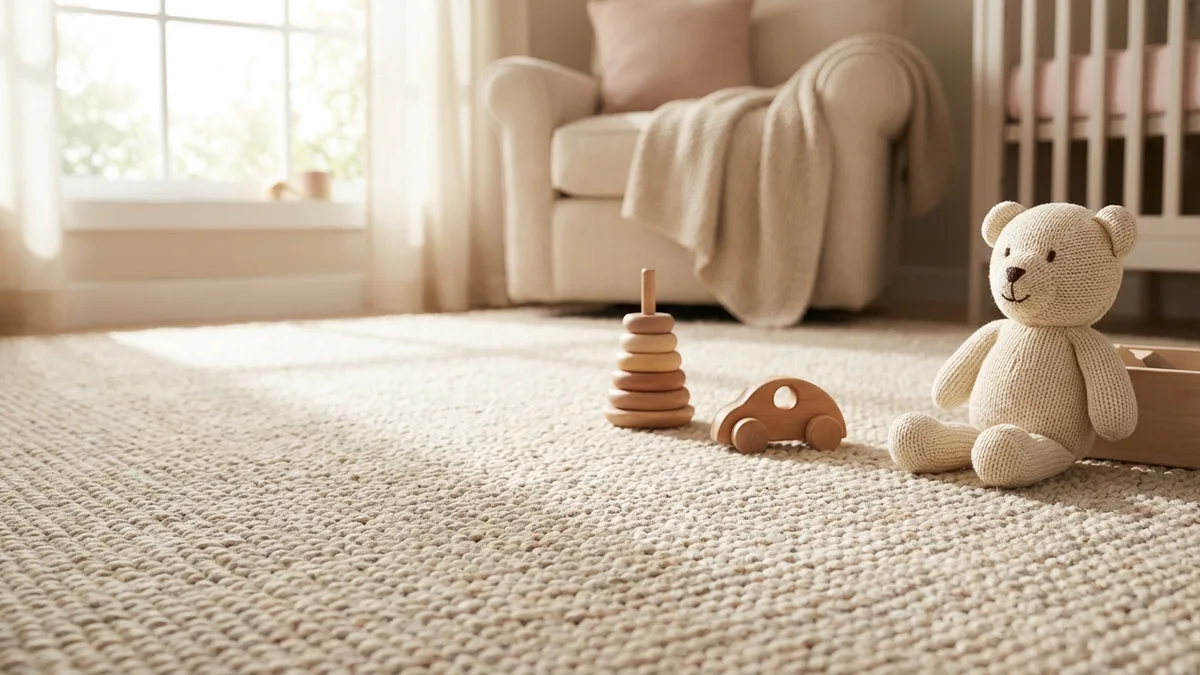
Your baby is going to spend a lot of time on the floor. Crawling, rolling, sitting, sleeping on a blanket, putting their face directly against the surface while figuring out how arms work. Whatever flooring you choose for their room isn’t just background. It’s a surface they’ll be in constant contact with during some of the most chemically sensitive months of their development.
So the carpet question matters. Parents often choose carpet for nurseries because it’s soft, warm, and cushions falls. Those are real advantages. But carpet also comes with a chemical profile that’s worth understanding before you install 200 square feet of it in the room where your baby sleeps.
What’s in New Carpet?
New carpet doesn’t just smell “new.” That distinctive odor comes from a cocktail of volatile organic compounds off-gassing from the carpet fibers, backing, adhesive, and padding. The specific chemicals vary by manufacturer and product, but common ones include:
4-Phenylcyclohexene (4-PCH). This is the compound most responsible for the “new carpet smell.” It’s a byproduct of the latex backing used in many carpets. It causes eye and respiratory irritation and is particularly noticeable in the first few days after installation.
Styrene. Found in some carpet backings, styrene is classified as a possible human carcinogen by the EPA.
Formaldehyde. Present in some carpet adhesives and treatments. It’s a known carcinogen and respiratory irritant. For more on this chemical across all household sources, see our formaldehyde guide.
Phthalates. Used in some vinyl-backed carpets as plasticizers. These are endocrine disruptors that interfere with hormonal development.
Flame retardants. While not as universal in carpet as they are in furniture, some carpet pads and treatments contain organohalogen flame retardants. These compounds are associated with thyroid disruption, neurodevelopmental effects, and cancer.
Perfluorinated compounds (PFAS). Stain-resistant carpet treatments often use PFAS chemistry. That Scotchgard-style stain resistance comes at a chemical cost. For the full picture on these chemicals, see our PFAS guide.
Dr. Leonardo Trasande, a pediatrician at NYU and author of Sicker, Fatter, Poorer, has estimated that endocrine disruptor exposure from products like chemically treated flooring contributes meaningfully to childhood health costs. His research frames this not as alarmism but as basic exposure math: babies are smaller, they breathe faster, and they’re in direct skin contact with these surfaces for hours every day.
The Dust Problem
New carpet chemistry is only half the story. The other half is what carpet collects over time.
Carpet acts as a reservoir for household dust, and household dust is not just dead skin cells and dirt. Studies have consistently found that indoor dust contains a cocktail of chemicals that have settled out of the air or been tracked in from outside:
- Lead particles (especially in older homes or near busy roads)
- Pesticide residue (tracked in on shoes)
- Flame retardant dust (from furniture, electronics, and carpet padding)
- Phthalates (from vinyl flooring, plastics, and personal care products)
- Pet allergens, dust mites, and mold spores
A study published in Environmental Science & Technology found measurable levels of flame retardants, phthalates, and PFAS in household dust across the majority of homes tested. Carpet traps more of this dust than hard flooring and releases it back into the breathing zone when disturbed by foot traffic, vacuuming, or a crawling baby.
This matters because of how babies interact with the floor. They don’t just sit on it. They put their hands on it and then put those hands in their mouth. Hand-to-mouth behavior in infants is constant, and it’s a primary pathway for ingesting dust-borne chemicals.
Dr. Shanna Swan’s work on early-life chemical exposures has documented that the prenatal and infant period is when chemical exposure has the most significant developmental impact. Her research shows measurable associations between early phthalate exposure and later reproductive and neurological outcomes.
What About Carpet Padding?
The pad underneath your carpet is often more concerning than the carpet itself. Carpet padding is frequently made from:
- Rebond foam (recycled polyurethane foam from furniture and mattress manufacturing). This is the most common type and can contain flame retardants from the original foam products.
- Rubber padding. Can emit VOCs and contain processing chemicals.
- Fiber padding. Made from recycled fibers, which can include treated textiles with unknown chemical histories.
Because the pad is sandwiched between the carpet and the subfloor, it doesn’t get the same level of scrutiny that the visible carpet does. But it off-gasses through the carpet, and babies lying on the floor are right on top of it.
If you’re installing carpet in a nursery, the pad choice matters as much as the carpet choice. Look for pads that carry Green Label Plus certification from the Carpet and Rug Institute, or choose natural felt or wool padding.
What the Carpet Industry Says
The carpet industry has made improvements. The Carpet and Rug Institute (CRI) runs a Green Label Plus certification program that tests finished carpet, cushion, and adhesive products for VOC emissions. Products that carry this label meet thresholds for formaldehyde, styrene, 4-PCH, and other compounds.
This is a step in the right direction, but it has limitations. Green Label Plus tests for a defined list of VOCs; it doesn’t test for flame retardants, PFAS, or phthalates. A carpet can be Green Label Plus certified and still contain stain-resistant PFAS treatments.
There’s also a timing issue. Green Label Plus testing measures emissions from new carpet under controlled conditions. It doesn’t account for the chemical accumulation that happens over the carpet’s lifetime as it collects dust and is treated with cleaning products.
Practical Guidance for Parents
Here’s where I think the evidence points:
If you’re installing new carpet in a nursery:
Choose carpet with the strictest certifications. Green Label Plus is the minimum. GreenGuard Gold is better. Look for carpet explicitly labeled PFAS-free and made without stain-resistant treatments.
Choose the pad carefully. Avoid rebond foam padding. Opt for natural fiber or felt padding. If that’s not available, at minimum get Green Label Plus certified padding.
Ventilate before the baby arrives. Install the carpet weeks before the baby will use the room. Open windows and run fans continuously. The most intense off-gassing happens in the first 72 hours, but allowing 2 to 4 weeks of ventilation before a baby occupies the room is ideal.
Skip the stain treatment. When the carpet installer asks if you want stain protection applied, say no. That treatment is almost always PFAS-based, and whatever stain resistance it provides isn’t worth the chemical exposure for an infant.
Dr. Philip Landrigan has consistently recommended reducing unnecessary chemical exposures during early childhood, calling it one of the most cost-effective public health interventions available. Choosing untreated flooring for a nursery fits that approach.
If you already have carpet in the nursery:
Vacuum frequently with a HEPA-filtered vacuum. Standard vacuums recirculate fine dust particles back into the air. HEPA filtration captures them. Vacuum the nursery at least twice a week, and vacuum when the baby isn’t in the room to let disturbed dust settle.
Use a non-toxic carpet cleaner. When the carpet needs deep cleaning, use a cleaner free of fragrances, optical brighteners, and synthetic surfactants. Check our best non-toxic cleaning products guide for options.
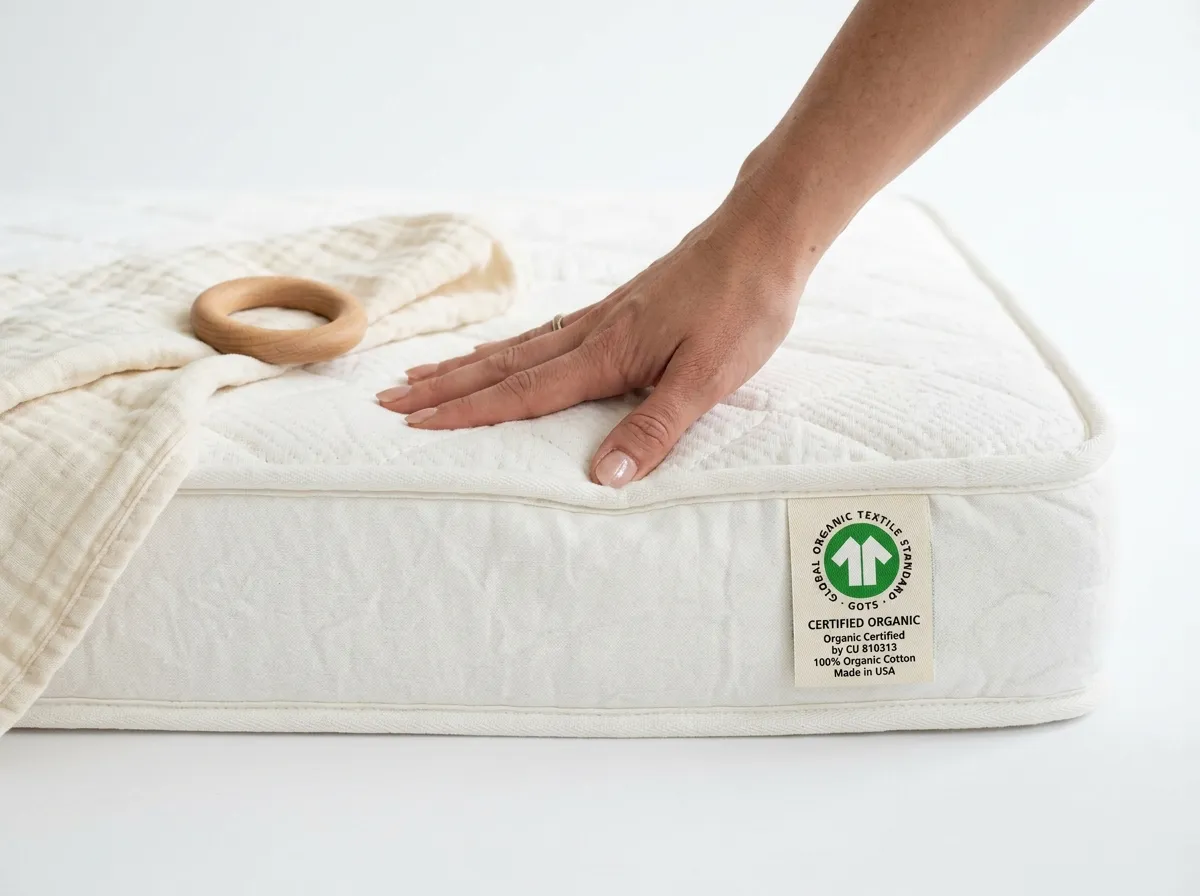
Place a clean, organic cotton blanket or play mat on the carpet as a barrier between baby and carpet. This doesn’t eliminate exposure but reduces direct skin contact with treated fibers and carpet-trapped dust. See our best non-toxic play mat guide for recommendations.
Don’t wear shoes in the house. The pesticides, lead, and other pollutants tracked in on shoes accumulate in carpet more than on any other flooring surface. A shoes-off policy at the door significantly reduces what ends up in your carpet.
If you’re choosing between carpet and hard flooring:
From a pure chemical exposure standpoint, hard flooring (hardwood, tile, or natural linoleum) is easier to keep clean and doesn’t trap dust the way carpet does. The tradeoff is that hard floors are cold and unforgiving for falls.
A reasonable middle ground is hard flooring with non-toxic area rugs that can be washed regularly. Wool rugs are naturally flame-resistant (so they don’t need chemical flame retardant treatments) and don’t off-gas VOCs the way synthetic carpet does. Check our best non-toxic rugs guide and our best non-toxic carpet guide for specific recommendations.
Flooring Options Side by Side
No flooring choice is risk-free. Every option involves some tradeoff between chemical exposure, physical safety, and practicality.
| Option | Main concern | Primary tradeoff |
|---|---|---|
| New synthetic carpet (nylon, polyester) | VOC off-gassing (4-PCH, styrene, formaldehyde), PFAS stain treatments, flame retardants in padding | Softest for falls, warmest surface - but highest chemical load in the first weeks and ongoing dust accumulation |
| Older carpet (3+ years, already in place) | Accumulated dust reservoir: flame retardants, phthalates, lead, pesticide residue | Lower active VOC off-gassing than new carpet, but chemical accumulation over time may offset that advantage |
| Area rug over hard floor | Rug chemistry varies widely (wool vs synthetic); backing adhesives; PFAS in stain-resistant treatments | Washable if wool; hard floor underneath is easy to clean; chemical profile depends heavily on rug material chosen |
| Hard flooring only (hardwood, tile, natural linoleum) | Finish chemistry in hardwood (polyurethane coats); tile grout cleaners; vinyl/LVP off-gases phthalates and VOCs | Easiest to keep clean, lowest dust accumulation - but cold, hard surface increases fall injury risk for new walkers |
What We Don’t Fully Know
The long-term health significance of low-level, chronic dust chemical exposure in infants is not well-characterized by current research. Most of the studies linking carpet to chemical exposure are biomonitoring studies - they confirm bisphenols, flame retardants, and phthalates turn up in children’s blood and urine at measurable levels. They’re less clear on what those levels mean for health outcomes at typical residential exposures. The dose question matters here. We know chemicals accumulate in carpet dust. We don’t have good longitudinal data on what exposure thresholds produce measurable health effects in children in typical home settings.
The Bigger Picture
According to NonToxicLab’s research, carpet in a nursery isn’t an automatic health hazard, but it does add chemical complexity to the room where your baby spends the most time. The combination of off-gassing from new carpet, dust accumulation over time, and the close physical contact babies have with the floor surface creates an exposure profile that’s worth managing.
You don’t need a perfectly sterile environment. Babies are resilient, and some level of environmental exposure is unavoidable and even normal. For most families with existing carpet that’s several years old, well-vacuumed with a HEPA filter, and not recently treated with stain chemicals, this is probably fine - the residual chemical load is real but likely low. The higher-risk scenarios are a newly installed carpet with fresh off-gassing and stain treatments in a room a baby uses immediately, or old carpet that hasn’t been cleaned in years. But where you can make a practical choice that reduces exposure to documented endocrine disruptors, carcinogens, and respiratory irritants without meaningful inconvenience, it’s worth doing.
Choose your carpet and pad carefully. Ventilate. Skip the stain treatment. Vacuum often. And if you’re starting from scratch in a nursery, consider whether hard flooring with washable rugs might give you both the safety and comfort you’re looking for.
For more on building a healthier nursery, see our non-toxic crib and kids furniture guide and our complete non-toxic baby products guide.
What Readers Want to Know
How long should I ventilate new carpet before a baby uses the room?
At minimum 72 hours with windows open and fans running. Ideally 2 to 4 weeks. The heaviest off-gassing occurs in the first few days, but VOC emissions continue at lower levels for weeks to months.
Is wool carpet safer than synthetic carpet for a nursery?
Yes, generally. Wool is naturally stain-resistant and flame-resistant, so it doesn’t need the chemical treatments that synthetic carpet requires. It also doesn’t off-gas VOCs the way nylon or polyester carpet does. The main drawback is cost. Wool carpet is significantly more expensive than synthetic options.
Do carpet tiles work as a nursery flooring option?
Carpet tiles (modular carpet squares) can be a good option because you can replace individual tiles if they get stained, and many brands offer low-VOC options. FLOR is a popular brand. Check for GreenGuard Gold certification and ask about PFAS content in any backing adhesive.
Can HEPA vacuuming really make a difference?
Yes. Studies show that regular HEPA vacuuming significantly reduces the concentration of dust-borne chemicals in carpet, including flame retardants, phthalates, and lead. The key is consistency and using a vacuum that doesn’t recirculate fine particles.
Is it safe to steam clean carpet in a nursery?
Steam cleaning with water alone is one of among the best-researched safe options deep-cleaning methods. It kills dust mites and removes allergens without chemicals. Avoid steam cleaning services that add chemical solutions, and make sure the carpet dries completely afterward to prevent mold growth.
Should I remove old carpet before a baby arrives?
If the carpet is old, stained, or of unknown origin, removing it and replacing it with clean flooring (or new, well-ventilated low-VOC carpet) is one of the more impactful nursery preparation steps you can take. Old carpet has had years to accumulate dust, allergens, and chemical residues.
Sources
- Environmental Science & Technology. Studies on chemical contaminants in household dust.
- Carpet and Rug Institute. Green Label Plus certification standards.
- Trasande, Leonardo. Sicker, Fatter, Poorer. Houghton Mifflin Harcourt, 2019.
- Swan, Shanna H. Count Down. Scribner, 2021.
- Landrigan, Philip J. Research on early childhood chemical exposure and public health.
- EPA. Styrene hazard assessment and classification.