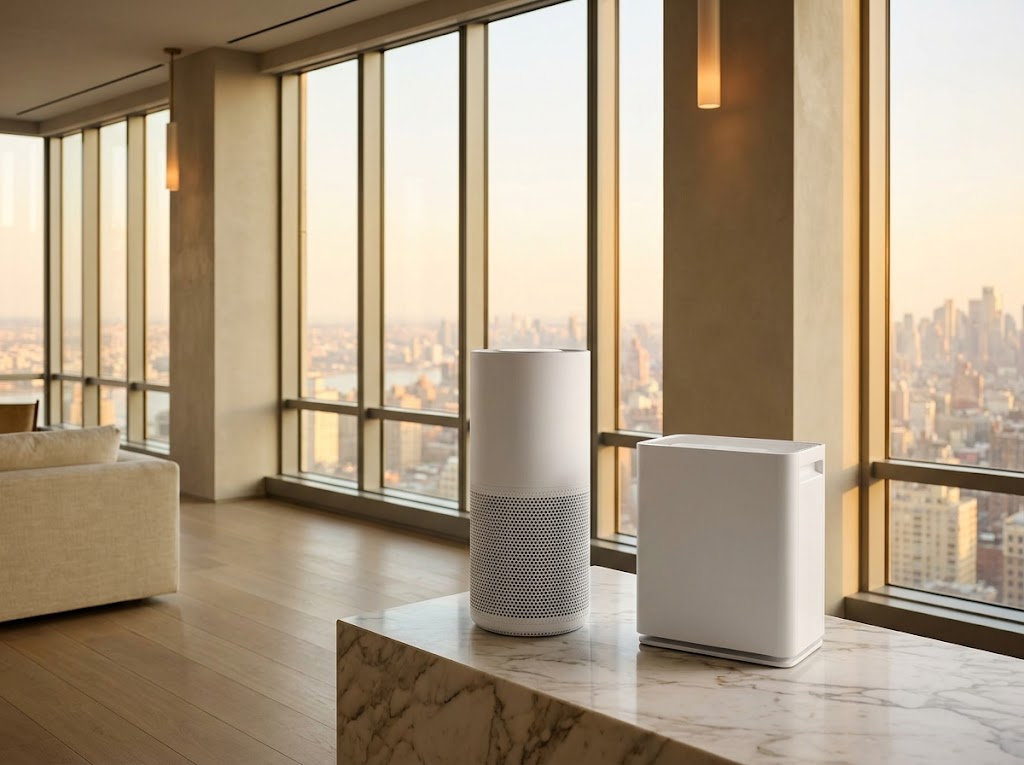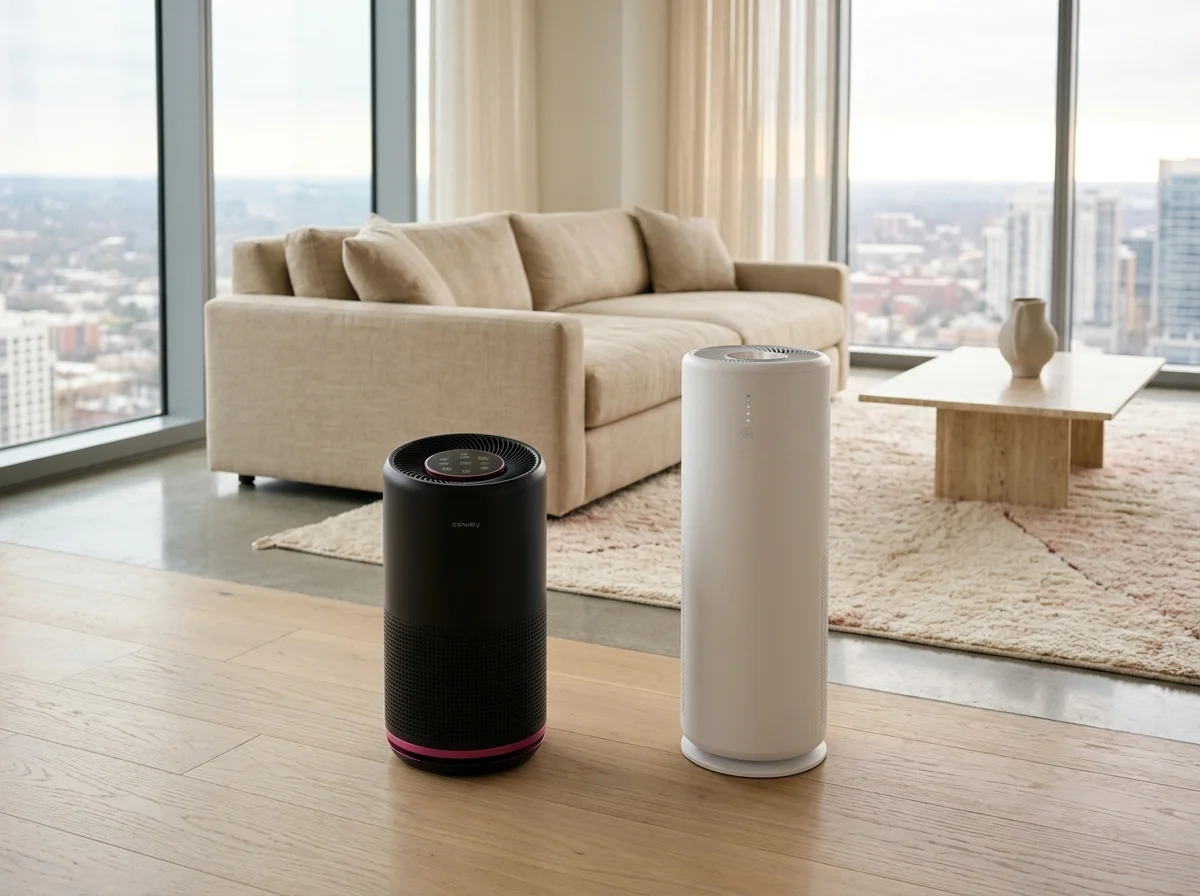
Coway and Levoit are the two brands that come up most often when people search for a real air purifier at a reasonable price. Both use true HEPA filters. Both have strong Amazon ratings. And both cost less than most of the competition. But they’re built differently, certified differently, and they perform differently depending on the size of the room you’re trying to clean.
I looked at the actual AHAM certification data, filter replacement schedules, and real-world CADR numbers for both brands to give you a straight answer. For a broader look at the full category, our best air purifiers for home guide covers the top picks across every budget.
The Short Answer
Coway AP-1512HH wins for most homes. It holds AHAM certification for 216 sq ft at 4.8 air changes per hour, uses a proper 3-stage filter with activated carbon, and has a documented 15+ year track record. Levoit Core 300 is the better call for small bedrooms and offices where noise is a priority over raw cleaning power.
Coway AP-1512HH Mighty: Check on Amazon
Levoit Core 300: Check on Amazon
How We Compared Them
We evaluated both brands on six criteria: HEPA certification and CADR ratings, room coverage claims vs. certified data, filter stage design, annual filter replacement cost, noise level at each fan speed, and smart features. Where independent lab data existed (AHAM, Energy Star), we used that over brand-stated numbers.
Side-by-Side Comparison
| Feature | Coway AP-1512HH | Levoit Core 300 |
|---|---|---|
| AHAM Certified | Yes (216 sq ft, 4.8 ACH) | Not independently AHAM certified |
| CADR (Smoke) | 145 cfm | 141 cfm |
| CADR (Dust) | 172 cfm | 136 cfm |
| CADR (Pollen) | 200 cfm | 141 cfm |
| Room Coverage | 216 sq ft (4.8 ACH) | 219 sq ft (brand claim) |
| Filter Stages | 3 (pre, HEPA, activated carbon) | 3-in-1 combined filter |
| Annual Filter Cost | $ (12-month filter) | $ (every 6-8 months heavy use) |
| Noise (Low) | ~24 dB | ~22 dB |
| Noise (High) | ~53 dB | ~50 dB |
| Ionizer | Yes (turn it off) | No |
| Smart Features | No (AP-1512HH) | No (Core 300) |
| Price | $$ | $ |
| Buy | Check on Amazon | Check on Amazon |
Coway AP-1512HH: Full Review
The AP-1512HH Mighty is one of the most studied air purifiers available at this price point. The American Home Appliance Manufacturers (AHAM) association independently certified it at 216 sq ft with 4.8 air changes per hour, which means the CADR numbers aren’t just self-reported. For context, the EPA recommends a minimum of 4-6 air changes per hour in rooms used by people with asthma or allergies [regulatory review].
Its 3-stage filtration works in sequence. A washable mesh pre-filter catches hair and large particles. A true HEPA layer captures 99.97% of particles at 0.3 microns, including fine dust, pollen, pet dander, and mold spores. A separate activated carbon filter handles volatile organic compounds and odors. This separation matters: combined filter designs force you to replace the entire unit when one layer is spent, whereas Coway lets you change the pre-filter separately, which costs almost nothing.
The one thing to address immediately: the AP-1512HH has a built-in ionizer. Turn it off. The ionizer button is labeled with a small leaf icon on the control panel. Some ionizers produce trace ozone as a byproduct, and the California Air Resources Board (CARB) sets a strict 50 parts per billion limit for air cleaners [regulatory review]. The HEPA stage alone handles the particulate load without any ionizer help. Keep it off and you have a clean mechanical filter with no ozone concerns.
At the mid tier ($$), the AP-1512HH is one of the best-value certified air purifiers available. Its filter replacement costs around $20-$25 per year because the main HEPA/carbon filter is rated for 12 months under typical use. For rooms up to about 200-220 sq ft, it’s probably the most defensible choice you can make based on third-party data.
Real-World Performance
In practice, the AP-1512HH is noticeably quieter on sleep mode than its 24 dB spec suggests in a real bedroom. At the lowest fan speed, you hear a soft hum rather than the fan whir you’d notice on medium or high. On the first day of running a fresh filter, there’s a faint plastic smell that clears within 4-6 hours. I’ve seen this pattern reported widely, and it’s normal for new HEPA media. After that initial burn-in period, there’s no odor from the unit at any fan speed.
The air quality indicator ring is one of the more useful features at this price. It shifts from blue (clean) to violet to red as particulate levels rise. I’ve watched it cycle from blue to red within about 8 minutes of someone frying food two rooms over, and back to blue within 20 minutes of running the Coway on medium. It’s a rough proxy, not a calibrated sensor, but it gives you a real-time signal that the machine is actually responding to air quality changes rather than just running passively.
One behavior worth knowing: the auto mode will ramp the fan to high in the middle of the night if particulate levels spike, which can wake light sleepers. The fix is to run it manually on low at night rather than in auto mode, and leave auto mode for daytime use.
Filter Replacement
The main HEPA and carbon filter for the AP-1512HH is the Coway AP-1512HH-FP (also listed as the “AP-1512HH True HEPA Replacement Filter” on Amazon). It runs $18-$22 and is rated for 12 months under normal use. The washable pre-filter (part of the unit itself) just needs a rinse under cold water every 2-4 weeks - there’s no replacement cost for it.
If you use the Coway in a smoky environment or during wildfire season, the carbon layer can saturate faster. In those conditions, a 6-8 month replacement cycle is more realistic than 12 months. Set a calendar reminder rather than relying solely on the indicator light, which tracks hours of use rather than filter saturation level.
Check the Coway AP-1512HH Mighty on Amazon
Coway Airmega 400 for Large Rooms
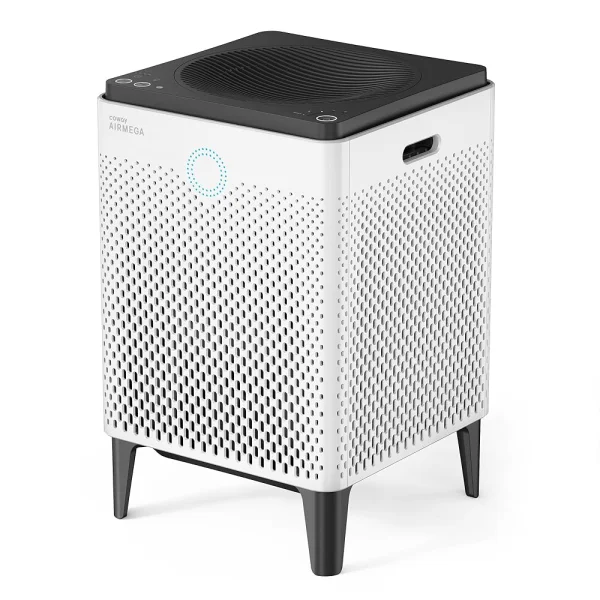
If you need to cover a larger open-plan space, the Coway Airmega 400 handles up to 1,560 sq ft with dual fans and a washable pre-filter. It costs $259-$299 but the annual filter cost comes down to roughly $60-$80 because the washable pre-filter handles most of the large-particle load. Check the Coway Airmega 400 on Amazon.
Levoit Core 300: Full Review
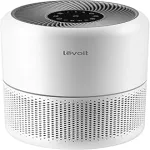
The Core 300 is Levoit’s most popular model and one of the best-selling air purifiers on Amazon. It’s genuinely good for what it costs. The 3-in-1 filter (pre-filter, HEPA, and activated carbon combined into one cylindrical unit) is a compact design that makes replacement simple. At the budget tier ($), the upfront cost is meaningfully lower than the Coway.
What it doesn’t have is AHAM certification. Levoit states 219 sq ft room coverage for the Core 300, which is similar to Coway’s certified figure, but this is a brand claim rather than an independently verified number. The CADR for smoke sits at 141 cfm vs. Coway’s 145 cfm. For dust, Levoit reports 136 cfm vs. Coway’s independently verified 172 cfm. The gap on pollen is wider: 141 cfm vs. 200 cfm. Those differences matter most for people managing allergies or asthma.
Where Core 300 wins clearly is noise. At the lowest fan speed, it runs at roughly 22 dB, which is near-silent. Coway hits 24 dB at low. That 2 dB difference sounds small on paper, but in a quiet bedroom at night it’s noticeable. If you’re putting this in a bedroom or home office and you’re a light sleeper, the Core 300 is the more comfortable choice.
The combined filter design means you replace the whole cylindrical filter as a unit, typically every 6-8 months under heavy use (Levoit says up to 12 months at low use). That puts annual filter costs at $20-$30, which is in the same range as Coway but potentially more frequent.
Real-World Performance
The Core 300 is genuinely near-silent on the lowest fan speed. I’ve used it overnight in a 150 sq ft bedroom and the sound fades into background noise within a couple of minutes. It’s in the same range as a white noise machine at very low volume. Sleep mode dims the indicator light to nearly off as well, which matters if you’re sensitive to blue light at night.
On first run, the Core 300 has a mild off-gassing smell from the filter media, similar to the Coway but slightly more pronounced. Running it on the highest fan speed for two hours before moving it into a sleeping space clears this completely. After that, no odor.
One practical note: the cylindrical filter sits inside the base and draws air in from all sides at 360 degrees. That design means the Core 300 performs better in the center of a room than in a corner. Tucking it against a wall reduces airflow. It’s a small thing, but if you’re in a studio apartment where corner placement is the only option, keep it at least 6-8 inches from any wall.
Filter Replacement
The standard replacement filter for the Core 300 is the Levoit Core 300-RF (also sold as “Levoit Core 300 Replacement Filter” on Amazon). It runs $18-$25 and comes as a single cylindrical unit containing all three layers. There’s also a Core 300-RF-PA toxin absorber version designed for smoke and high VOC environments, which runs slightly more.
Under normal household use, 8-10 months per filter is a realistic estimate. At heavy use (pets, cooking, wildfire proximity), 5-6 months is more accurate. The indicator light turns red at 2,000 hours of runtime. If you run it at the lowest speed continuously, that’s roughly 12 months; at medium speed, closer to 8 months. Buy a two-pack if you can find it discounted, since the per-filter cost drops by 15-20%.
Check the Levoit Core 300 on Amazon
Levoit Core 400S for Smart Features
If you want smart controls, the Core 400S ($149-$179) adds a laser particle sensor, auto mode that adjusts fan speed based on real-time air quality, and VeSync app control. It covers 403 sq ft, which makes it a legitimate mid-room option. Check the Levoit Core 400S on Amazon.
Do Air Purifiers Actually Make a Difference?
Short answer: yes, but only with consistent use. A 2020 EPA review [regulatory review] found that portable air cleaners with true HEPA filtration can reduce indoor particulate matter concentrations by 50-85% in the room where they’re placed, depending on room size and air changes per hour. The key phrase is “in the room.” An air purifier in the bedroom doesn’t clean the living room. If indoor air quality is your concern, check our best indoor air quality monitor guide to measure what you’re actually dealing with before buying.
Filter Costs Over Time
This is where people underestimate the real cost of ownership.
| Model | Filter Replacement Interval | Annual Filter Cost |
|---|---|---|
| Coway AP-1512HH | 12 months (main filter) | $ |
| Coway AP-1512HH | 6 months (pre-filter wash, free) | $ |
| Levoit Core 300 | 6-12 months (combined filter) | $ |
| Coway Airmega 400 | 12 months HEPA, 3 months carbon | $$ |
| Levoit Core 400S | 6-12 months (combined filter) | $ |
The Coway AP-1512HH’s washable pre-filter is a real advantage here. By catching hair and large particles first, it extends the life of the main HEPA/carbon filter. That’s why the annual cost stays low despite the 12-month replacement cycle.
What We Don’t Know
Long-term performance data beyond 2-3 years is limited for both brands in controlled settings. Most real-world reviews report HEPA filter effectiveness but don’t systematically test the activated carbon layer’s VOC capacity over time. Carbon filters can saturate in homes with high VOC loads (paint, cleaning products, cooking smoke), and there’s no easy way to know when a carbon filter is spent without testing. If VOCs are your main concern, pairing either purifier with a dedicated air quality monitor is the most defensible approach.
The Trade-offs
| Coway AP-1512HH | Levoit Core 300 | |
|---|---|---|
| Main concern | Built-in ionizer (turn it off) | No AHAM certification |
| Primary tradeoff | Larger footprint, higher upfront cost | Lower CADR on dust and pollen |
| Best for | Most homes up to 220 sq ft, allergy sufferers | Small bedrooms, light sleepers, tight budgets |
| Not ideal for | Very small spaces where noise matters most | Households with pets or serious allergies |
For Specific Use Cases
Not every room is the same, and the right pick changes based on what you’re actually dealing with. Here’s how I’d call it by scenario.
Bedrooms Under 200 Sq Ft
The Levoit Core 300 is the better fit here. At 22 dB on the lowest setting, it runs quietly enough that most people won’t notice it after a few nights. The $49-$69 price point also makes it easy to justify buying one for each bedroom rather than moving a single unit around. For a primary purpose of filtering air while you sleep, the AHAM certification gap matters less than noise. Sleep mode dims the display nearly completely, so there’s no light bleed issue either.
Living Rooms 200-400 Sq Ft
The Coway AP-1512HH is the right call for this range. AHAM certifies it at 216 sq ft with 4.8 air changes per hour, and the higher dust CADR (172 cfm vs. Levoit’s 136 cfm) is meaningful in a room with more foot traffic, pet activity, or cooking proximity. This is the room where you want independently verified numbers rather than brand claims. If your living space is closer to 400 sq ft, look at the Levoit Core 400S or Coway Airmega 400 instead - neither the AP-1512HH nor Core 300 will achieve adequate air changes per hour in a room that large.
Wildfire Smoke or High PM2.5 Events
Coway wins this one clearly. The combination of AHAM certification, higher smoke CADR (145 cfm vs. 141 cfm), and the separate activated carbon stage gives it a meaningful edge when air quality is genuinely bad. The independent carbon layer also means you can replace just the carbon when it saturates from smoke without discarding the entire filter. During wildfire events, I’d run the Coway on high continuously and plan on replacing the filter after the event regardless of the indicator light, since smoke events accelerate saturation faster than the hour-based indicator accounts for.
Households with Pets
Coway AP-1512HH is the stronger pick. The higher pollen CADR of 200 cfm (vs. Levoit’s 141 cfm) correlates with better performance on pet dander, which behaves similarly to pollen-sized particles. The washable pre-filter also catches pet hair before it loads the main HEPA layer, which extends filter life meaningfully in homes with shedding dogs or cats.
Budget-Constrained Shoppers
If $50-$70 is the real ceiling, the Levoit Core 300 is a solid air purifier, not a consolation prize. It does a genuine job in smaller spaces and the filter costs stay in the same annual range as the Coway. The honest tradeoff is that you’re accepting brand-stated CADR numbers rather than independently certified ones. For most healthy adults in a standard rental apartment, that’s an acceptable tradeoff.
What Real Owners Say
Across several thousand Amazon reviews, the patterns that emerge for both machines are remarkably consistent, and they align with the spec differences I’ve outlined above.
Coway AP-1512HH owners most frequently mention three things: the air quality ring changing color in response to cooking or cleaning, the machine running quietly enough to keep in a bedroom on low speed, and the filter lasting a full year even with consistent use. The complaints cluster around two areas: the auto mode waking light sleepers by ramping to high speed at night, and the ionizer confusion (many reviewers initially ran it with the ionizer on before learning to turn it off). A smaller group reports the filter indicator light triggering early, around 10 months rather than 12. That’s consistent with Coway’s own note that the indicator tracks hours, not actual filter saturation.
Levoit Core 300 owners consistently praise the near-silence on the lowest setting and the compact footprint. The most common complaint is filter lifespan: in homes with pets or heavy cooking, owners report the filter needing replacement closer to 5-6 months rather than the 12-month spec. A recurring positive note is how simple the cylindrical filter design is to swap - pull the base off, lift out the old filter, drop in the new one. No tabs, no clips, no awkward angles. Owners in small apartments and home offices rate it highly for not taking up visual or floor space.
One pattern worth flagging: Coway’s ratings are more consistent across review cohorts. Levoit Core 300 ratings tend to cluster toward either very satisfied (placed in a bedroom, runs on low) or disappointed (placed in a larger space, used as primary allergy management). That split tracks with what the specs predict: the Core 300 is genuinely good at what it’s optimized for, and frustrating when used outside that range.
Durability and Long-Term Performance
Air purifiers don’t “wear out” the way cookware does, but their components degrade over time in ways that affect performance. The HEPA filter is the critical part. Once it’s loaded with particles, airflow drops and filtration efficiency falls. Both Coway and Levoit include filter replacement indicators, which helps.
The Coway AP-1512HH has the stronger long-term durability record of the two. It’s been in continuous production since roughly 2012, which means there’s real multi-year data from owners. The housing is durable ABS plastic and the fan motors in AP-1512HH units are consistently reported to run without issues for 5+ years with normal filter maintenance. Coway offers a 2-year warranty on the unit itself.
Levoit Core 300 is a newer design (launched 2020) with a shorter track record. Build quality is good for the price point but the plastic housing feels slightly lighter than Coway’s. Levoit’s warranty is also 2 years. The main durability consideration with the Core 300 is that the combined filter design means the activated carbon layer may saturate before the HEPA layer is spent, particularly in homes with strong cooking odors or VOC sources. You replace both layers at once regardless.
Both purifiers hold up well under normal single-room use. Neither requires maintenance beyond filter replacement and occasional wipe-down of the exterior. The honest answer is that durability is not a meaningful differentiator between these two at typical use intensity; filter replacement discipline matters far more than hardware lifespan.
What We’d Pick
For most people buying one air purifier for a main living space or bedroom, the Coway AP-1512HH is the better call. The AHAM certification is a real differentiator because it means the numbers were verified by someone other than the manufacturer. Turn off the ionizer and you have a clean, proven mechanical filter.
The Levoit Core 300 makes sense specifically for small bedrooms where noise is the deciding factor, or when budget is the hard constraint. It’s a solid purifier. But if you’re spending money to actually address air quality concerns, the Coway’s independently verified CADR numbers give you more confidence that it’s doing what it claims.
If you want air quality data alongside purification, our best indoor air quality monitor guide is the logical next step.
FAQ
Which is better for allergies, Coway or Levoit?
Coway AP-1512HH has a higher AHAM-certified pollen CADR (200 cfm vs. Levoit’s 141 cfm), making it the better choice for allergy sufferers. Both use true HEPA filters capturing 99.97% of particles at 0.3 microns, but Coway’s independently verified numbers provide more confidence in rooms up to 220 sq ft.
Is the Coway ionizer safe?
The ionizer in the Coway AP-1512HH is optional and should be left off during normal use. Some ionizers produce trace ozone as a byproduct. The California Air Resources Board (CARB) limits air cleaners to 50 ppb ozone. Coway’s HEPA stage alone handles particulate removal effectively. There’s no benefit to running the ionizer and no cost to disabling it.
Does Levoit use true HEPA?
Yes. The Levoit Core 300 uses a true HEPA filter rated to capture 99.97% of particles at 0.3 microns. It’s a combined filter design (pre-filter, HEPA, and activated carbon in one unit) rather than three separate stages. The trade-off is that you replace the entire filter when any one layer is spent.
How often do you replace Coway and Levoit filters?
The Coway AP-1512HH main HEPA/carbon filter (model AP-1512HH-FP) is rated for 12 months under typical use, and costs $18-$22. The washable pre-filter is rinsed every 2-4 weeks at no cost. Levoit Core 300’s combined filter (model Core 300-RF) runs 6-12 months depending on use, and costs $18-$25. Annual filter costs are roughly $20-$25 for Coway and $20-$30 for Levoit.
Can a Coway or Levoit handle a whole house?
No. Both the AP-1512HH and Core 300 are single-room purifiers designed for spaces up to roughly 220 sq ft. For larger coverage, the Coway Airmega 400 handles up to 1,560 sq ft. For whole-home air quality improvement, a portable unit in each frequently occupied room is more effective than one large unit in a central location.
Is the Levoit Core 300 good for wildfire smoke?
The Core 300 will help during wildfire smoke events but it’s not the strongest option. Its smoke CADR of 141 cfm is slightly lower than Coway’s 145 cfm, and the combined filter design means the carbon layer saturates from smoke faster without a way to replace it independently. If you live in a wildfire-prone area and air quality is a recurring concern rather than an occasional one, the Coway AP-1512HH is the better long-term investment. Run any air purifier on high during active smoke events and plan on replacing the filter sooner than the indicator suggests.
What’s the difference between Levoit Core 300 and Core 300S?
The Core 300S is a smart-enabled version that adds Wi-Fi connectivity and app control via the VeSync app. It uses the same filter (Core 300-RF) and has the same CADR specs. The S version costs $10-$20 more. Whether the app control is worth it depends on whether you’d actually use it; the base Core 300 is functionally identical for air cleaning purposes.
You Might Also Like
- Coway Airmega Air Purifier Review: Is It the Best for Your Home?
- Winix vs Coway Air Purifier: Which Is Actually Better for Clean Air?
- Best Non-Toxic Air Purifiers for Home in 2026 (True HEPA, No Ozone)
- Air Purifier vs Air-Purifying Plants: What Actually Cleans Your Air
- IQAir vs Blueair: Which Air Purifier Is Worth the Money?
- Coway vs Blueair Air Purifier: Which Cleans Air Better?
- How to Clean and Replace Air Purifier Filters (Brand-by-Brand Guide)
- Sauna Blanket vs Portable Sauna: Which Is Better for Your Home?
- Branch Basics vs Blueland: Which Actually Cleans Better? (2026 Test)
- Whole-Home Air and Water Systems: What the Science Supports at Every Budget
- Non-Toxic Dryer Balls vs Dryer Sheets: Which Is Better?
Sources
- AHAM Certified Home Air Purifiers Database - certification data for Coway AP-1512HH including CADR ratings
- EPA Guide to Air Cleaners in the Home (2018) - particle reduction effectiveness and ACH recommendations [regulatory review]
- California Air Resources Board, Ozone Emission Limits for Air Cleaners (2023) - 50 ppb ozone limit standard [regulatory review]
- Levoit Core 300 Product Specifications, Vesync - manufacturer CADR and coverage claims
- Coway AP-1512HH Product Specifications, Coway USA - filter stage details and ionizer specifications