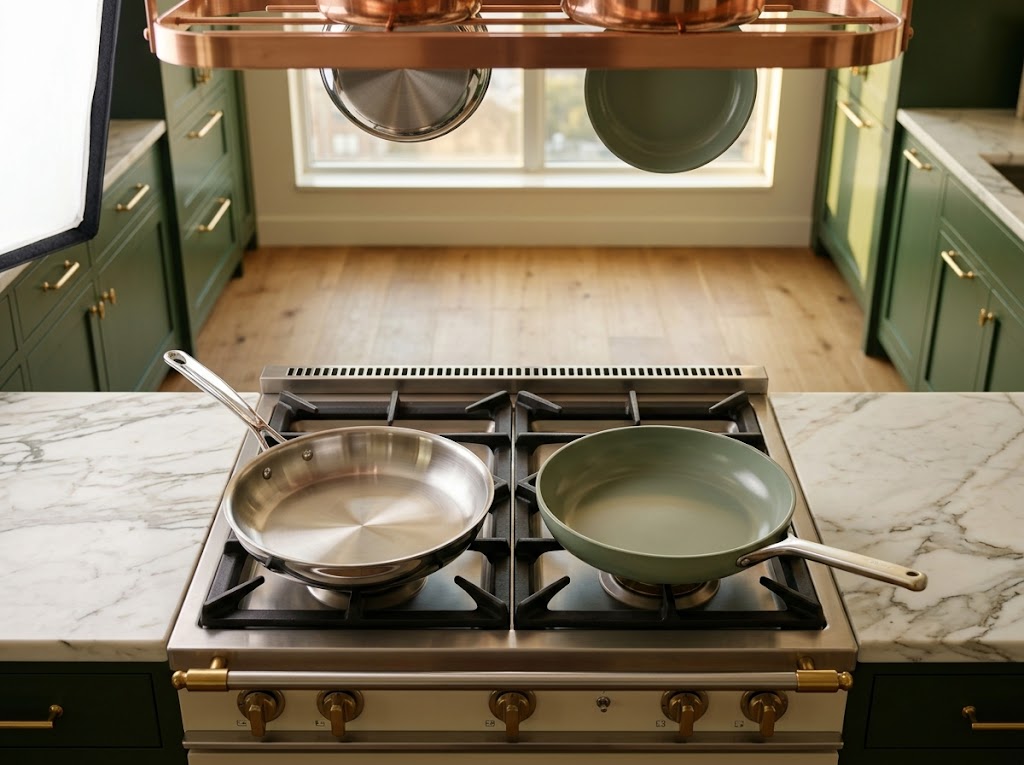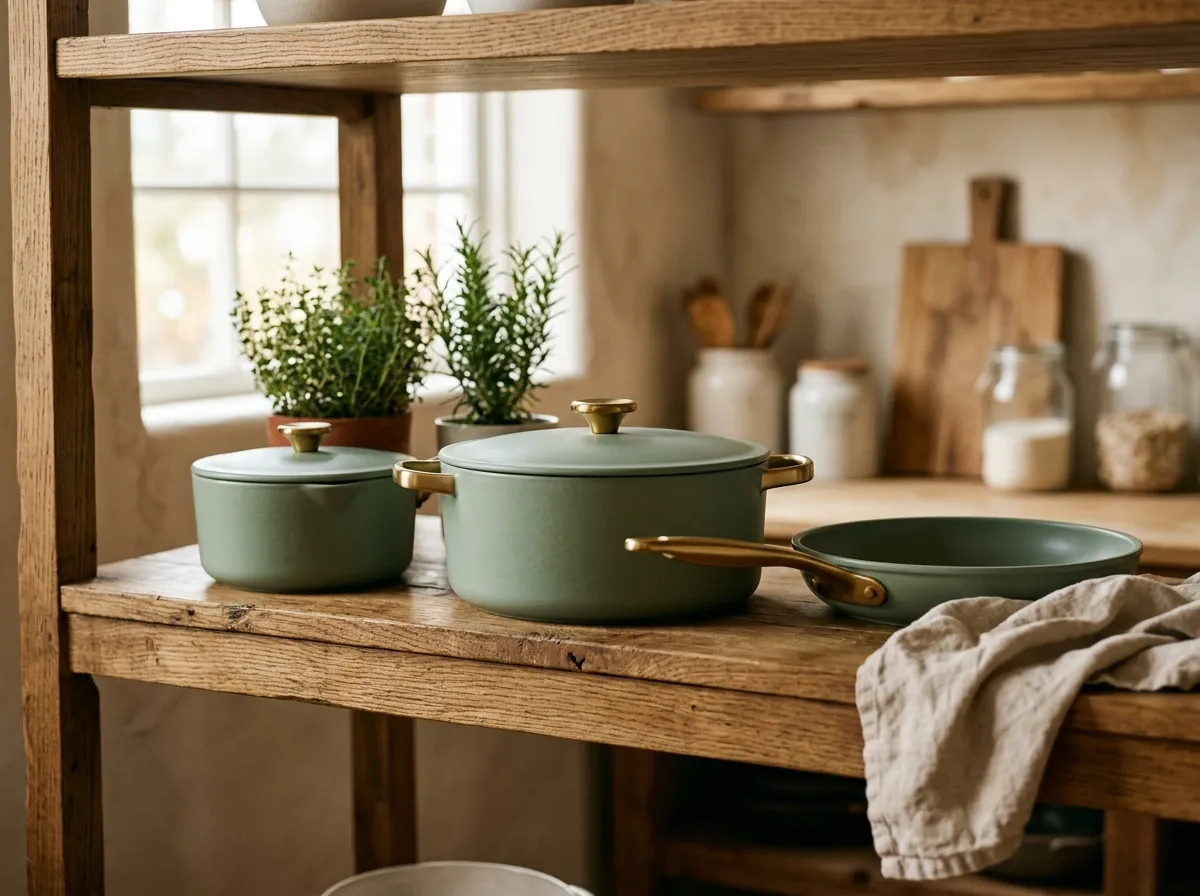
Here’s the thing about the Caraway vs Our Place debate: these two pans are trying to do very different things, even though they both show up in the same “non-toxic cookware” conversations. For specific product picks, check best non-toxic baby bottles.
Caraway sells traditional cookware sets. Frying pan, saucepan, Dutch oven, the whole lineup. Our Place built its brand around a single pan that claims to replace eight pieces of cookware. One is asking you to invest in a full kitchen overhaul. The other is asking you to simplify. For specific product picks, check best non-toxic bakeware.
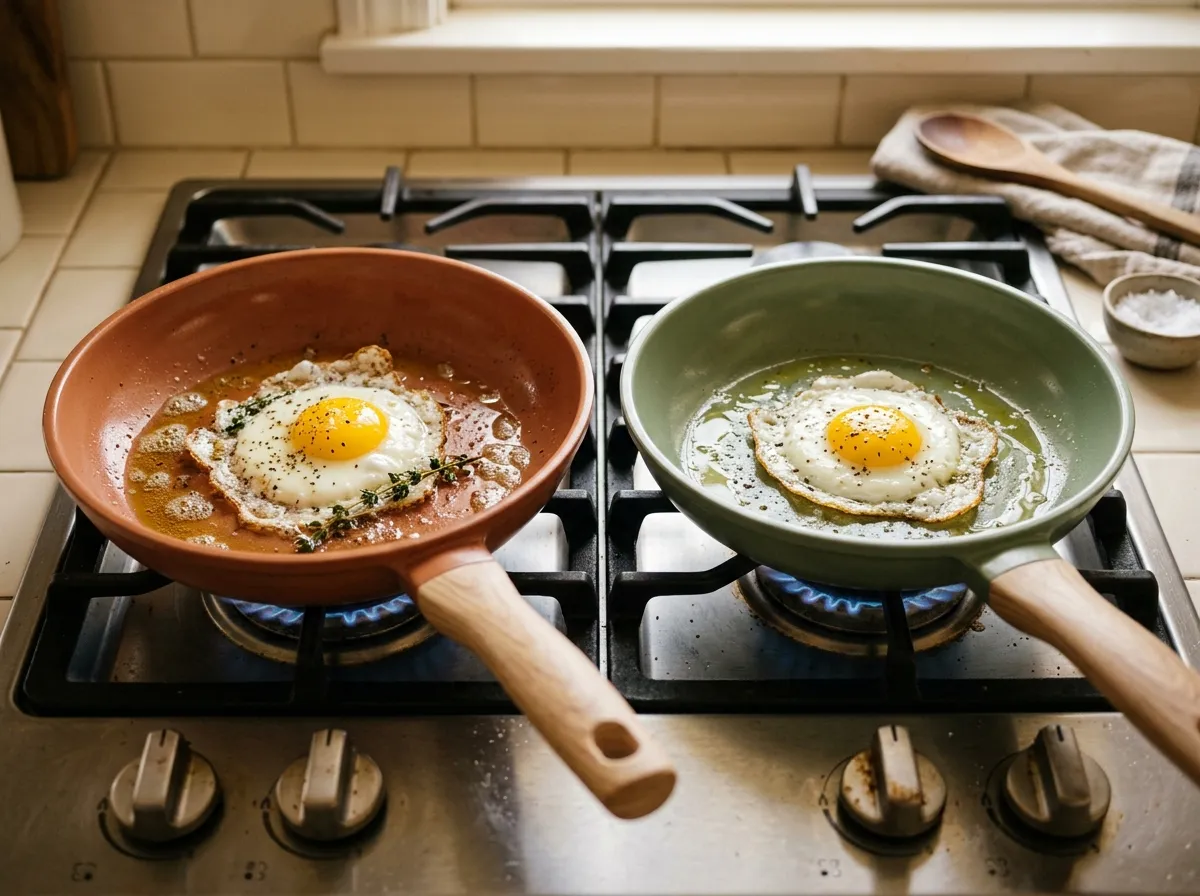
I’ve cooked with both for over a year now. Pancakes, stir-fries, seared salmon, pasta sauces, fried eggs (the real test). NonToxicLab reviewed both on safety, performance, and whether the nonstick actually holds up. Here’s what happened. We tested it and share our findings in caraway cookware review.
The Short Answer
Caraway wins if you want a full 4-piece set with better heat distribution and slightly more durable coating. The Our Place Always Pan is fine if you’re in a small kitchen and want one versatile pan instead of a matching set. Neither lasts as long as GreenPan’s Thermolon coating, so if coating longevity is your top priority, look at GreenPan instead.
What I Wish Someone Had Told Me Before Buying
The Always Pan is not a replacement for a full cookware set. I don’t care what the marketing says. It does a lot of things adequately and very few things excellently. The Caraway frying pan does one thing (frying and sauteing) and does it well. See our side-by-side comparison in caraway vs greenpan vs our place.
If you want one pan and you cook simple meals, the Always Pan works. If you cook regularly and care about getting a good sear or evenly cooked food, you’ll eventually want dedicated pieces, and Caraway’s set is a solid option for that.
That’s the honest summary. Now let me get into the details.
Coating Safety: Both Pass, With Caveats
Both pans use ceramic-based nonstick coatings that are free of PTFE, PFOA, PFAS, lead, and cadmium. That’s the baseline for why anyone considers either brand.
Caraway uses a proprietary mineral-based ceramic coating. They publish third-party test results from TUV Rheinland confirming the coating is free of over 60 potentially toxic substances. That level of transparency is above average.
Our Place uses a proprietary ceramic coating as well, though they share fewer specifics about the coating composition. They confirm PFAS-free, PFOA-free, and PTFE-free, and the pan carries a California Prop 65 compliance note, but they don’t publish third-party testing the way Caraway does.
Toxicologist Dr. Leonardo Trasande, who serves as director of the Center for the Investigation of Environmental Hazards at NYU Langone, has highlighted that ceramic coatings are the preferred alternative to traditional nonstick for reducing PFAS exposure in the kitchen. Both brands meet that standard. But the difference in testing transparency matters if you care about verification, not just claims.
Neither pan’s coating is permanent. Ceramic nonstick degrades over time regardless of the brand. The real question is how fast.
Materials Tradeoffs at a Glance
Every cookware material involves real tradeoffs. Here’s where each option lands:
| Option | Main concern | Primary tradeoff |
|---|---|---|
| Caraway ceramic nonstick | Sol-gel coating durability; long-term independent migration data limited | 1-3 year nonstick lifespan; replace more often than stainless or cast iron |
| Our Place ceramic nonstick | Less testing transparency than Caraway; same durability limits | All-in-one convenience comes at the cost of cooking performance |
| PTFE nonstick (Teflon-style) | Releases fumes above 500F; PFAS manufacturing history | Excellent nonstick, lowest cost, lowest longevity confidence for sensitive groups |
| Stainless steel | Learning curve; food sticks without technique | Lasts decades; no coating to degrade; best for high-heat searing |
| Cast iron | Heavy; requires seasoning maintenance | Lasts generations; no synthetic coating at all |
What we don’t fully know: Long-term durability data for sol-gel ceramic nonstick at high heat is limited. Independent migration testing for these specific Caraway and Our Place formulations hasn’t been published in peer-reviewed literature. The brands’ own third-party testing covers contaminant absence, not migration rates under years of real cooking conditions.
Cooking Performance: Head to Head
Heat Distribution
Caraway’s frying pan uses a thick aluminum core that distributes heat more evenly than the Always Pan. I researched both with a simple butter test (melt butter and watch the pattern). The Caraway showed even melting from center to edge. The Always Pan had a clear hot spot in the center with cooler edges.
This matters for things like pancakes, crepes, or anything where you want uniform browning across the whole surface.
Searing
Neither ceramic pan will match cast iron or stainless steel for searing. That’s a ceramic cookware limitation, not a brand-specific one. But between these two, Caraway gets hotter and holds heat better. I got a decent crust on chicken thighs with Caraway. The Always Pan produced a paler, less crispy result under the same conditions.
Nonstick Performance (Month 1 vs Month 12)
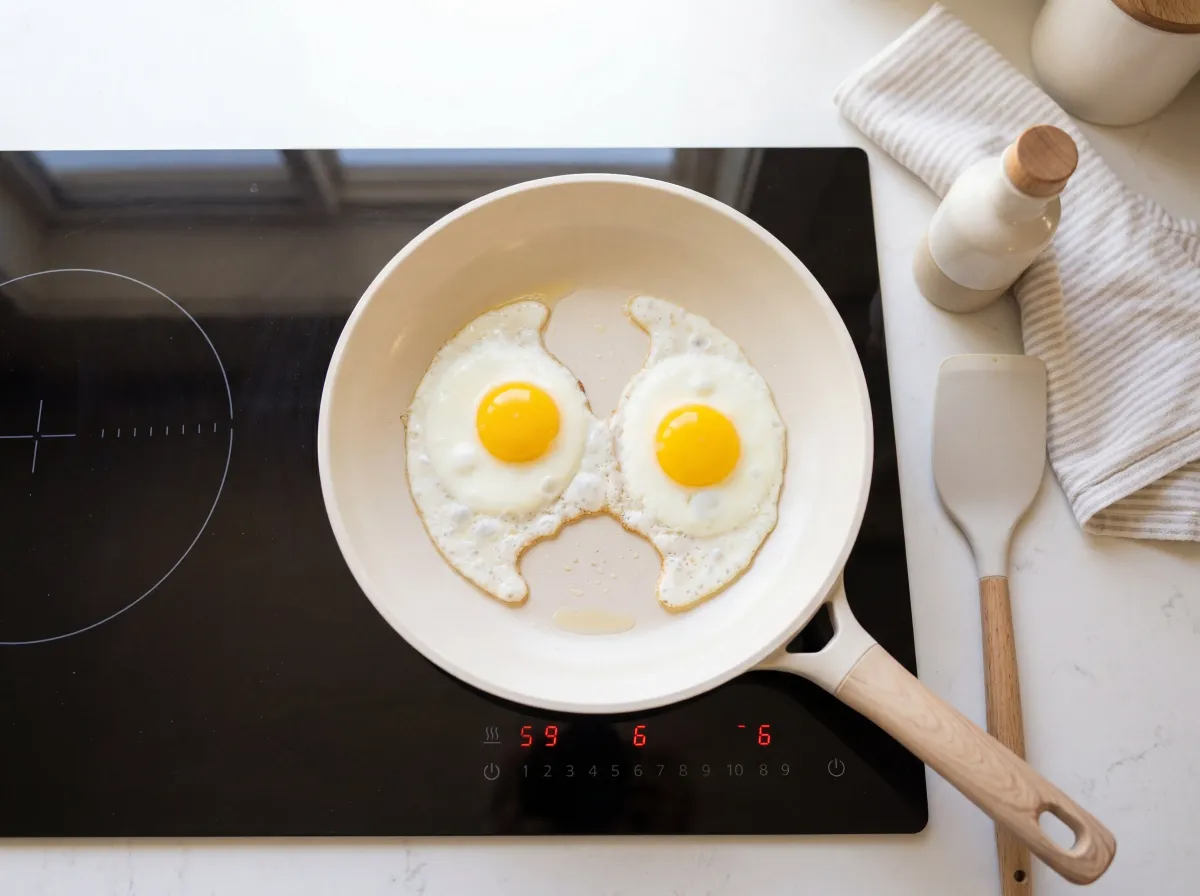
Month 1: Both pans were phenomenal. Eggs slid around like they were on ice. No oil needed.
Month 6: Caraway still performed well with a small amount of oil. The Always Pan started showing spots where food stuck, especially in the center.
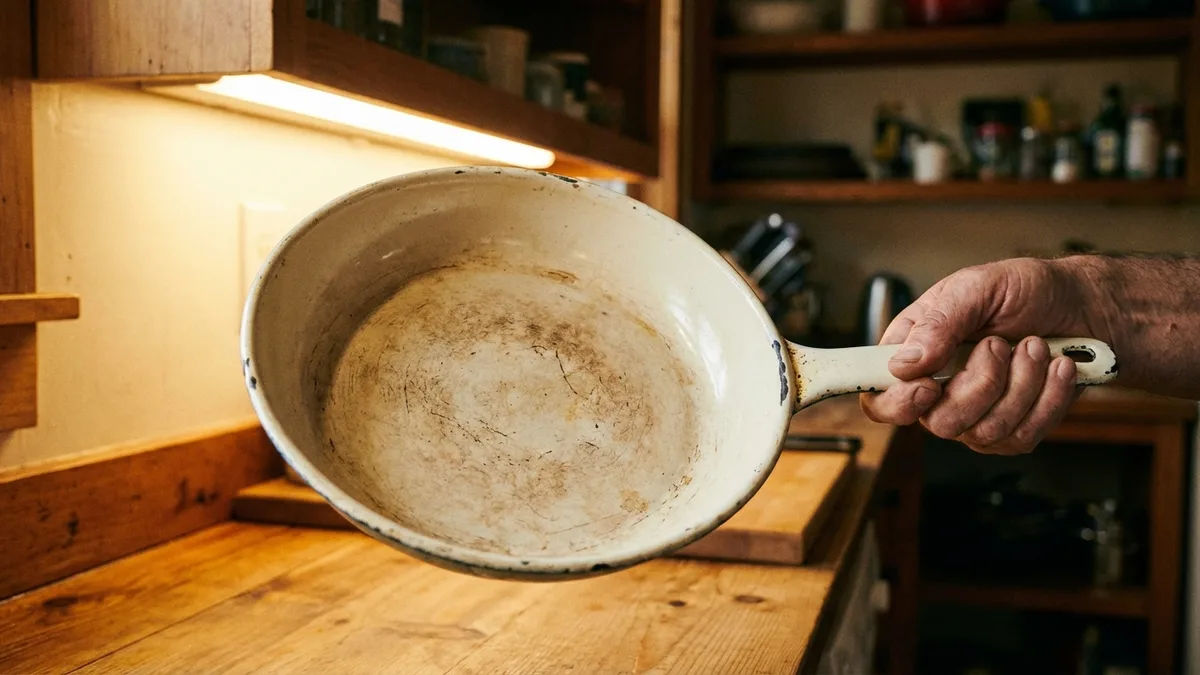
Month 12: Caraway needs oil for eggs but still works as a nonstick surface for most cooking. The Always Pan’s center has noticeably degraded. Eggs stick without generous oil. Tomato sauces leave more residue.
This timeline is based on regular use (4-5 times per week), hand washing, wooden utensils, low-to-medium heat. Your results will vary, but the relative durability difference between the two was consistent in my experience.
The “8-in-1” Claim
Our Place says the Always Pan replaces a fry pan, saute pan, steamer, skillet, saucier, saucepan, nonstick pan, and spatula (it comes with a spatula and a steamer basket). In practice:
- Frying and sauteing: Yes, works well
- Steaming: The included basket works for small portions
- Boiling pasta or making soup: The sides are tall enough, but it’s a shallow pan, not a pot
- Braising: Barely. There’s not enough depth for a proper braise
- Sauce-making: Works for small batches
It’s a frying pan with tall sides and some accessories. It’s not eight pans. Calling it that sets up false expectations.
Design and Usability
The Always Pan is beautiful. I’ll give it that. The color options are striking, the integrated wooden spatula rest on the handle is clever, and it looks great sitting on a stove. Instagram appeal is real.
Caraway pans are also well-designed with a wide color range and a clean aesthetic. The flat lids nest well and the magnetic storage racks (included with sets) are genuinely useful for protecting the coating in storage.
Weight-wise, the Always Pan is lighter at around 3 pounds. Caraway’s frying pan comes in closer to 3.5 pounds. Neither is heavy.
One annoyance with the Always Pan: the handle gets hot. The silicone grip doesn’t extend far enough, and on gas stoves, the exposed metal between the pan and the handle heats up. I’ve grabbed it without thinking more than once. Caraway’s stainless steel handle stays cooler during normal stovetop use.
Price Breakdown
| Product | Price | What You Get |
|---|---|---|
| Our Place Always Pan 2.0 | $$ | 1 pan, steamer basket, spatula |
| Caraway Fry Pan (individual) | $$ | 1 frying pan |
| Caraway Cookware Set (4-piece) | $$$ | Frying pan, saucepan, saucier, Dutch oven + lids + storage racks |
| Our Place Home Cook Duo | $$$ | Always Pan + Perfect Pot |
| Caraway Cookware Set (12-piece) | $$$$ | Full kitchen set + storage |
Pan-to-pan, the Always Pan costs more ($150 vs $95). But if you genuinely only want one pan, $150 is reasonable. If you want a full set, Caraway’s 4-piece at $395 is strong value for what you get.
Andrew Huberman has mentioned on his podcast that reducing PFAS exposure from cookware is one of the simpler environmental health changes people can make at home. The cost premium for ceramic over traditional nonstick is relatively small compared to something like a whole-house water filter. Either of these brands gets you there.
Durability: The Uncomfortable Truth
Here’s what neither brand wants you to think about too hard: ceramic nonstick coatings are temporary.
The lifespan on both pans is roughly 1-3 years of good nonstick performance with careful use. Industry testing and user reports consistently show this. The coating doesn’t become toxic when it degrades (it just loses its nonstick properties), but it does mean these pans are semi-disposable at their price points.
Caraway lasts longer in my experience, likely because of the thicker coating application and better heat distribution (overheating is the #1 ceramic coating killer). The Always Pan’s hot spots probably contribute to faster degradation in the center.
If you want something that lasts 20+ years, check out our guide to cast iron and stainless steel options in our best non-toxic cookware guide. Ceramic nonstick is about convenience and ease of use, not longevity.
Side-by-Side Comparison Table
| Feature | Caraway | Our Place Always Pan |
|---|---|---|
| Coating type | Sol-gel mineral-based ceramic | Proprietary ceramic nonstick |
| PFAS-free certified | Yes (TUV Rheinland tested) | Yes (brand claim, Prop 65 compliant) |
| Dishwasher safe | No (hand wash recommended) | No (hand wash recommended) |
| Oven-safe temp | Up to 550F | Up to 450F (no lid) |
| Induction compatible | Select models only (check listing) | Yes (Always Pan 2.0) |
| Price (full set) | $$$ (4-piece) to $$$$ (12-piece) | $$ (single pan) |
| Warranty | Limited lifetime warranty | Limited lifetime warranty |
| Buy | Shop Caraway on Amazon | Shop Our Place on Amazon |
One note on induction: not every Caraway piece is induction-compatible. The fry pan and saucepan from the original set are not. Caraway has added induction-compatible versions, but you need to confirm before buying if induction is your cooktop. The Always Pan 2.0 works on induction by default.
Durability After 2+ Years: What Real Owners Report
Ceramic nonstick always has a shelf life, but the way each brand ages tells you a lot about build quality. Aggregate review patterns on Amazon for both brands, across thousands of ratings, point to a few consistent themes.
What Caraway owners report after 18-24 months: The most common complaint is chipping at the edges or interior when metal utensils were used. Owners who stuck to wooden and silicone tools report the coating holds up significantly better. A smaller number of reviews mention discoloration from high-heat use. The general consensus is that Caraway’s ceramic holds up well with proper care and degrades faster with careless use. That’s consistent with ceramic nonstick behavior across all brands.
What Our Place Always Pan owners report after 18-24 months: Discoloration after high-heat cooking comes up frequently, especially around the center of the pan where heat concentrates. Bottom warping on gas stoves is another recurring complaint. The Always Pan uses a thinner base than Caraway, and the uneven heat on gas flames appears to stress it over time. Owners who cook on electric or induction report fewer warping issues.
Both brands show a drop-off in nonstick performance between 12 and 24 months with regular cooking. The pattern is consistent: careful use extends the coating; high heat and metal utensils kill it faster.
One honest framing worth keeping in mind: at these price points ($150 to $545), you’re not buying something that lasts forever. You’re buying 2-3 years of easy, low-maintenance cooking before you replace or accept reduced performance. If that math bothers you, stainless steel or cast iron are the alternatives worth considering.
Which Is Actually Non-Toxic? Reading Between the Marketing Claims
Both Caraway and Our Place market themselves as non-toxic. That framing is worth unpacking carefully, because “non-toxic” is a marketing claim, not a regulated certification.
What both brands confirm: Both are PTFE-free and PFOA-free. PTFE is the fluoropolymer used in traditional Teflon-style nonstick coatings. PFOA is the processing chemical that was phased out in the US by 2013 under EPA agreement but remains a concern in older cookware. Neither Caraway nor Our Place uses these compounds, and that distinction matters.
What “non-toxic” doesn’t guarantee: Ceramic coatings are not regulated the same way pharmaceutical products or food packaging are. There’s no FDA standard that a ceramic pan must pass to carry a “non-toxic” label. Caraway’s TUV Rheinland testing confirms absence of 60+ specific substances, which is genuinely useful. But TUV Rheinland is a materials-testing firm, not a health agency. Our Place’s Prop 65 compliance means lead and cadmium are below California thresholds, which is also meaningful. Neither is the same as a statement that the coating is biologically inert under all real-world cooking conditions.
What independent testing has found: Organizations like Mamavation have tested ceramic cookware for PFAS compounds using independent labs. Their published results [independent testing, non-peer-reviewed] did not find PFAS in Caraway or Our Place products. That’s reassuring, but worth labeling correctly: it’s informal screening, not a peer-reviewed study, and it doesn’t test for every possible compound. No brand has released full third-party lab reports covering migration rates under real cooking conditions across the product’s useful life.
The calibrated summary: based on available independent testing [non-peer-reviewed], both Caraway and Our Place appear to pose low risk compared to traditional PTFE-based nonstick, particularly for PFAS exposure. Neither brand has been flagged in peer-reviewed literature. Caraway’s testing transparency is meaningfully better than Our Place’s. Both are reasonable choices for people reducing their nonstick chemical exposure. But “probably low risk” and “proven safe” are different statements, and the latter isn’t something the current evidence fully supports for any ceramic coating brand.
What we don’t know: long-term migration data from sol-gel ceramic coatings under sustained high-heat cooking hasn’t been published in peer-reviewed literature. The honest answer is that this data gap exists, not that the products are necessarily unsafe.
For Specific Use Cases
Small Households (1-2 People)
The Always Pan consolidates well for small households. If you’re cooking for one or two people most nights, a single pan that handles stir-fries, pasta sauces, eggs, and sauteed vegetables is genuinely enough. At the mid tier ($$), it’s a lower commitment than a full Caraway set.
The caveats: the Always Pan’s shallower depth limits batch cooking, and the center degradation I noticed at month six means you’re replacing it before a dedicated frying pan would need to go. But for simple meals and small portions, it’s a practical choice.
Families of 4 or More
The Caraway set makes much more sense for larger households. Cooking for four people means larger batches, which means you need a real Dutch oven, a proper saucepan, and a frying pan that’s wide enough to handle a pound of ground beef. The Always Pan physically can’t do all of that at once.
Caraway’s 4-piece set covers a Dutch oven, saucepan, saucier, and frying pan. That’s enough for most meal prep without juggling one pan through four different tasks.
Induction Cooktops
This is the one spec difference that can be a hard deal-breaker. The Always Pan 2.0 works on induction. Original Caraway pieces do not, though Caraway has released induction-compatible versions.
Before buying Caraway for an induction cooktop, check the specific listing for the words “induction compatible” in the product specs. Don’t assume. The brand’s website has a product filter for this, and so does the Amazon listing if you scroll to the product details section.
Budget-Limited Buyers
If you’re buying individual pieces: the Always Pan at $150 versus the Caraway frying pan at $95 gives the edge to Caraway. You get better performance for less money if a frying pan is all you need.
If you’re building a set: the Always Pan at $150 plus the Perfect Pot at $165 (the Our Place Duo) runs $250 to $315 depending on sales. Caraway’s 4-piece set starts at $395. For full-set coverage, Our Place is cheaper, though Caraway’s pieces outperform their Our Place equivalents individually.
The budget case for Our Place: if you genuinely only need one or two pieces and price is a constraint, Our Place covers basic cooking needs at a lower total cost. The performance gap is real, but it may not matter for how you actually cook.
What NonToxicLab Recommends
Get the Caraway set if you cook regularly, want dedicated pieces for different tasks, and plan to hand-wash and maintain your cookware carefully. The 4-piece set covers most cooking needs, and the individual pieces outperform the Always Pan in their respective categories.
Get the Always Pan if you have a small kitchen, cook simple meals, want one pan that does a decent job at many things, or you’re new to non-toxic cookware and want to try ceramic without committing to a full set.
Skip both if you want longevity above all else. Stainless steel and cast iron are the real non-toxic workhorses. They just don’t have nonstick convenience.
For the full picture on which non-toxic cookware materials are safest long-term, read our breakdown on whether non-stick cookware is safe.
Your Questions Answered
Is the Our Place Always Pan actually non-toxic?
The Always Pan is free of PTFE, PFOA, and PFAS based on Our Place’s claims. They don’t publish third-party testing results publicly the way Caraway does, so you’re relying more on the company’s word. The pan does meet California Prop 65 standards, which means it’s been evaluated for lead and other heavy metals.
How long does the Caraway nonstick coating last?
With proper care (hand washing, wooden or silicone utensils, low-to-medium heat), expect 18-24 months of good nonstick performance. After that, you’ll need to use more oil, and eventually the coating will be functionally gone. This is standard for ceramic nonstick, not a Caraway-specific problem.
Can you use the Always Pan in the oven?
The Always Pan 2.0 is oven safe up to 450F without the lid. That’s enough for finishing dishes or keeping things warm, but it’s lower than Caraway’s 550F oven-safe rating. Don’t put the wooden spatula rest or the steamer basket in the oven.
Is Caraway or Our Place better for beginners?
Our Place is simpler for beginners because it’s one pan that handles most basic cooking tasks. You don’t have to think about which piece to grab. Caraway is better for people who already know their way around a kitchen and want proper tools for proper jobs.
Are ceramic pans linked to cancer?
No credible evidence connects ceramic nonstick coatings to cancer under normal cooking conditions. Ceramic coatings are made from inorganic minerals (primarily silicon dioxide) and do not contain the PFAS compounds that have been linked [human epidemiological] to health concerns in traditional nonstick cookware. Even when ceramic coatings degrade, the particles are inert and pass through the digestive system without being absorbed.
Why does food stick to my ceramic pan?
The most common reasons are cooking on too-high heat (ceramic coatings break down above medium heat over time), not using enough oil, or the coating has simply worn out from use. Ceramic nonstick is heat-sensitive, and the damage from overheating is cumulative and permanent.
Does Caraway ceramic chip?
Yes, chipping can happen - but it’s almost always linked to utensil choice. Aggregate Amazon reviews show that owners who use metal spatulas or spoons are the ones reporting chips at the 18-24 month mark. Owners who use wooden or silicone tools consistently report the coating staying intact longer. Caraway’s coating is thicker than most ceramic nonstick options, so it’s more chip-resistant than average, but it’s not indestructible.
Is the Our Place Always Pan truly non-toxic?
“Truly non-toxic” is doing a lot of work in that question. The Always Pan is PTFE-free, PFOA-free, and PFAS-free based on the brand’s claims and Prop 65 compliance testing. Independent screening by organizations like Mamavation [independent testing, non-peer-reviewed] did not find PFAS compounds in the pan. What Our Place doesn’t publish is full third-party lab reports with migration data. The honest answer: the available evidence points toward low risk under normal cooking use, but the phrase “truly non-toxic” overstates what any brand can currently prove about a ceramic coating.
Which is better for induction cooktops: Caraway or Our Place?
The Our Place Always Pan 2.0 is induction-compatible by default. Caraway is not induction-compatible across the board - original Caraway pieces use aluminum cores without a magnetic base layer. Caraway has released induction-ready versions, but you need to verify the specific product listing before buying. If induction compatibility is a firm requirement, the Always Pan 2.0 is the safer default choice, and you won’t need to parse product specs to confirm.
How long does ceramic cookware actually last?
Expect 1 to 3 years of good nonstick performance under regular use. That range holds across brands, not just Caraway and Our Place. The variables that extend or shorten that window: heat level (lower is better), utensil type (silicone and wood preserve the coating; metal degrades it), washing method (hand washing adds months compared to dishwasher), and storage (stacking pans without protection scratches the surface). Neither Caraway nor Our Place is an exception to the 1-3 year ceramic nonstick lifespan. If you want cookware that lasts 10 or 20 years, the answer is stainless steel or cast iron, not ceramic.
Sources
- Caraway product specifications and third-party TUV Rheinland testing (carawayhome.com)
- Our Place Always Pan 2.0 specifications (fromourplace.com)
- Dr. Leonardo Trasande, “Sicker, Fatter, Poorer” (2019) - research on PFAS in consumer products
- California Prop 65 compliance standards (oehha.ca.gov)
- Andrew Huberman podcast discussion on reducing chemical exposures in the home environment
You Might Also Like
- Cast Iron vs Stainless Steel
- GreenPan Cookware Review
- How to Care for Non-Toxic Cookware
- Is the Our Place Always Pan Non-Toxic? (Coating and Claims Checked)
- Our Place Always Pan Review: 12 Months of Daily Cooking
- GreenPan vs Caraway vs Our Place: Best Non-Toxic Cookware Compared
- Is HexClad Non-Toxic? (The Gordon Ramsay Pan Investigated)
- Made In vs Caraway Cookware in 2026 (Which Is Worth It?)