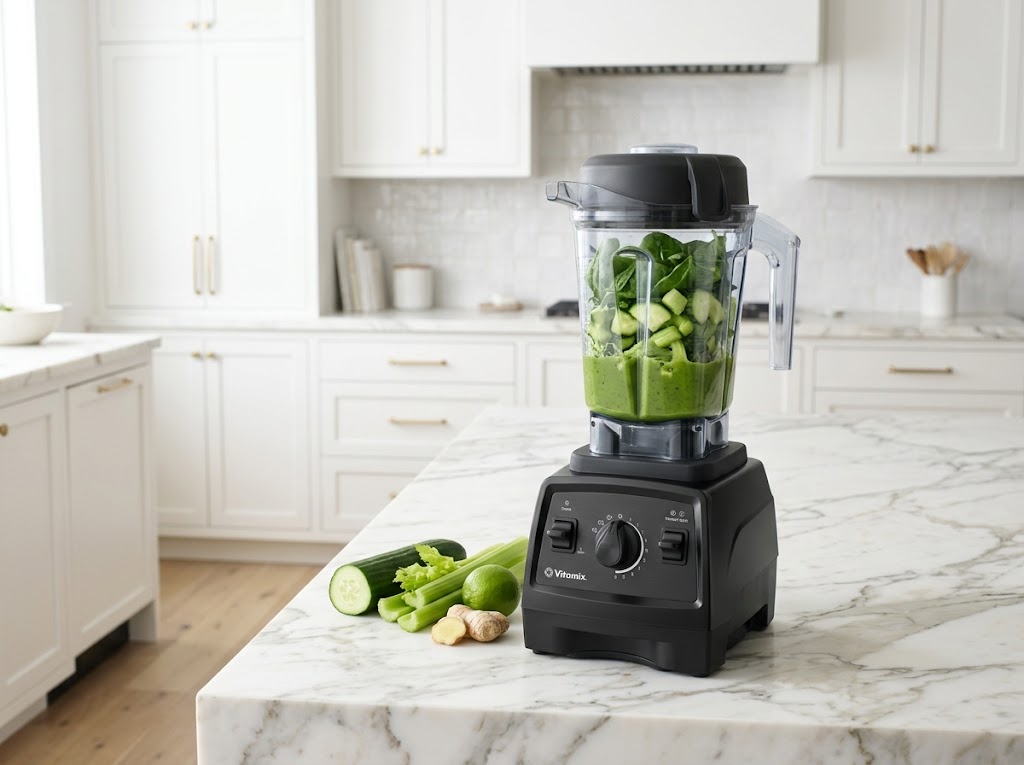
The Vitamix is one of the most recommended kitchen appliances in the non-toxic home space. High-end, durable, and used by everyone from health bloggers to professional chefs. But it’s still a plastic blender. And if you’ve spent any time reading about BPA, microplastics, or chemical migration from food contact materials, you’ve probably wondered whether the container is actually safe.
The short answer: Vitamix containers are made from Eastman Tritan, a plastic that has passed rigorous safety testing and is BPA-free. But the longer answer, the one that matters for people buying a $500 appliance specifically for their health, involves some nuance that most product pages won’t tell you.
What the Vitamix Container Is Actually Made Of
All Vitamix consumer blender jars are made from Eastman Tritan copolyester. Eastman Tritan is a proprietary plastic that launched in 2007 as a safer alternative to polycarbonate, which was the standard blender material before BPA concerns pushed the industry toward alternatives.
Tritan is classified as a copolyester, meaning it’s a type of polyester plastic made from ester subunits. Unlike polycarbonate, it’s manufactured without bisphenol-A (BPA), bisphenol-S (BPS), or other bisphenol compounds. The three monomers that go into Tritan, dimethyl terephthalate (DMT), 1,4-cyclohexanedimethanol (CHDM), and 2,2,4,4-tetramethyl-1,3-cyclobutanediol (TMCD), have each been individually tested for estrogenic and androgenic activity.
The Vitamix blades are hardened stainless steel, laser-cut and aircraft-grade. The only food-contact plastic in a Vitamix blender is the container itself and the lid (also Tritan).
Vitamix also offers a 48-ounce stainless steel container (ASIN B089ZMPRLD) that eliminates all plastic contact for anyone who wants to go that route.
The BPA-Free Claim: What It Does and Doesn’t Mean
“BPA-free” is a meaningful label when it comes to polycarbonate plastics. BPA (bisphenol-A) is a well-documented endocrine disruptor with strong human evidence, and removing it from food contact materials is a genuine safety improvement.
But “BPA-free” doesn’t mean “no chemical migration from plastic.” All plastics can leach some compounds under certain conditions, heat, UV exposure, repeated mechanical stress, and acidic foods are the main triggers. The question is whether the compounds that migrate from Tritan are present at levels that cause harm.
This is where the science gets genuinely complicated. A 2011 study commissioned by PlastiPure and CertiChem claimed that Tritan exhibited estrogenic activity, similar to the concern with BPA. Eastman challenged these findings in federal court and won; the jury found the study’s methods were flawed and barred the researchers from making estrogenic activity claims about Tritan. Eastman’s own funded studies, including Osimitz et al. (2012) published in Food and Chemical Toxicology [regulatory review], found no estrogenic or androgenic activity in Tritan’s three monomers.
A more recent concern is chemical migration at trace levels. One study detected BPA migration from Tritan water bottles at approximately 0.030 micrograms per kilogram in first-use testing, with levels dropping below detection in subsequent tests. Whether a single-use trace reading of 0.030 µg/kg, far below the EU limit of 0.05 mg/kg, is meaningful for health is unclear. Current regulatory consensus does not classify it as a concern.
What the Research Shows
On Tritan monomer safety: The three monomers used in Eastman Tritan have cleared FDA food contact notifications and passed in vitro receptor transactivation assays as well as standard in vivo hormonal activity tests [regulatory review, Osimitz et al., 2012, Food and Chemical Toxicology]. Eastman has submitted over 30 studies to regulators supporting Tritan’s safety profile.
On microplastics from blending: This is the more recent and legitimate concern. A 2023 peer-reviewed study published in the Journal of Hazardous Materials [laboratory study] measured microplastic and nanoplastic release from a kitchen blender during operation. Blending water and ice for 30 seconds in a standard plastic jar released roughly 0.36 to 0.78 billion particles. The friction between the blade motion and the inner wall of the container was identified as the primary mechanism.
That’s a real finding. Dr. Philip Landrigan at Boston College, who leads research on environmental threats to children’s health, has noted that microplastics are now detectable in human blood, lungs, and placentas, though the health consequences of that exposure at typical dietary levels remain uncertain [human biomonitoring, mechanistic proposed].
On heat and plastic migration: Tritan is rated as heat-resistant, and Vitamix’s official guidance is that the container is safe for hot liquids. That said, the general principle from food safety research is that heat accelerates chemical migration from polymers. If you regularly blend very hot soups directly in the Vitamix container, the theoretical risk of migration is somewhat higher than cold blending, though no specific Vitamix-Tritan-heat study exists that I can cite.
On blade wear and metal: High-speed blending at Vitamix’s operating RPMs (up to 37,000 RPM) does create significant shear force. The stainless steel blades are hardened to resist degradation, and metal leaching from blade wear at normal use levels is not a documented concern.
How Concerning Is It, Really?
Vitamix’s Tritan container is one of the better-researched food-contact plastics on the market. The BPA-free claim is substantiated, the monomer toxicity testing is more thorough than most kitchen plastics, and it’s probably fine under normal use, especially for cold blending of fruits, vegetables, and non-acidic foods.
The microplastic concern is real, but it’s also not Vitamix-specific. Any plastic blender jar, regardless of material, sheds particles during high-speed operation. The 2023 study didn’t single out any brand; it measured a generic household blender. Vitamix’s Tritan is likely no worse than alternatives, and the company’s build quality means the container is less likely to be scratched or worn in ways that accelerate particle shedding.
| Concern | Risk Level | Who is Most Affected |
|---|---|---|
| BPA exposure | Very low, not present in Tritan | General population |
| Estrogenic chemical migration | Low, contested evidence, regulatorily cleared | Pregnant individuals, infants (precautionary) |
| Microplastic shedding during blending | Moderate, documented, dose unknown | Anyone using plastic jar daily |
| Hot liquid blending in plastic | Low-moderate, general polymer migration principle | Those blending hot soups regularly |
| Blade metal leaching | Very low, hardened stainless, no documented concern | General population |
The people with the strongest case for reducing exposure are pregnant individuals, those with infants, and anyone blending multiple times daily over years. For everyone else, the absolute risk from a well-made Tritan container used normally is likely small.
What to Do About It
If you’re happy with your Vitamix and just wanted to know whether to be worried: you don’t need to replace it. The container is among the better-researched, lower-risk food-contact plastics available.
If you want to further reduce plastic exposure:
Upgrade to the stainless steel container. Vitamix makes a 48-ounce stainless steel container (compatible with all Ascent and Venturist series machines) that eliminates plastic entirely from the food-contact surface. The lid is still Tritan, but that’s a much smaller contact area. It runs around $200-$250 and is sold directly by Vitamix and on Amazon.
Avoid blending hot liquids in plastic. If you make hot soups in the blender, consider using an immersion blender in a stainless steel pot or letting liquids cool before transferring to the Vitamix jar.
Don’t blend with a scratched or cloudy jar. A degraded jar surface sheds more microplastics. If your Vitamix container is visibly scratched on the interior, it’s worth replacing, Vitamix sells replacement containers.
Cold smoothies in plastic are lower risk. Most of the migration concern relates to heat and mechanical wear over time. A cold smoothie blended in a new or well-maintained Tritan container is a low-risk use case by any current evidence standard.
For our full breakdown of low-risk cookware and food prep materials, see our guide to non-toxic kitchen equipment.
What We Don’t Know Yet
The microplastics story is genuinely unsettled. We know particles are shed during high-speed blending. We know microplastics are detectable in human tissue. What we don’t know is what dose from food-contact plastic use specifically causes what kind of harm, in what population, over what timeframe.
Long-term epidemiological data on dietary microplastic exposure and health outcomes does not yet exist. The 2023 blender study quantified particle counts but didn’t assess particle composition or bioavailability. We also don’t know how Tritan’s microplastic output compares to other plastics by particle count, the study used a generic jar, not Tritan specifically.
On the chemical migration side: most of the Tritan safety research was funded by Eastman, which is a genuine limitation. Independent, government-funded studies on Tritan copolyester migration under real-world blending conditions are limited. That gap isn’t a signal of danger, it’s just a gap.
FAQ
Is the Vitamix container BPA-free?
Yes. All Vitamix consumer blender containers are made from Eastman Tritan copolyester, which contains no BPA, BPS, or other bisphenol compounds. Vitamix switched from polycarbonate to Tritan specifically to avoid bisphenol concerns.
Does the Vitamix leach chemicals into smoothies?
The evidence on Tritan chemical migration is mixed. Eastman’s studies, including peer-reviewed work published in Food and Chemical Toxicology, found no estrogenic or androgenic activity from Tritan’s monomers. Trace BPA was detected in first-use Tritan bottle testing at 0.030 µg/kg, far below regulatory limits. Microplastic shedding during high-speed blending is documented and probably the more relevant current concern.
Is it safe to blend hot liquids in the Vitamix?
Vitamix says yes, and Tritan is rated as heat-resistant. The general food safety principle is that heat increases chemical migration from polymers, but there’s no Vitamix-specific hot-blending study showing a health concern. If you’re cautious, let soups cool before blending or use an immersion blender in stainless steel.
Is the Vitamix stainless steel container worth it?
For people who want to eliminate plastic contact entirely, yes. The stainless steel container (ASIN B089ZMPRLD, compatible with Ascent and Venturist series) means the only plastic in the process is the lid, a much smaller surface area. It’s also better for hot blending. The main downsides: you can’t see contents while blending, and it costs $200-$250.
How does the Vitamix compare to other blenders for toxin safety?
Vitamix uses the same Tritan copolyester that most premium blenders use, so the material is similar. What sets Vitamix apart is build quality, fewer scratches and less surface degradation over time, which likely means lower microplastic shedding long-term. The 10-year warranty also means you’re less likely to be running an old, worn container. Among plastic blenders, Vitamix is not worse than competitors and is probably better in practice due to durability.
Does the Vitamix have PFAS or Teflon coatings?
No. The Vitamix container has no non-stick coating, PTFE, PFAS, or any applied surface treatment. The blending surface is plain Tritan plastic. The blades are uncoated hardened stainless steel.
You Might Also Like
- Are Black Plastic Spatulas Safe? What the 2024 Chemosphere Study Got Wrong (and What’s Actually a Concern)
- Is BPA-Free Actually Safe? (Spoiler: Not Really)
- Best Non-Toxic Coffee Maker in 2026 (No Plastic, No BPA)
- Is the Instant Pot Non-Toxic? What the Materials Actually Say
- Best Non-Toxic Electric Kettle in 2026 (Plastic-Free, BPA-Free)
- Best Non-Toxic Baby Bottles in 2026 (Glass, Stainless Steel, and Silicone)
- Best Non-Toxic Water Bottles in 2026 (Glass, Steel, No Plastic)
Sources
- Osimitz et al. (2012), Food and Chemical Toxicology, peer-reviewed study on estrogenic and androgenic activity of Tritan’s three monomers; found no hormonal activity.
- Journal of Hazardous Materials (2023), ScienceDirect, laboratory study measuring microplastic and nanoplastic release from a kitchen blender during operation.
- Eastman Tritan Copolyester Product Safety Summary, Eastman’s regulatory dossier summarizing safety testing data for Tritan.
- Food Packaging Forum, Tritan Endocrine Disruption Study, independent analysis of Tritan safety research and the contested PlastiPure findings.
- PMC, Beyond the food on your plate (2024), peer-reviewed study examining microplastic contamination sources in home kitchens.