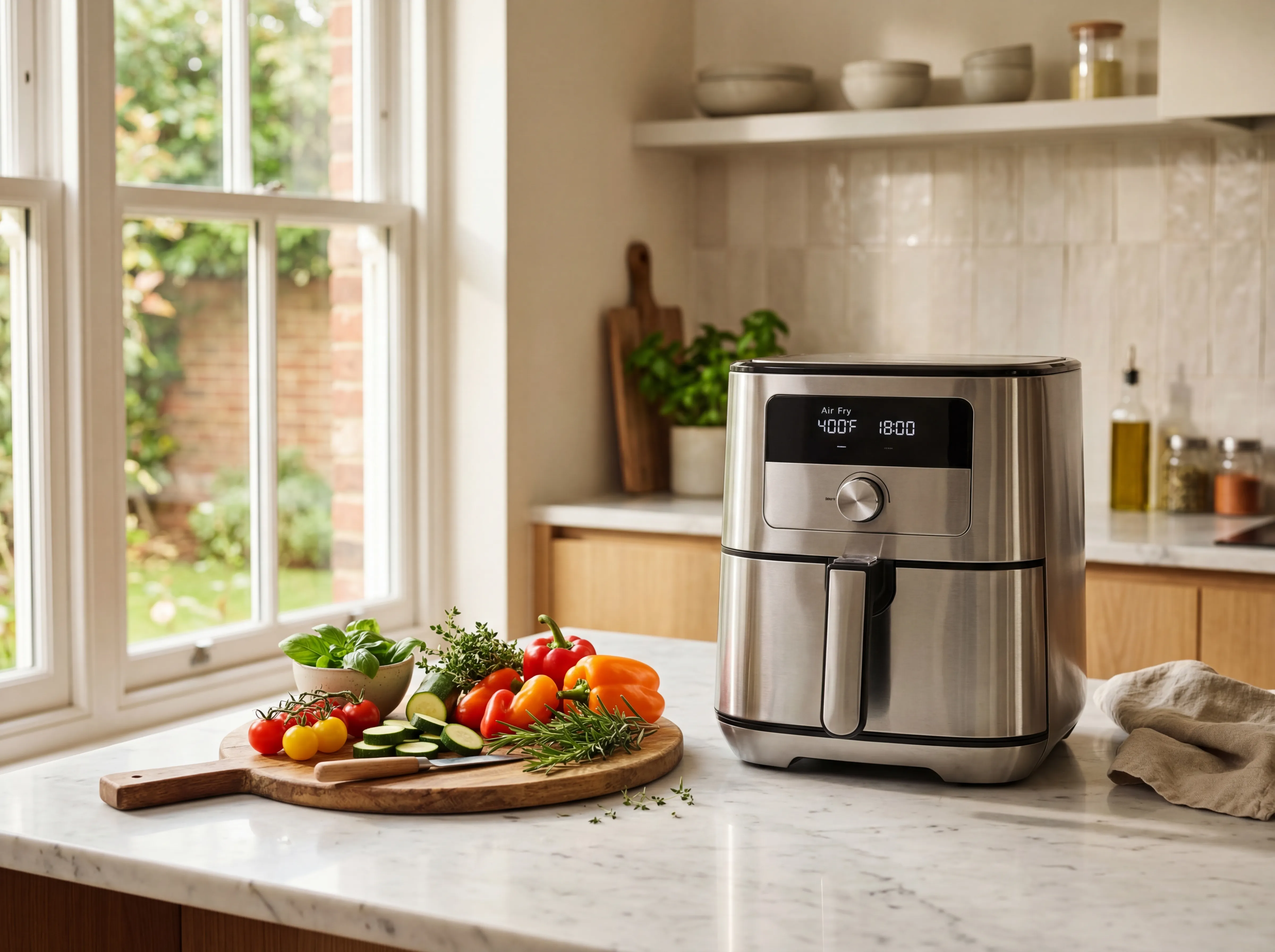
Most air fryers on the market still use nonstick coatings made with PFAS, the same “forever chemicals” that contaminate drinking water and accumulate in your body over time. When those coatings heat up, they can release fumes and particles directly onto your food.
The good news: several brands now make air fryers with stainless steel, glass, or certified PFAS-free ceramic coatings. I spent weeks comparing every option and narrowed it down to 8 models that are genuinely safe.
Here are my picks, starting with the best overall.
Quick Picks: Best Non-Toxic Air Fryers
- Best Overall: Typhur Sync (PFAS-free ceramic, built-in meat thermometer, $199)
- Best Glass Air Fryer: Ninja Crispi Pro (borosilicate glass containers, $280)
- Best Budget Pick: Bella 4Qt Slim (certified ceramic, under $60)
- Best Large Capacity: HYSapientia 26Qt Oven (all-metal, no coatings, $130-170)
- Best Toaster Oven Style: Our Place Wonder Oven Pro (ceramic nonstick, $325)
- Best for Watching Food Cook: Fritaire Glass Bowl (tempered glass, rotisserie, $130-180)
- Best Smart Features: Cosori Iconic (PFAS-free ceramic on stainless steel, $249)
- Best Dual Heating: Typhur Dome 2 (top and bottom elements, $200-250)
What Makes an Air Fryer “Non-Toxic”?
Before getting into the picks, you need to understand what you’re avoiding and why.
Traditional air fryers use PTFE (polytetrafluoroethylene) coatings on their baskets. PTFE is a type of PFAS, the broad family of synthetic chemicals that earned the nickname “forever chemicals” because they never break down in the environment or your body.
When PTFE coatings overheat, they release toxic fumes. And even at normal cooking temperatures, scratched or worn coatings can flake particles directly into your food.
The three safe alternatives are:
Stainless steel (uncoated): Non-reactive at any temperature. Nothing to scratch, chip, or off-gas. The safest option, period. You just need a bit more oil to prevent sticking.
Borosilicate or tempered glass: Chemically inert and heat-resistant. Naturally coating-free. Some glass air fryers let you watch your food cook, which is a nice bonus.
PFAS-free ceramic coatings: A safe nonstick alternative when backed by third-party testing. Not all ceramic claims are equal, though. Look for brands that name specific certifications rather than just printing “non-toxic” on the box.
What to watch out for: Some air fryers only remove PFAS from the basket but keep it on interior side walls. Chemicals on those walls can still aerosolize and land on your food. Mamavation, which commissions independent lab testing through EPA-certified facilities, found that the majority of air fryer brands are not even complying with California’s AB1200 disclosure law. Many refused to answer direct questions about their coatings, calling them “proprietary.”
Bottom line: if a company won’t tell you what’s in the coating, don’t trust the coating.
”PFOA-Free” Does NOT Mean “PFAS-Free”
This is the single biggest misconception in non-toxic cookware, and it trips up even careful shoppers.
PFOA (perfluorooctanoic acid) is one specific chemical within the PFAS family. It got a lot of press because it was used in manufacturing Teflon for decades and was linked to cancer, thyroid disease, and immune system damage. Under public pressure, major manufacturers agreed to phase it out starting in 2015.
Here’s the problem: PFOA is one chemical out of more than 14,000 known PFAS compounds. When a brand stamps “PFOA-free” on the box, they are telling you that one specific chemical is absent. They are saying nothing about the thousands of other PFAS chemicals that could still be present in the coating.
And many of those replacement chemicals are just as concerning. GenX, for example, was developed as a direct substitute for PFOA. Early research suggests it carries similar health risks, including liver damage and immune suppression. Yet a product containing GenX can legally be marketed as “PFOA-free.” The same goes for PFBS, PFHxS, and dozens of other short-chain PFAS compounds that manufacturers have quietly swapped in as replacements. The regulatory framework has not kept pace with these substitutions, which means the burden of verifying safety falls on you, the consumer.
This is not a theoretical concern. Mamavation’s lab testing has found detectable levels of organic fluorine (a marker for PFAS) in air fryers from brands that prominently advertise “PFOA-free” on their packaging. The label is technically accurate. It is also deeply misleading.
What to look for instead:
- “PFAS-free” (this covers the entire chemical family)
- “PTFE-free” (eliminates the most common PFAS-based coating)
- Third-party lab results showing no detectable organic fluorine
- FDA certification of food-contact surfaces
- California AB1200 compliance documentation
If a product only says “PFOA-free” and nothing else, treat it as a yellow flag. It might be perfectly safe. It also might be swapping one forever chemical for another. Without broader testing data, you simply cannot tell.
Material Safety Hierarchy: Safest to Least Safe
Not all “non-toxic” materials carry the same level of confidence. Here’s how they rank, from most trustworthy to least.
Tier 1: Glass (Safest) Borosilicate and tempered glass are chemically inert. They do not react with food at any temperature, they contain no coatings, and there is nothing that can degrade over time. Glass is the gold standard for chemical safety. The only downsides are fragility and weight. Borosilicate glass (used in the Ninja Crispi Pro) is more thermal-shock resistant than standard tempered glass, which means it handles rapid temperature changes better. If you see “borosilicate” on the spec sheet, that’s the higher-quality glass type.
Tier 2: Stainless Steel (Uncoated) Medical-grade and food-grade stainless steel is non-reactive and incredibly durable. It will never off-gas or flake. There are no coatings to wear down. You trade convenience for safety here, because food sticks more without a nonstick surface, but that’s easily solved with a bit of oil or parchment paper. One thing to be aware of: not all stainless steel is the same grade. 304 stainless steel (also called 18/8) is the standard for food-contact applications. 316 stainless steel (surgical grade) is even better but rarely found in consumer air fryers. Both are safe. Lower grades are less corrosion-resistant but still far safer than any PFAS-containing coating.
Tier 3: Verified Ceramic (PFAS-Free with Third-Party Testing) Ceramic coatings that come with FDA certification, independent lab testing, or named certifications (like Bella’s EverGood line) are a safe choice. The coating is made from inorganic minerals, primarily silica, and does not contain PFAS when manufactured properly. Ceramic coatings do wear down over time, typically lasting 2-3 years of regular use before the nonstick performance fades. The good news is that worn ceramic doesn’t become toxic; it just becomes less slippery. The key word is “verified.” Without proof, the claim is just marketing.
Tier 4: Unverified “Ceramic” (No Testing Data) Plenty of budget air fryers slap “ceramic coated” on the box without providing any lab data, certification names, or testing results. Some of these are genuinely PFAS-free. Others are not. You have no way to confirm either way. This tier is a gamble, and the stakes are your health. The word “ceramic” is not regulated in this context. Any manufacturer can use it regardless of what’s actually in the coating formulation. Without third-party testing documentation, “ceramic” is a description of how the coating looks and feels, not a guarantee of what it contains.
Tier 5: PTFE/Teflon (Least Safe) PTFE coatings are a type of PFAS. They can release toxic fumes when overheated (above roughly 500 degrees F, though degradation can begin at lower temperatures). Scratched or chipped PTFE flakes off into food. This is the material you’re trying to avoid. It’s worth knowing that “Teflon” is just DuPont/Chemours’ brand name for PTFE. Other manufacturers use PTFE under different trade names, so the absence of the word “Teflon” does not mean the absence of PTFE.
Every air fryer on my recommended list falls into Tier 1, 2, or 3. I did not include any products that sit in Tier 4 or 5.
The 8 Best Non-Toxic Air Fryers
1. Typhur Sync - Best Overall
Price: $199-$219 | Capacity: 8 quarts | Coating: PFAS-free ceramic (FDA-certified)
The Typhur Sync stands out for a feature no other air fryer offers: a built-in wireless meat thermometer. No app pairing, no Bluetooth hassle. You just stick the probe in your chicken and the air fryer monitors the internal temperature for you.
Beyond the thermometer gimmick (which is genuinely useful), the Sync is a solid performer. The 8-quart basket holds enough food for a family of six. It has 9 cooking functions, heats to 450 degrees, and runs at 55dB, which is quiet enough that you won’t notice it from the next room.
The ceramic coating is FDA-certified and free of PFAS, PTFE, PFOA, lead, and cadmium. The basket is dishwasher safe.
Why it’s my top pick: Practical features, generous capacity, verified safe coating, and a price under $220. It checks every box.
Who should skip it: If you want to eliminate coatings entirely, go with the Ninja Crispi Pro or HYSapientia below. Ceramic is safe, but some people prefer zero coatings as a matter of principle.
2. Ninja Crispi Pro 6-in-1 - Best Glass Air Fryer
Price: $279.99 | Capacity: 6-quart and 2.5-quart glass containers | Coating: None (borosilicate glass)
This is the only air fryer from a major brand that uses glass cooking containers instead of coated baskets. The borosilicate glass is the same material used in lab equipment and Pyrex. It is chemically inert at any cooking temperature, which means there is nothing to scratch, flake, or off-gas.
The Crispi Pro comes with two glass containers (6-qt and 2.5-qt), and you can buy a 4-qt separately. The containers are microwave-safe, freezer-safe, and dishwasher-safe. You can cook in them, store leftovers in the fridge, and reheat in the same container.
It runs at 1800 watts with six cooking functions: Max Crisp, Air Fry, Bake/Proof, Roast, Recrisp, and Dehydrate. The temperature range goes from 80 to 450 degrees, which is wider than most competitors.
Why it ranks #2: Glass is arguably the safest material possible. No coating debates, no certification questions. The tradeoff is a higher price and the need to be careful with glass containers.
Who should skip it: If you have kids who might knock a glass container off the counter, consider the stainless steel HYSapientia instead.
3. Bella 4Qt Slim - Best Budget Pick
Price: $57-$60 | Capacity: 4 quarts | Coating: EverGood ceramic (certified PFAS, PFOA, PTFE, lead, and cadmium free)
If you want a non-toxic air fryer without spending $200+, this is the one. Bella’s “EverGood” ceramic coating comes with explicit certifications that it’s free of PFAS, PFOA, PTFE, lead, and cadmium. That’s more transparency than you get from brands charging four times the price.
The 4-quart capacity works for one to two people. It has six presets (air fry, bake, roast, broil, reheat, dehydrate) and a 60-minute auto shutoff. The “slim” design takes up about half the counter space of a standard air fryer.
It comes in several colors (Oatmilk, Surf, Plum, Blossom) if you care about matching your kitchen.
Why it ranks #3: You get certified non-toxic cooking for under $60. Hard to argue with that value.
Who should skip it: The 4-quart capacity is too small for families. If you cook for more than two people, look at the Typhur Sync or HYSapientia.
4. HYSapientia 26Qt Air Fryer Oven - Best Large Capacity
Price: $130-$170 | Capacity: 26 quarts | Coating: None (bare stainless steel and galvanized steel)
If you want zero coatings and maximum cooking space, this is your air fryer. HYSapientia uses bare stainless steel on the exterior, galvanized steel inside, and stainless steel racks and rotisserie accessories. There is no nonstick coating anywhere on this machine.
The 26-quart capacity is enormous. It fits a whole chicken with room to spare. You get 10 cooking functions including rotisserie, dehydrate, and pizza mode. The 1800-watt heating element with 360-degree convection fan delivers consistent results across the oversized cooking chamber.
The tradeoff with no coating is that food sticks more easily. You’ll want to use parchment paper liners or a light spray of oil, especially for things like breaded chicken or fish.
Why it ranks #4: All-metal construction means there is literally nothing to worry about from a chemical safety standpoint. The large capacity and rotisserie function make it a versatile kitchen workhorse.
Who should skip it: This thing is big. Measure your counter space first. It also takes longer to preheat than smaller air fryers.
5. Our Place Wonder Oven Pro - Best Toaster Oven Style
Price: $325 ($349 for stainless steel finish) | Capacity: 30 liters (~32 quarts) | Coating: Ceramic nonstick on cast aluminum (PFAS and PTFE free on all food-contact surfaces)
Our Place built its reputation on non-toxic cookware, and the Wonder Oven Pro carries that commitment into the air fryer space. The ceramic nonstick coating on the cast-aluminum base is free of PFAS and PTFE on every surface that touches your food.
This is a countertop oven that replaces your air fryer and your toaster oven. It has 8 cooking modes (Air Fry, Bake, Roast, Broil, Toast, Reheat, Proof, Dehydrate), three cooking tiers, and fits a 12-inch pizza or a whole chicken.
The cast-aluminum base distributes heat evenly, which helps with baking. The quartz and stainless steel heating elements are durable and easy to clean.
Why it ranks #5: If you want a premium, good-looking appliance from a brand with a strong non-toxic track record, this is it.
Who should skip it: At $325+, it’s the most expensive option on this list. If non-toxic cooking is the main goal and aesthetics are secondary, the HYSapientia gives you more capacity for less than half the price.
6. Fritaire Glass Bowl Air Fryer - Best for Watching Food Cook
Price: $130-$180 | Capacity: 5 quarts | Coating: None (tempered glass bowl, stainless steel accessories, BPA-free)
The Fritaire takes a different approach. Instead of a basket, it uses a transparent tempered glass bowl. You can see your food cooking in real time without opening the lid and losing heat.
It comes with a rotisserie attachment, a French tumbler for fries, and an air stand for general cooking. The halogen heating element provides 360-degree heat circulation. There is a self-cleaning mode where you fill the bowl with water and soap, press a button, and walk away.
Zero coatings of any kind. The glass bowl and stainless steel accessories are the only surfaces that touch your food.
Why it ranks #6: The glass bowl design is fun and genuinely useful for monitoring food. The rotisserie attachment is a nice bonus at this price point.
Who should skip it: The 5-quart capacity is mid-range. If you regularly cook for a crowd, you need something bigger. The glass bowl also requires more careful handling than a metal basket.
7. Cosori Iconic Smart Air Fryer - Best Smart Features
Price: $249 | Capacity: 6.5 quarts | Coating: PFAS-free ceramic nonstick on stainless steel
The Cosori Iconic is for people who want non-toxic cooking and smart home integration. It connects to the VeSync app for recipes, cooking presets, and voice control through Alexa or Google Assistant.
The build quality is excellent. Cosori says 96% of the visible exterior is metal, which gives it a premium look that plastic air fryers can’t match. The DC motor provides more precise airflow control than standard AC motors.
The temperature range is wide (90-450 degrees), and it comes with a 5-year warranty, which is the longest I’ve seen from any air fryer brand. The PFAS-free ceramic coating on the stainless steel basket is easy to clean and dishwasher safe.
Why it ranks #7: Smart features, build quality, and an industry-leading warranty. The only reason it’s not higher is the $249 price, which puts it in competition with the glass-based Ninja Crispi Pro.
Who should skip it: If you don’t care about app connectivity and smart home integration, you’re paying extra for features you won’t use.
8. Typhur Dome 2 - Best Dual Heating
Price: $200-$250 | Capacity: 5.6 quarts | Coating: PFAS/PTFE-free ceramic nonstick (FDA-certified, no titanium dioxide or silicon dioxide)
The Dome 2 is the only air fryer on this list with heating elements on both the top and bottom of the cooking chamber. Most air fryers only heat from the top, which can leave the bottom of your food less crispy. Dual heating solves that problem.
It has 15 cooking functions, fits a 12-inch pizza, and has a self-cleaning cycle. The ceramic coating is FDA-certified and specifically confirmed free of titanium dioxide and silicon dioxide in addition to PFAS and PTFE.
The flat, wide basket design spreads food out more than a traditional deep basket. This means less crowding and more even crisping.
Why it ranks #8: Dual heating is a real performance advantage. It’s lower on the list only because the Typhur Sync (same brand) offers better value with more capacity and the built-in thermometer for a similar price.
Who should skip it: If you’re choosing between the two Typhur models, the Sync is the better buy for most people unless even heating is your top priority.
Comparison Table
| Model | Price | Capacity | Material | Coating-Free? | Dishwasher Safe |
|---|---|---|---|---|---|
| Typhur Sync | $199-219 | 8 qt | Metal + ceramic | No (ceramic coated) | Yes |
| Ninja Crispi Pro | $280 | 6 qt + 2.5 qt | Borosilicate glass | Yes | Yes |
| Bella 4Qt Slim | $57-60 | 4 qt | Metal + EverGood ceramic | No (ceramic coated) | Yes |
| HYSapientia 26Qt | $130-170 | 26 qt | Stainless/galvanized steel | Yes | Racks only |
| Our Place Wonder Oven Pro | $325-349 | 32 qt | Cast aluminum + ceramic | No (ceramic coated) | Varies |
| Fritaire Glass Bowl | $130-180 | 5 qt | Tempered glass + stainless | Yes | Yes |
| Cosori Iconic | $249 | 6.5 qt | Stainless steel + ceramic | No (ceramic coated) | Yes |
| Typhur Dome 2 | $200-250 | 5.6 qt | Metal + ceramic | No (ceramic coated) | Yes |
Air Fryers We Investigated and Rejected
Recommending safe products is only half the job. You also need to know which popular air fryers didn’t make the cut, and why.
Philips Premium Airfryer XXL Philips is one of the most recognized names in air fryers. They essentially popularized the category. But when asked directly about the composition of their nonstick coatings, Philips has repeatedly declined to provide specifics, calling the formulation “proprietary.” That’s not acceptable. If you won’t tell consumers what’s touching their food, you don’t earn a spot on a safety-focused list. Mamavation’s testing flagged Philips models as having detectable organic fluorine on food-contact surfaces.
Instant Vortex Plus The Instant Vortex line is hugely popular and affordable, but the baskets use PTFE-based nonstick coatings. PTFE is a PFAS chemical. Instant Brands has not released third-party testing data showing their coatings are PFAS-free, and independent testing suggests the presence of fluorine compounds. Until that changes, these stay off the list.
Cuisinart TOA-60 Convection Toaster Oven Air Fryer Cuisinart’s air fryer ovens are well-built kitchen appliances with strong cooking performance. The problem is transparency. Cuisinart provides minimal information about the nonstick coatings used on their baking pans and air fryer baskets. Repeated inquiries about PFAS status have not produced clear answers. “Minimal information” is not the same as “confirmed safe.”
Gourmia Air Fryers (multiple models) Gourmia sells some of the cheapest air fryers on the market, and you’ll find them stacked in big-box stores. Mamavation’s independent lab testing returned mixed results across Gourmia’s product line, with some models showing detectable fluorine on food-contact surfaces. The brand has not provided sufficient documentation to resolve these findings. At these price points, the Bella 4Qt Slim offers verified safety for comparable money.
Hamilton Beach Sure-Crisp Hamilton Beach markets several air fryer models as having “nonstick” interiors without specifying the coating type or chemistry. When pressed, the company has not provided PFAS-free certifications or third-party lab data. The lack of transparency puts Hamilton Beach in the same category as Philips and Cuisinart: possibly safe, but unverifiable.
I want to be fair here. Some of these brands may well use safe coatings. The issue is proof. When a company won’t provide testing data or disclose ingredients, you’re left making assumptions. I’d rather recommend brands that show their work.
Brand Transparency Scorecard
How open are major air fryer brands about what’s in their coatings? I contacted each brand, reviewed their published documentation, and cross-referenced with independent lab testing. Here’s where they landed.
Transparent (Discloses coating composition, provides certifications or third-party testing data)
- Typhur - Names specific certifications (FDA), discloses what the coating is free of (PFAS, PTFE, PFOA, lead, cadmium, titanium dioxide, silicon dioxide), responds to consumer inquiries
- Our Place - Clear labeling of PFAS-free and PTFE-free claims on all food-contact surfaces, strong brand track record from their cookware line
- Bella - The EverGood ceramic line comes with named certifications and explicit chemical-free claims (PFAS, PFOA, PTFE, lead, cadmium)
- Fritaire - No coatings to disclose (glass and stainless steel only), which is transparency by default
Mostly Transparent (Some product lines are clear, others are less so)
- Cosori - The Iconic line is well-documented as PFAS-free ceramic on stainless steel with a 5-year warranty. Older Cosori models and budget lines have less clear documentation. If you buy Cosori, stick with the Iconic or verify the specific model.
- Ninja - The Crispi line uses glass containers, so there’s nothing to hide. Other Ninja air fryer lines use traditional nonstick coatings, and Ninja’s disclosures about those coatings are less specific. The brand says newer models are “designed without PFAS and PTFE” but independent testing on non-Crispi models is limited.
Opaque (Won’t disclose coating details, limited or no third-party data)
- Philips - Calls coating formulations “proprietary.” Independent testing has detected organic fluorine.
- Cuisinart - Minimal public information about coating composition on air fryer accessories
- Instant Brands (Instant Vortex) - Known PTFE usage on baskets, no PFAS-free certifications published
- Hamilton Beach - No specific coating disclosures or PFAS-free claims
- Gourmia - Mixed independent lab results, insufficient documentation to confirm safety
This scorecard is not about accusing brands of being unsafe. Opaque brands might use perfectly fine coatings. The point is that you cannot verify it, and in a market where “PFOA-free” labels are used to obscure the broader PFAS question, verification matters.
How to Verify PFAS Claims Yourself
You don’t have to take any brand’s word for it. Here are the tools and steps you can use to check air fryer safety claims on your own.
Check California AB1200 Compliance
California’s AB1200 law, which took effect in 2023, requires cookware manufacturers to disclose the presence of PFAS on food-contact surfaces. If a product contains intentionally added PFAS above a certain threshold, the manufacturer must label it. This applies to cookware sold in California, which effectively means most products sold nationally.
What to do: Look for AB1200 compliance statements on the product packaging or the manufacturer’s website. If a brand sells in California and has no AB1200 disclosure, that’s a positive sign (it suggests the product is below the PFAS threshold). But the absence of a disclosure is not the same as a certified “PFAS-free” claim. Mamavation found that many brands are simply ignoring the law rather than complying with it.
Look Up Proposition 65 Data
California’s Proposition 65 requires businesses to warn consumers about exposure to chemicals that cause cancer, birth defects, or reproductive harm. PFOA is on the Prop 65 list. While Prop 65 doesn’t cover all PFAS compounds, a Prop 65 warning on an air fryer is a red flag worth investigating.
You can search the Prop 65 warnings database at the California Office of Environmental Health Hazard Assessment (OEHHA) website.
Email the Manufacturer Directly
This is surprisingly effective. Send a simple email to the brand’s customer service asking three specific questions:
- Does this product contain PFAS (including PTFE and PFOA) on any food-contact surface?
- Can you provide third-party lab testing data or certifications confirming this?
- Is this product compliant with California AB1200?
Brands with nothing to hide will answer all three. Brands that respond with vague language (“our products meet all safety standards”) or redirect you to generic marketing pages are telling you something by not telling you something.
Watch for These Red Flags in Marketing Language
- “PFOA-free” without mentioning PFAS or PTFE. This is the most common misdirection. PFOA was phased out years ago; being free of it is the bare minimum, not a safety achievement.
- “Non-toxic coating” with no named certification or testing body. “Non-toxic” has no legal definition in this context. Any brand can say it.
- “Eco-friendly” or “green” nonstick. These are marketing terms with no regulatory meaning.
- “Proprietary coating” or “advanced nonstick technology.” If a brand describes the coating with marketing buzzwords but won’t name the actual material or chemistry, that’s a deliberate choice to obscure.
- “BPA-free” used prominently on air fryer marketing. BPA is a concern for plastics, not for nonstick coatings. When a brand highlights BPA-free status on an air fryer, they may be trying to create a safety halo effect that distracts from the coating question.
Use Mamavation’s Published Results as a Shortcut
Before you go through all this effort, check whether Mamavation has already tested the air fryer you’re considering. Their published investigations cover dozens of popular models and brands, and the testing is done through EPA-certified labs. It’s the most comprehensive independent resource available. Their results are free to read on their website and are organized by product category.
Commission Your Own Testing (for the Very Committed)
If you already own an air fryer and want to know what’s in the coating, you can send a sample to a lab that tests for total organic fluorine. This is the same method Mamavation uses. Labs like EPA-certified environmental testing facilities can run the analysis. It typically costs a few hundred dollars, so it’s not practical for everyone, but it’s an option if you want certainty about a specific product you already own.
How I Chose These Air Fryers
Every air fryer on this list meets three requirements:
-
No PFAS, PTFE, or PFOA on any food-contact surface. Not just the basket. The walls, racks, and any surface that food or hot air touches must be free of forever chemicals.
-
Material transparency. The manufacturer publicly discloses what their cooking surfaces are made of. If a brand calls their coating “proprietary” and refuses to elaborate, they didn’t make the cut.
-
Practical for daily use. A non-toxic air fryer that doesn’t cook well is just an expensive countertop decoration. Every pick here performs well for its price category.
I also gave priority to brands that have third-party testing or certifications (FDA, Mamavation lab testing, California AB1200 compliance) rather than relying solely on marketing claims.
Do Air Fryers Really Contain PFAS?
Yes, the majority of them do.
Mamavation, a consumer advocacy site, commissioned testing through an EPA-certified lab and found that most air fryers on the market contain PFAS in their nonstick coatings. Some brands had PFAS on food-contact surfaces. Others kept the basket clean but used PFAS on interior walls where chemicals can still aerosolize and fall onto food during cooking.
The bigger problem is opacity. Most air fryer brands refuse to disclose the exact composition of their coatings. Mamavation found that the vast majority are not complying with California’s AB1200 law, which requires cookware manufacturers to disclose PFAS usage.
This doesn’t mean every traditional air fryer is dangerous. But if a brand won’t tell you what’s in the coating, you have no way to verify their safety claims.
FAQ
Is ceramic coating safe in air fryers? Yes, when it’s genuinely PFAS-free. Ceramic coatings use silica (sand) as the base material instead of PFAS. The key is third-party verification. Look for FDA certification or independent lab testing. Marketing labels like “green” or “eco-friendly” don’t mean much without testing data behind them.
Are stainless steel air fryers better than ceramic? From a safety standpoint, stainless steel is the most bulletproof option because there’s no coating to worry about. Ceramic is safe when certified, but coatings can wear down over time. The tradeoff is that stainless steel requires more oil and can be harder to clean.
Does the Ninja air fryer have PFAS? The Ninja Crispi line uses borosilicate glass containers with no coatings, so those models are PFAS-free. Other Ninja models use nonstick coatings that may contain PFAS. Ninja states that food-contact surfaces in newer models are “designed without PFAS and PTFE,” but independent lab testing on their traditional models is limited.
Can I just use parchment paper in a regular air fryer? Parchment paper creates a barrier between food and the coating, but it doesn’t prevent chemical off-gassing from heated coatings into the air inside the cooking chamber. If the coating contains PFAS, fumes can still reach your food even with a liner.
How long do ceramic air fryer coatings last? With proper care (hand washing, avoiding metal utensils, not overheating empty), ceramic coatings typically last 2-3 years before they start losing their nonstick properties. When the coating wears down, it doesn’t become toxic. It just becomes less nonstick. You can keep using it safely; you’ll just need more oil.
What about the plastic parts in air fryers? Most air fryer plastics are rated for high-heat use, but some lower-quality models use plastics that can off-gas at high temperatures. If you notice a strong plastic smell during the first few uses, run the air fryer empty at max temperature for 20-30 minutes to burn off manufacturing residues. Models with mostly metal or glass construction (like the HYSapientia and Ninja Crispi) minimize plastic exposure.
Is PFOA-free the same as PFAS-free? No, and this distinction is extremely important. PFOA is a single chemical within the PFAS family of over 14,000 compounds. A product labeled “PFOA-free” has removed that one chemical but may still contain other PFAS, including PTFE (the basis of Teflon) and newer replacement chemicals like GenX. Always look for “PFAS-free” labeling instead, backed by third-party testing. The “PFOA-free” label alone tells you almost nothing useful about the overall safety of a coating.
Is the Cosori air fryer PFAS-free? It depends on the model. The Cosori Iconic Smart Air Fryer uses a PFAS-free ceramic nonstick coating on a stainless steel basket, and Cosori has been relatively transparent about this specific product line. However, older Cosori models and their budget lines may use different coatings with less documentation. If you’re buying Cosori, verify the specific model. The Iconic is the one I can recommend with confidence.
What’s the safest material for an air fryer? Glass is the safest, followed closely by uncoated stainless steel. Both are chemically inert and contain no coatings that could degrade or off-gas. Verified PFAS-free ceramic comes third. It is safe when properly manufactured and certified, but it is still a coating, which means it can wear down over time. The safest choice depends on your priorities: if absolute chemical safety is the goal, glass or bare stainless steel cannot be beaten.
Glass vs ceramic vs stainless steel: which is safest for air frying? Glass wins by a slim margin. It is the most chemically inert material available and has zero coating concerns. Stainless steel is essentially tied with glass for safety but is more durable and practical (no breakage risk). Certified ceramic is safe but sits a tier below because it’s a manufactured coating rather than a raw material, and its safety depends on the manufacturer’s formulation and quality control. For most people, any of the three is a good choice. The real risk is in PTFE/Teflon coatings and unverified “ceramic” products from brands that won’t share testing data.
What’s the best non-toxic air fryer under $100? The Bella 4Qt Slim at $57-$60. It uses Bella’s EverGood ceramic coating, which is certified free of PFAS, PFOA, PTFE, lead, and cadmium. That’s more third-party documentation than most air fryers costing $200+. The only limitation is the 4-quart capacity, which works well for one to two people but is too small for families. If you need more space and can stretch your budget slightly, the HYSapientia 26Qt starts around $130 and uses bare stainless steel with no coatings at all.
Are expensive air fryers safer than cheap ones? Not necessarily. Price reflects features, build quality, brand positioning, and marketing budgets. It does not reliably correlate with coating safety. The Bella 4Qt Slim costs under $60 and has better safety documentation than many air fryers in the $200-$300 range. On the other end, the Philips Premium Airfryer XXL is expensive and well-built but won’t disclose its coating composition. Buy based on verified safety claims, not price tags.